UND leads $20 million federal initiative to transform diabetes care for seniors
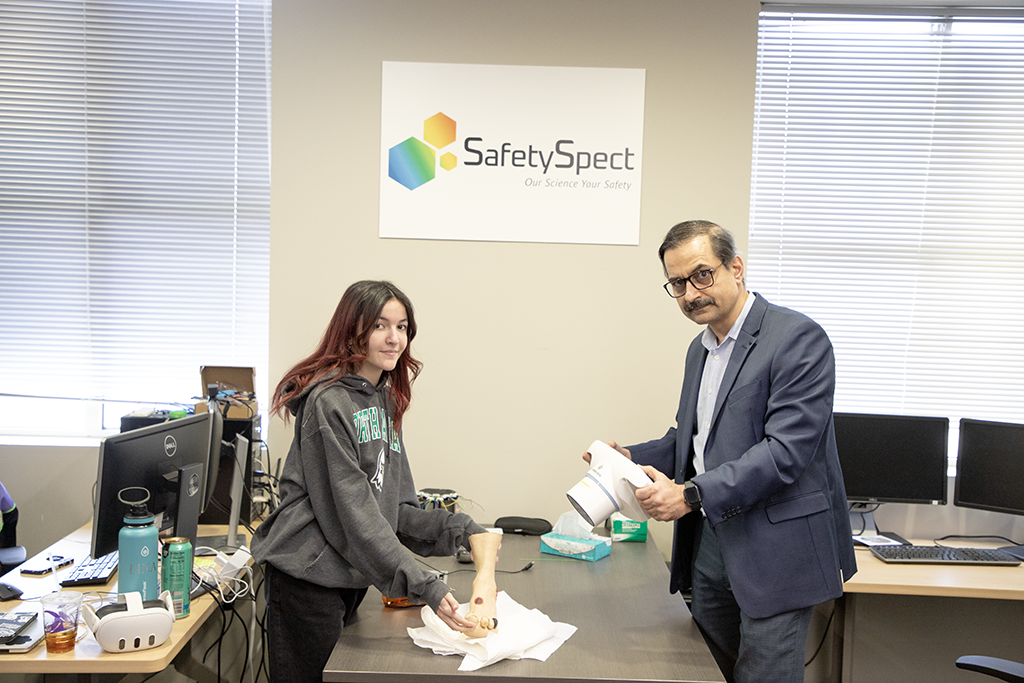
Kouhyar Tavakolian, professor of Biomedical Engineering and director of UND’s Bioinnovation Zone, and graduate student Lina Bouakkaz demonstrate Hyperview, a tissue oximetry device that will be used to image wounds
The University of North Dakota is leading a major national effort to improve chronic disease management for older adults after receiving a highly competitive federal agreement of up to $19.9 million through the Advanced Research Projects Agency for Health (ARPA-H).
Working alongside key partners SafetySpect Inc., ComDel Innovation and Edgewood Healthcare, UND researchers will help develop Edge4Care.ai, a decentralized artificial intelligence platform designed to predict and prevent serious diabetes-related complications before they require emergency care.
The award includes up to $16.9 million in federal funding and an additional $3 million in industry matching funds, highlighting both the scientific promise and real-world viability of the technology.
“This project exemplifies what becomes possible when academia, industry and care providers work as a unified innovation ecosystem,” said Kouhyar Tavakolian, professor of Biomedical Engineering, director of UND’s BioInnovation Zone (BiZ) and principal investigator for the initiative. “Together, we are translating cutting-edge research into solutions that improve patient outcomes, reduce health care costs and preserve independence for older adults.”
Addressing a growing chronic disease crisis
Chronic diseases cost the U.S. health care system more than $966 billion each year, with diabetes representing one of the most urgent and costly challenges. Every few minutes, an American experiences a life-altering limb loss due to diabetes-related complications.
Each year, more than one million people develop diabetic foot ulcers, leading to over 130,000 amputations nationwide.
Edge4Care.ai aims to shift health care from reactive treatment to proactive prevention by identifying wound risks early — before hospitalization becomes necessary — potentially reducing the need for costly acute interventions.
Bringing AI directly to the point of care
Unlike traditional digital health systems that rely on centralized cloud servers, Edge4Care.ai uses a proprietary edge computing architecture, processing patient data locally within care facilities.
This approach provides several critical advantages:
- Privacy by Design — data stays secure within the care environment
- Expanded Rural Access — advanced AI can reach underserved and rural communities
- Explainable AI — the platform analyzes more than 100 risk factors and explains why a patient may be at risk
David G. Armstrong, Distinguished Professor of Surgery and Neurological Surgery at the University of Southern California and a member of the project’s leadership team, emphasized the significance of bedside AI.
“By bringing the power of AI directly to the patient’s bedside, we are bridging the gap between high-tech capability and high-touch care,” Armstrong said.
Recognizing Key Partners in Innovation
The initiative brings together a strong consortium of academic, clinical and industry expertise through the Senior Healthcare Innovation Consortium (SHIC):
- University of North Dakota — lead awardee providing research oversight and predictive modeling
- SafetySpect Inc. — lead technology innovator developing the AI platform
- ComDel Innovation — hardware manufacturing partner supporting U.S.-based production
- Edgewood Healthcare — clinical deployment and validation partner in senior care settings
Kenneth Barton, CEO of SafetySpect Inc., noted the broader potential impact of the work.
“Success will enable important technology for federated data sharing and model development that could be used for countless conditions,” Barton said.
Supporting national prevention priorities
The Edge4Care.ai initiative aligns with federal priorities focused on prevention, independence and reducing the burden of chronic disease. While the platform is being developed initially for diabetes complications, the technology could expand to other conditions such as heart disease and chronic obstructive pulmonary disease (COPD).
By combining clinical science, AI innovation and compassionate caregiving, UND and its partners are working to redefine the future of chronic disease management in America.
Federal funding statement
“This research was funded, in part, by the Advanced Research Projects Agency for Health (ARPA-H). The views and conclusions contained in this document are those of the authors and should not be interpreted as representing the official policies, either expressed or implied, of the U.S. Government.”
Editor’s note:
This story is based in part on an original press release by BCM Services Group Corp and EINPresswire.