Opportunity is in the AIR
The Artificial Intelligence Research Center brings disciplines together to shape safer, smarter AI
Artificial intelligence is changing the world faster than most people can keep up with it.
While it’s transforming how doctors detect disease, how communities prepare for severe weather and how autonomous systems make decisions, it’s also changing how nations — and us as individuals — think about security, privacy and trust.
The Artificial Intelligence Research (AIR) Center was built for exactly this moment.
The AIR Center serves as UND’s hub for AI education, research, and community engagement. Its mission reaches beyond advancing powerful new software and hardware systems to solve real-world problems; the center is also focused on preparing students and researchers to develop AI that is economically viable, technologically resilient, and ethically grounded.
That mission is especially important because AI is no longer confined to one field. Its opportunities (and risks) span nearly every research field and sector of modern life.
Aerospace, agriculture, autonomous systems, cybersecurity, infrastructure, medicine and even weather forecasting — the center’s cross-disciplinary model is helping AIR Center address a wide range of urgent challenges. In North Dakota, several of those areas have particularly strong local relevance, with direct implications for the state’s economy, safety, and future workforce.
“The center is partnering with several universities and companies on federal projects,” says Naima Kaabouch, Chester Fritz Distinguished Professor and Director of the Artificial Intelligence Research Center. “It strengthens the state’s economy by attracting funding and creating high-skill jobs. It also helps modernize key industries such as agriculture, energy, drones, and healthcare by developing AI tools tailored to regional needs.”
What sets the AIR Center apart is that it is not only focused on what AI can do, but on how it should be done. Work done with fundamental AI models aims to create systems that are explainable, safe, secure, fair, transparent and accountable, while also protecting privacy, civil rights and civil liberties.
So, even in a field often defined by speed, responsibility remains AIR’s highest priority.
Beyond being a research center, the AIR Center is a resource for students and junior faculty to access mentoring, collaboration, and hands-on learning in one of the fastest-moving areas of science and engineering. For UND, that makes the center both a research and talent engine — a place where students can prepare for careers in fields being reshaped in real time by artificial intelligence.
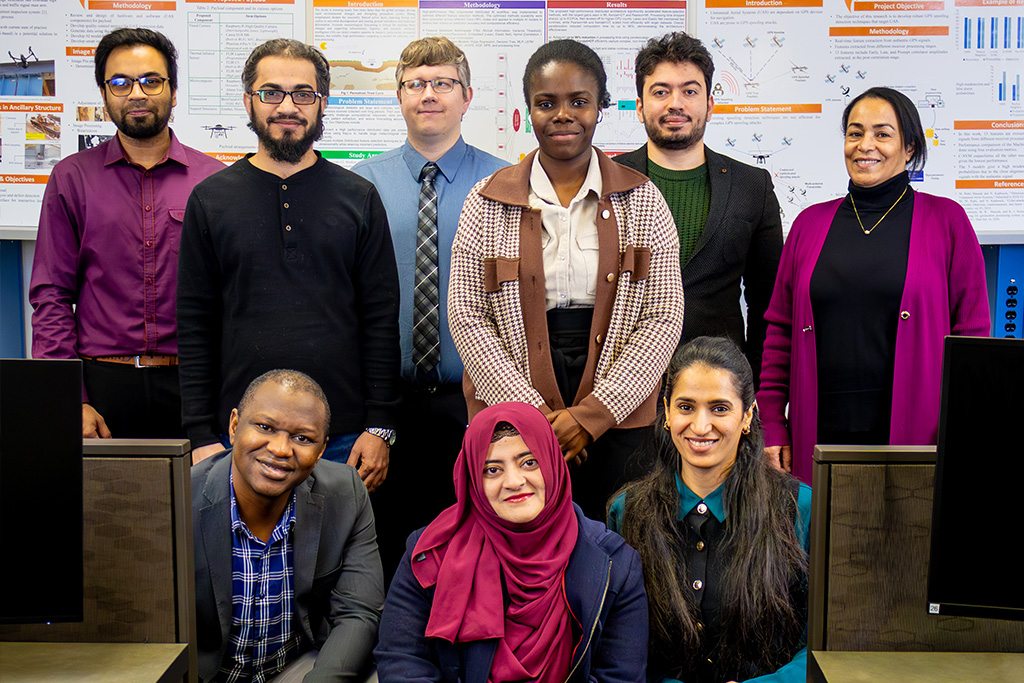
Meet the students behind the research happening in the AIR Center:
Emmanuela Andam, an electrical engineering student, is involved in multiple AIR projects spanning malware detection, UAV cybersecurity and AI weather forecasting for Alaska. Andam’s work uses machine learning and AI to detect, classify and analyze cyber threats across different systems.
Toro Dama Caleb, also studying electrical engineering, works at the intersection of artificial intelligence and cybersecurity. Caleb’s research focuses on protecting critical infrastructure, including unmanned aircraft systems, traffic management systems and smart grids, while also exploring how physics-informed AI can strengthen resilience against emerging threats.
Kyle Foerster, an electrical engineering student, develops, tests and deploys AI models using distributed high-performance computing. Foerster’s work supports Arctic research through LiDAR damage detection and weather and permafrost prediction in extreme cold climates.
Soumaya Ghali, a non-degree student, supports AIR’s broader artificial intelligence research efforts and contributes to its interdisciplinary research environment.
Mahrukh Khan, an artificial intelligence student, is working on soil moisture estimation through the NISAR project, which uses L-band radar imagery provided through a collaboration between NASA and ISRO. Khan’s work adds an environmental and remote sensing dimension to AIR’s research portfolio.
Meisam Shayegh Moradi, an electrical engineering student, is helping build the Arctic Knowledge Base System, a project that uses high-performance computing and distributed AI workflows to analyze extreme cold environments. Moradi’s work includes predictive geospatial intelligence, LiDAR-based point cloud processing, Arctic road damage detection, weather modeling and large-scale environmental system modeling.
Nafiul Nawjis, a computer science student, is researching LiDAR-based road damage localization. Nawjis developed an uncertainty-aware geometric voting framework that helps turn noisy point-cloud predictions into clearer damage regions and surface-aligned bounding boxes, improving accuracy under difficult sensing conditions.
Muhammad Umair, an electrical engineering student, contributes to the Arctic Knowledge Base System through LiDAR road damage dataset preparation, 3D deep learning applications and distributed processing of soil temperature data.
Written by Paige Prekker // UND College of Engineering & Mines