Worth a thousand words: Students in UND’s Indigenous Health doctoral program add words to their own photographs to build community
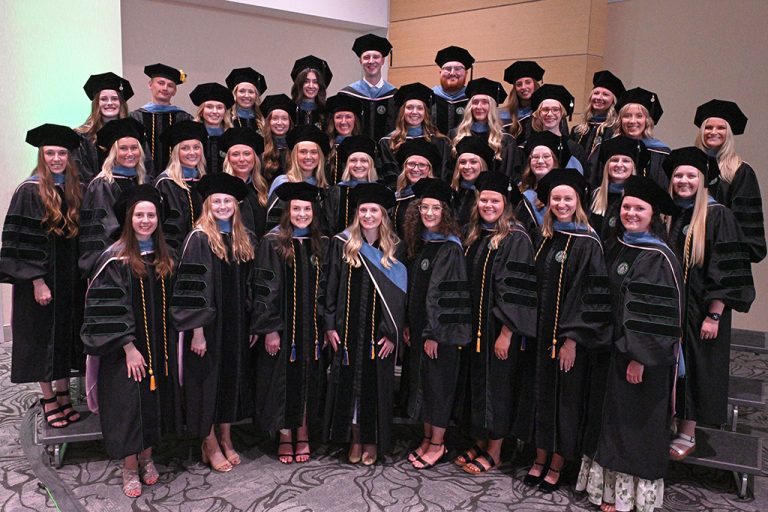
Looking at the UND Summer Commencement program in her hand, Tara Wolfe, a graduate student in UND’s Department of Indigenous Health, reflected on her roots in the Eastern Band of Cherokee Indians and the Zuni Pueblo Tribe. A program manager for the Zuni Youth Enrichment Project in Zuni, N.M., Wolfe was struck by the significance of the event in which she was then taking part up in North Dakota.
“This experience matters because it serves as [a] monumental, pivotal point for Indigenous people worldwide and shows true perseverance of creating spaces in higher education institutions and shifting the paradigm,” Wolfe later wrote of the photograph she took at the graduation ceremony. “We all know too well of the boarding schools and the trauma inflicted upon our people. We are creating an equitable world because we are obtaining the highest level of education in this moment. I will be the first Ph.D. graduate student in my family and I do this in memory of my parents.”
Camera obscura
Wolfe wasn’t alone in her reflection.
Last summer, students in the UND’s world-first medical school-housed Indigenous health doctoral program completed a research project that asked them to capture their experience of living and working on Indigenous health across the United States.
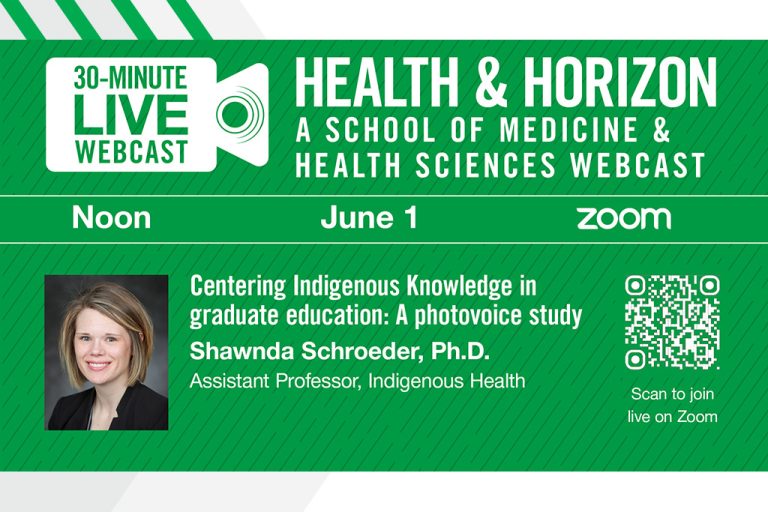
Led by Shawnda Schroeder, Ph.D., assistant professor in the Department of Indigenous Health, the students participated in project-based focus groups that gave them a chance to discuss their narratives alongside an image they felt best fit the personal narrative they wished to record.
They did so via the “participatory photography” platform PhotoVoice, which, according to the organization’s website, offers “digital storytelling and self-advocacy projects for underrepresented or issue-affected groups.”
“The primary goal of this research project was to give our students an opportunity to think about and then present images with narratives related to their experience of our network of Indigenous health scholars,” explained Schroeder. “We hope that this will not only promote our program but also generate interest in similar curriculum design throughout UND to support Indigenous students.”
In other words, because the doctoral program is almost entirely online, and because it attracts students from around the world, UND’s Indigenous Health team embeds in-person summer seminars annually to allow the student cohorts to better bond with each other and celebrate their scholarship.
But as Schroeder suggests, such travel doesn’t come cheap.
“We are also hoping this can be utilized to generate alumni and community giving to support student travel during our summer seminar in the future,” she said. “We’re hoping to attract not only UND students and faculty but alumni. There are also a number of other groups we’d love to see there, including Indigenous Elders.”
Public event
Part of the project involves presenting students’ narratives alongside their photos at a public event. This year, that event – Promoting Community: A Visual Journey of Indigenous Health Doctoral Students – will be held in the UND Memorial Union in Grand Forks, N.D., on Tuesday, March 25.
In addition to the photo display, the Promoting Community event will feature an opening prayer with Schroeder’s colleague Dr. Julie Smith-Yliniemi assistant professor of Indigenous Health, a presentation by Dr. Chris Nelson, dean of UND’s School of Graduate Studies, and a lecture by Schroeder.
“This project is so innovative in its approach to telling personal stories and stories from communities,” added David Wilson, Ph.D., chair of the Department of Indigenous Health and associate vice president for health research at UND. “It allows the story to be shaped by those who have experienced this history, which provides more validity and meaning for the participants. A photo is definitely worth a thousand words and from an Indigenous perspective makes this project unique.”
For her part, Cassandra Peña, a Phoenix, Ariz., native with roots in both the Hopi Tribe and the Gila River Indian Community, is excited to be featured at the event.
“This photo represents our future,” Peña explained in her narrative. “This image reflects my experience in the summer seminar because it was meaningful that this program allowed me to visualize the outcome of hard work and dedication. This experience matters because it supports Indigenous communal values and creates a safe space where students feel comfortable and welcomed.”