Atmospheric Sciences Instruments on the Roof
Several collaborations came to fruition this summer as guest instruments were installed on top of Clifford Hall.
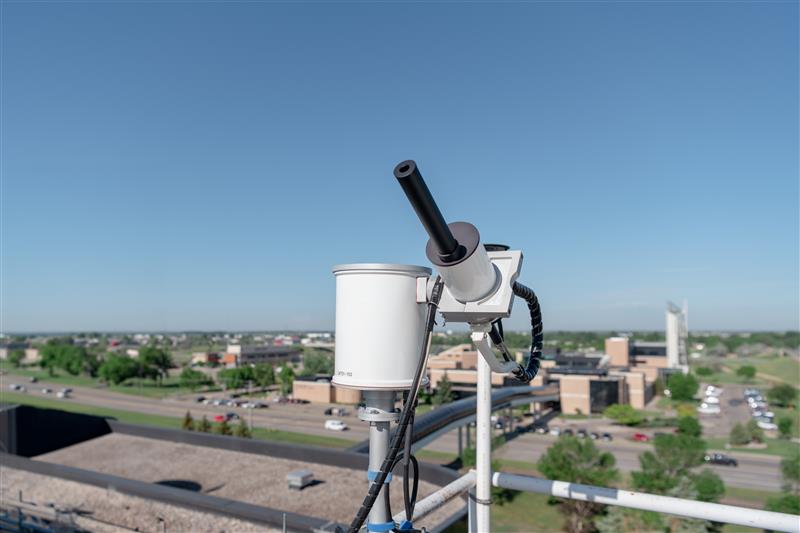
The first instrument, known as Pandora, is a spectrometer that tracks the Sun and Moon to detect minute changes in ultra- violet and visible light. This information is then used to identify the amount of trace gases in the atmosphere such as ozone, nitrogen dioxide, formaldehyde, and sulfur dioxide. This effort led by NASA and the EPA will improve long-term monitoring of these gases in the region. An additional Pandora was installed at Sitting Bull College in Fort Yates, ND.
The second instrument is known as a Waggle node and is part of the larger SAGE software-Defined Sensor network. SAGE was funded by the National Science Foundation to design and build national-scale reusable cyber infrastructure to enable AI computing on the edge.
The project is led by Northwestern University and leverages open- source hardware and software developed by Argonne National Laboratory. The Waggle node includes multiple camera systems and weather instruments that are controlled by a computer. Users can program the computer to do machine learning tasks on the instrument itself. For example, other Waggle nodes have been used to track clouds, detect traffic, and even identify hazards such as floods and wildfires.
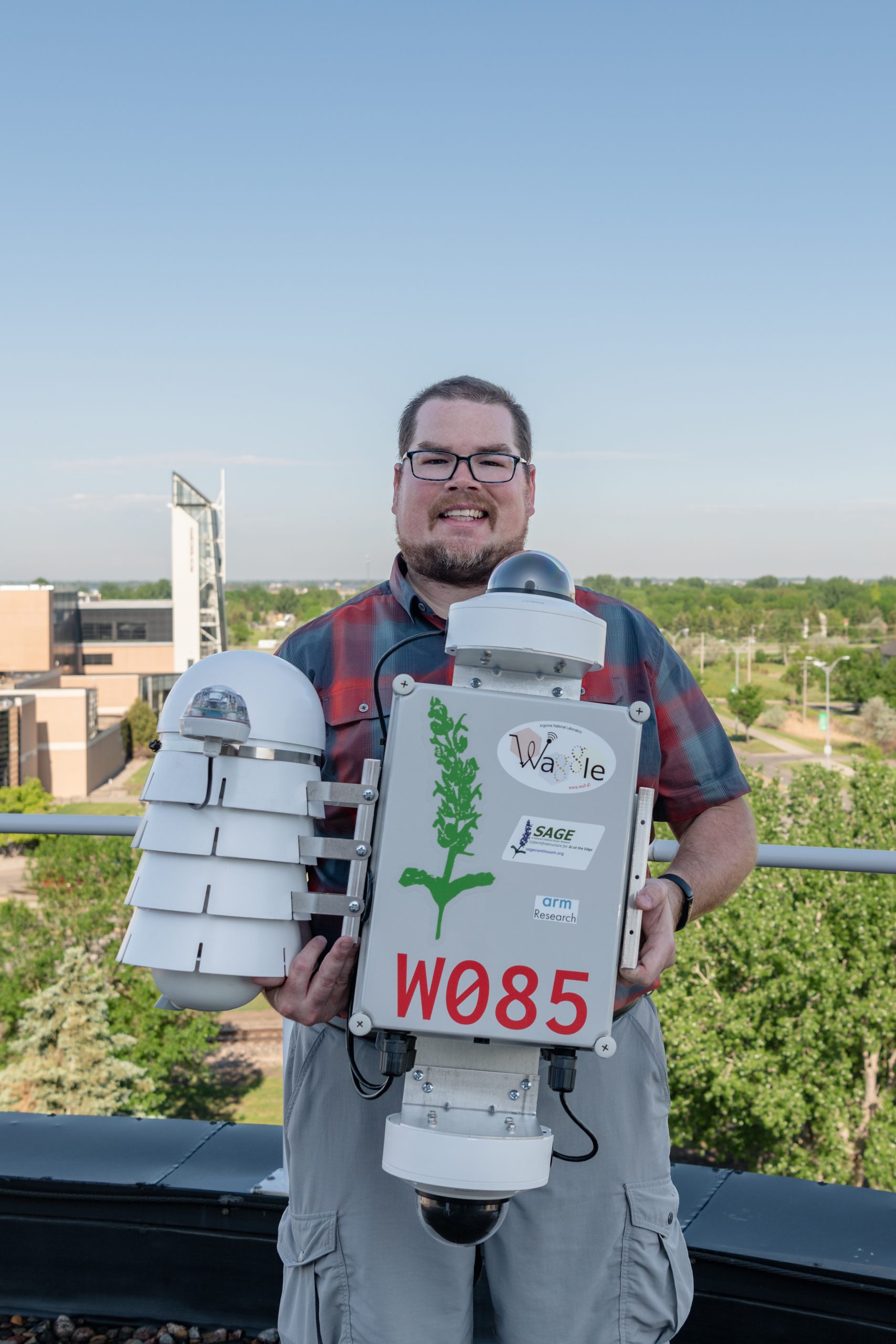
Director for Atmospheric Sciences. Professor Kennedy is
holding the SAGE instrument.
Atmospheric Sciences Department


