Commissioning the Odegard Ground Station
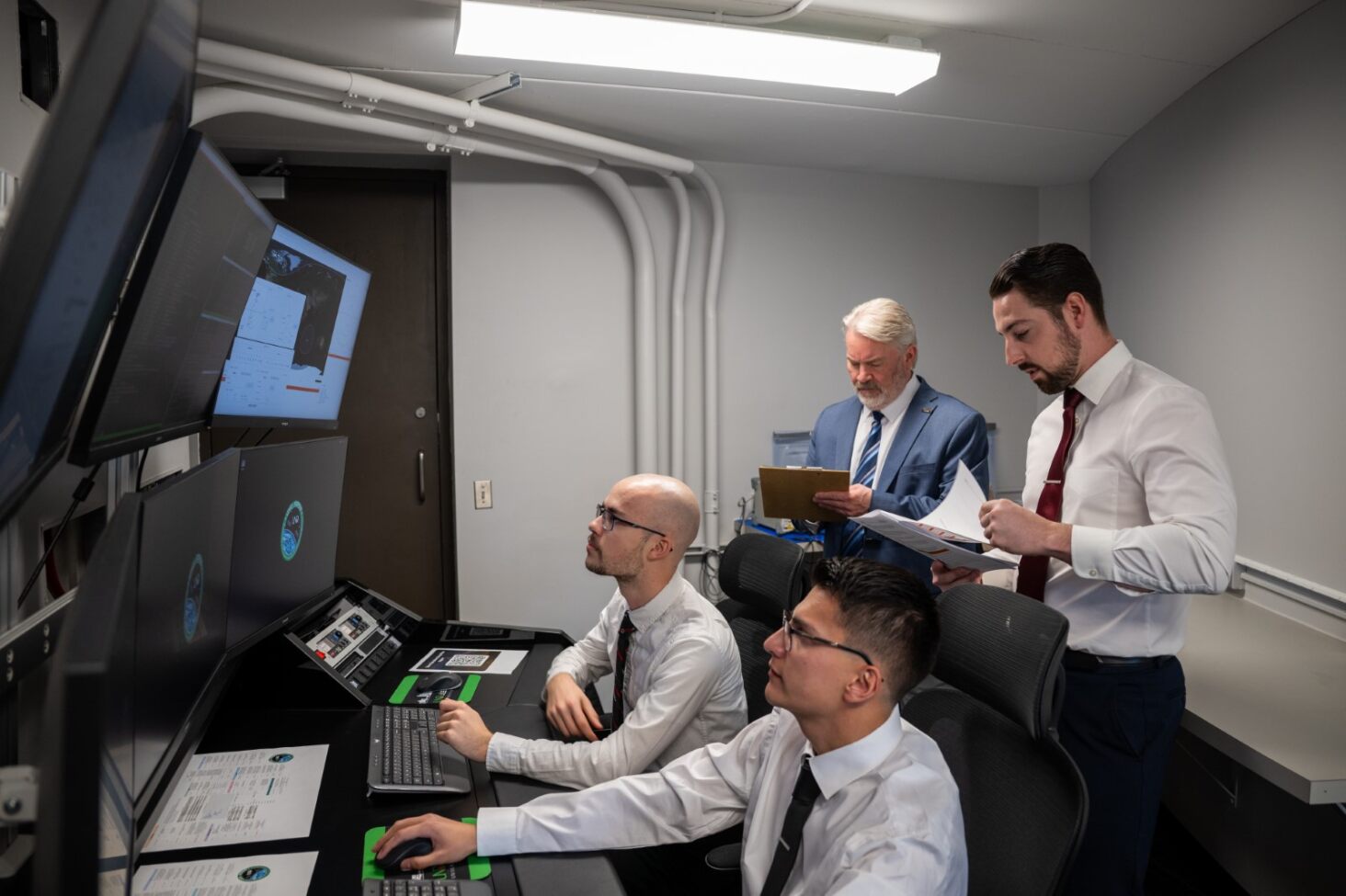
Launching the Commissioning Phase of UND’s Ground Station
On July 23rd, UND proudly welcomed three engineers from Added Value Solution (AVS) to begin commissioning the Odegard Ground Station, the future hub of the UND Space Operations Group (SOG) and a training ground for UND’s next generation of satellite operators.
Weeks earlier, key components—including the Server Rack, VHF/UHF Antennas, S/X Band Dish Antenna, and Mission Control Center (MCC) Desk—had arrived on campus and were stored on site. With everything in place, the team kicked off an eight-day effort that demanded planning, coordination, and collaboration between UND Facilities, UND Networking, the Space Operations Group, and external partners.
From Unboxing to Assembly
Day 1 began with a kickoff meeting and the unboxing of materials. With the MCC desk already assembled by SOG, students were ready to jump in and support AVS engineers as the work began.
Over the next two days, assembly was in full swing. AVS engineers took charge of the UHF/VHF Antennas and the Server Rack, while SOG handled the assembly of the S/X Band Dish Antenna. For many students, this was a highlight, as they received hands-on experience with hardware that will become a cornerstone of their training in satellite operations.
Overcoming Challenges
Day 4 brought one of the most memorable challenges: crane operations. Preassembled components needed to be lifted to the fourth floor, where the ground station resides. Suddenly, a torrential downpour of rain threatened the server rack while it was still outside.
With quick thinking, the team covered the equipment as best as they could and then worked together to manually lift the 500-pound server rack through the building entrance. It took eight people in total, rotating positions to maneuver the rack through tight spaces until it was safely inside. This moment captured the teamwork and determination that defined the entire project.
Wiring, Testing, and Calibration
Days 5 and 6 focused on wiring and electrical work, handled primarily by AVS engineers. Much to everyone’s relief, the server rack showed no signs of water damage and powered on nominally.
The final two days were dedicated to testing and calibration. AVS split into two groups: one took the FlatSat (a testbed made up of the satellites’ internal components) and a signal generator to the airport roof, while the other remained at the ground station. Using this setup, the team calibrated the antennas and confirmed the software was ready to establish contact with UND ROADS 1 & 2.
Looking Ahead
After eight days of intense work, the Odegard Ground Station is nearly commissioned. AVS engineers will continue remote refinements to finalize requirements before handing off nominal operations to UND.
In the meantime, SOG will begin conducting passes and attempting communications with UND ROADS 1 & 2 as student operators continue their training. The next major milestone? The handoff of nominal operations to UND and the start of the next phase of the ROADS Mission: Far-Field Rendezvous, where one satellite will begin maneuvering to “catch up” with the other.
The future is bright for UND’s space program, and this commissioning marks another step toward establishing the University of North Dakota as a leader in small satellite operations.


