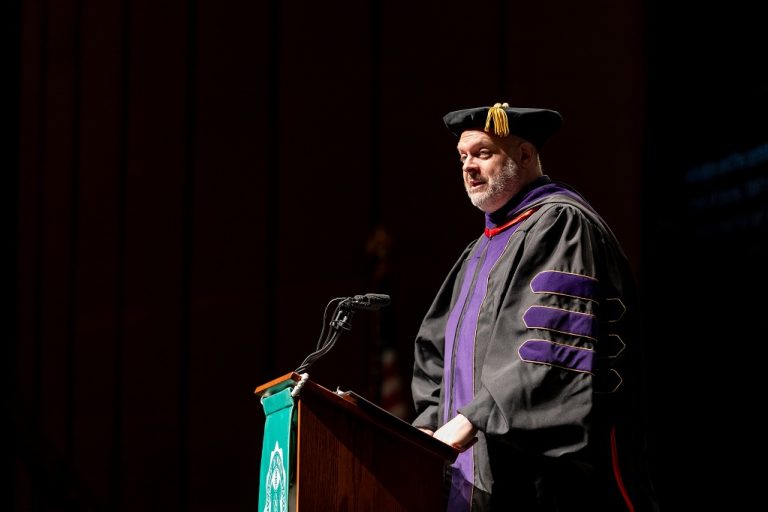
Former Interim Dean, Bradley Myers, Discusses Rising Law School Applications and AI’s Growing Influence
Applications to U.S. law schools have increased 12% to 21% over last year––and more than 38% over two years, according to the Law School Admissions Council. Myers offers expert insight into what’s driving the trend and how artificial intelligence is reshaping legal education.
GRAND FORKS — For generations, the path to becoming a lawyer followed a fairly predictable formula: earn a degree, attend law school, pass the bar exam and begin practicing law. But across the Upper Midwest, legal educators and attorneys say that formula is beginning to evolve as law schools adapt to changing workforce demands, new technology, and shifting expectations within the profession itself.
Law school applications for the 2026 cycle are experiencing a significant surge. According to the Law School Admission Council , applications are up between 12% and 21% over the previous year and more than 38% compared to two years ago. The increase is making admissions more competitive while also forcing schools to reconsider how they prepare students for modern legal practice.
Different lawyers, different goals
At the same time, the legal profession is becoming increasingly diverse in both background and career path. Attorneys interviewed for this story described dramatically different motivations for entering the field and varying ideas of what success as a lawyer looks like.
Some attorneys are drawn to litigation and courtroom advocacy, while others prefer transactional work that allows for more predictable schedules and long-term client relationships. Reganne Ritterman, a law clerk with German Law in Grand Forks, North Dakota, plans to pursue estate planning and contract law after sitting for the bar exam this summer.

“I decided some type of transactional work would probably be better for me,” Ritterman said. “The nice parts about estate planning are that the clients are so appreciative and I can leave my work at work.”
Others are motivated by public service and advocacy. Alayna Holmstrom, a commercial litigation attorney and partner at Davenport Evans in Sioux Falls, South Dakota, said the profession appealed to her because of the opportunity to advocate for clients during difficult moments.

“What keeps me going is being able to say that I provided the best work for my clients that I could, regardless of the outcome,” Holmstrom said.
Aidan Goetzinger, who followed in his father’s footsteps by attending the University of South Dakota Knudson School of Law and practicing in his hometown of Rapid City, South Dakota, said community impact remains one of the most rewarding aspects of the profession.
“The ability to give back to the community and to help people when they’re at their lowest lows is a really rewarding experience,” Goetzinger said.
Legal educators say those varying career goals are reshaping legal education itself.
“A hundred years ago, law was entirely an apprenticeship,” said Brad Myers, interim dean at the University of North Dakota School of Law. “Law schools began adding experiential requirements because firms wanted graduates who were ready to practice immediately.”
Experiential learning opportunities — including clinics, internships, mock trial programs and public service placements — have become increasingly central to law school curriculum nationwide. Retired Vice Admiral Darse E. “Del” Crandall Jr. is also set to begin his tenure as dean of the UND School of Law on July 1, 2026, as the school continues expanding its leadership and programming during a period of growth.
Rethinking legal licensure
Changes to the bar exam are also influencing how schools structure legal education. Historically, law schools focused heavily on preparing students to pass the bar exam, the licensing test required to practice law in most states. But that approach is beginning to shift as schools place greater emphasis on practical experience and real-world legal skills. Even where traditional bar exams remain in place, the emergence of the NextGen Bar Exam — scheduled for phased implementation beginning in 2026 — is expected to reshape curriculum priorities nationwide by focusing more heavily on legal analysis, practical lawyering skills, and application-based learning rather than rote memorization.
The University of South Dakota recently completed the first year of a five-year pilot program approved by the South Dakota Supreme Court. The Public Service Pathway program allows up to 10 law students each year to earn admission to the bar through a supervised public service track rather than a traditional bar examination route.
Students in the program must complete all graduation requirements, serve in a semester-long public service placement, and undergo review by the Board of Bar Examiners. In return, graduates commit to two years of public service work following graduation.
Neil Fulton, dean of the USD Knudson School of Law, said the program reflects the school’s emphasis on relationships and service. “For us at USD, connection is really central to our identity,” Fulton said. “We’re a smaller school with many touchpoints between faculty and students.”
Licensing expectations continue to vary by state as well. Minnesota attorneys on active status must complete 45 continuing legal education (CLE) credit hours every three years, including ethics, bias elimination, and mental health training. North Dakota requires 36 CLE hours, including ethics credits, while South Dakota currently does not mandate CLE requirements to maintain a law license.
Preparing lawyers for an AI era
At the same time, law schools and firms are grappling with one of the profession’s fastest-moving developments: artificial intelligence. William McGeveran, dean of the University of Minnesota Law School, said AI is already reshaping legal practice, particularly in research-heavy and high-volume areas of work.
“AI is going to be extraordinarily disruptive,” McGeveran said. “We want students to learn to use AI as a tool, but not a crutch.”
According to McGeveran, AI is increasingly being used for tasks such as document review, legal research, and generating preliminary drafts of briefs and contracts. Some firms are already integrating platforms such as Westlaw Advantage with AI-assisted legal research tools into daily practice.
Still, McGeveran emphasized that many core elements of legal work remain deeply human. “AI will never deliver an oral argument, execute a negotiation, counsel a client, or deliver bad news to a litigant,” he said. “Those interpersonal and analytical skills are still going to require lawyers.”
That human-centered focus was a consistent theme among both educators and practicing attorneys we spoke with. Despite evolving technology, changing licensing pathways, and increasingly competitive admissions, many said the profession’s core purpose remains rooted in service, advocacy, and relationships.
“At the end of the day,” Holmstrom said, “law firms are still looking for dynamic applicants who want to put in hard work.”
As legal education continues to evolve across the Upper Midwest, law schools are increasingly balancing traditional legal theory with practical experience, technological adaptation, and public service. While the path to becoming a lawyer may no longer look exactly the way it did a generation ago, educators and attorneys alike agree that the profession’s central mission — helping people navigate some of the most important moments of their lives — remains unchanged.