UND professor brings ethics, philosophy to bear on conflict in Middle East
Philosopher Jack Russell Weinstein presents full account of conflict’s moral complexities, in hopes of inspiring greater empathy on both sides
 Arguments about Israel and Palestine are almost always accusatory and polemical. Rather than learning from one another, opponents jockey for the moral high ground, trying to find that one attack they believe proves their side to be completely on the right, without compromise.
This means Israel’s advocates dismiss Palestinian land claims without due consideration, and pro-Palestinian voices falsely accuse Israel of the most heinous modern crimes: colonialism, genocide, and apartheid. None of this is productive or healthy.
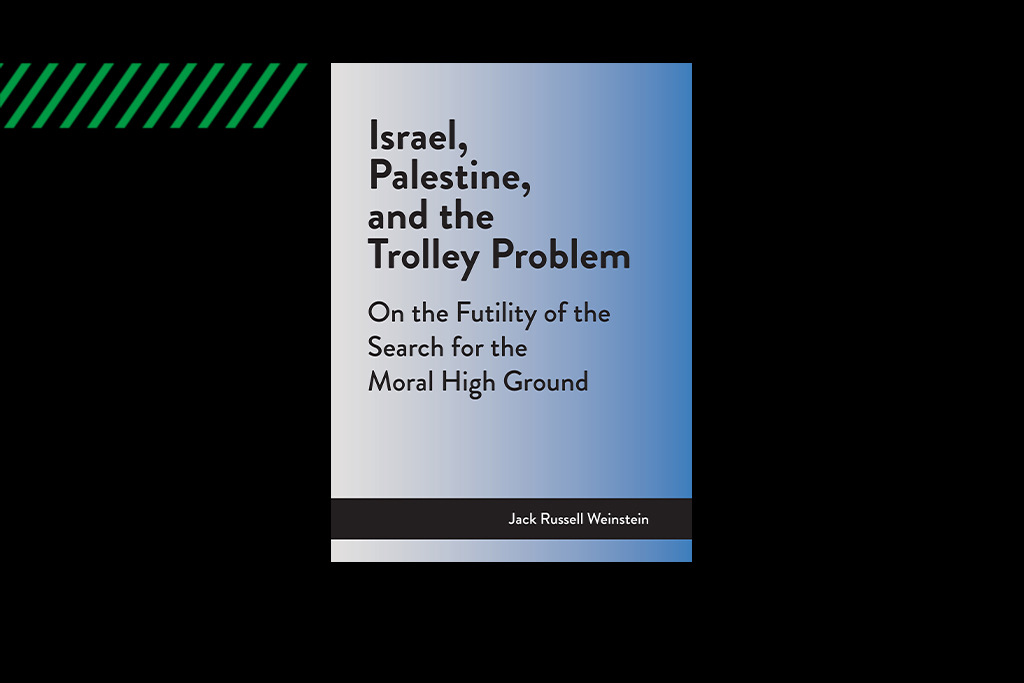
In “Israel, Palestine, and the Trolley Problem: On the Futility of the Search for the Moral High Ground,” a new book from The Digital Press at UND, philosopher Jack Russell Weinstein interweaves philosophy, history, politics, and personal experience to expose the argumentative mistakes we all make too often.
Mapping out moral psychology — how we actually make moral decisions — and using the famous Trolley Problem as a metaphor, Weinstein paves the way for a new, more empathetic exchange of ideas about today’s most puzzling moral dilemma: how to find peace in the Middle East.
Classical perspective
Weinstein is Chester Fritz Distinguished Professor of Philosophy at UND, and in his book, he starts by looking at this very modern geopolitical problem though the lens of classical ethics.
What insight does Immanuel Kant’s famous “Categorical Imperative” offer for considering the best way forward? What is the role of virtue ethics, Plato and Aristotle’s morality of character?
And what might a utilitarian — one whose ethics centers on achieving the greatest good for the greatest number — have to say?
Alas, these approaches are inadequate to resolving the conflict’s central dilemmas: the facts that both sides have legitimate claims to the disputed land, and that the historical dynamics which led to the current stalemate have rendered the claims irreconcilable.
As mentioned above, Weinstein likens the situation to the Trolley Problem, a conundrum often discussed in philosophy classes. “First posed by philosopher Phillippa Foot in 1967, the moral dilemma of the Trolley Problem is as follows,” Weinstein writes:
“An unstoppable trolley faces a fork in the tracks. One direction leads to the trolley running over a group of five people, and the other leads to the trolley killing just one. You are the switch operator; which track do you send the trolley down?”
Clearly, “there is no easy answer,” Weinstein notes. “No matter which you choose, someone dies. … Simply put, there is no moral solution to the current stalemate (in the Middle East,” he continues.
“As with the Trolley Problem, every fork in the road leads to undeserved death.”
Painted into corners
In the book’s latter half, Weinstein answers objections to this sobering conclusion. What about claims that Israel is a colonialist power, a status that automatically renders it the guilty party?
Well, “have you ever celebrated Christmas and have you ever sung ‘O Little Town of Bethlehem?’” Weinstein asks.
“If your answer to either of these two questions is yes, you know that Jews have been in Israel and Palestine for more than two thousand years. … My argument is that Jews have as much claim to indigeneity as anyone, and that calling Israel a colonial power is a gross misunderstanding of the facts.”
But if that’s the case, isn’t Israel justified in doing everything it can to defend its borders, including responding aggressively to Hamas?
The trouble is, such a view discounts the fact that the Palestinians who lived on the land that is now Israel were forcibly displaced, Weinstein points out – and Canada, to name just one example, in 1999 declared Nunavut an Indigenous province with its own government, in recognition of the fundamental unfairness of a similar displacement in that nation’s past.
One reason why the prospect of a good outcome seems impossibly remote is the vehemence with which both sides assert their righteousness, Weinstein suggests. “(T)he worst fuel for this particular fire is that everyone in it is convinced that they are morally superior and are therefore completely in their right to act as atrociously as they can,” he writes.
Thus, if the world is to avoid the two tracks of the Trolley Problem, that process surely must start with both sides acknowledging the conflict’s moral complexity. But few tasks are more difficult in human affairs: “Trying to be fair is a curse of its own kind,” Weinstein writes.
“Once you decide that everyone matters, the world becomes a much less hospitable place.”
****
Like all books from The Digital Press at the University of North Dakota, “Israel, Palestine, and the Trolley Problem: On the Futility of the Search for the Moral High Ground,” is available as a free download and as a low-cost paperback. Interested readers are invited to download the book from the website of The Digital Press, or buy the paperback edition for $7.