UND, SafetySpect adding ‘MoonLight’ to space agriculture
NASA-funded program seeks to advance sustainable food production in space environments
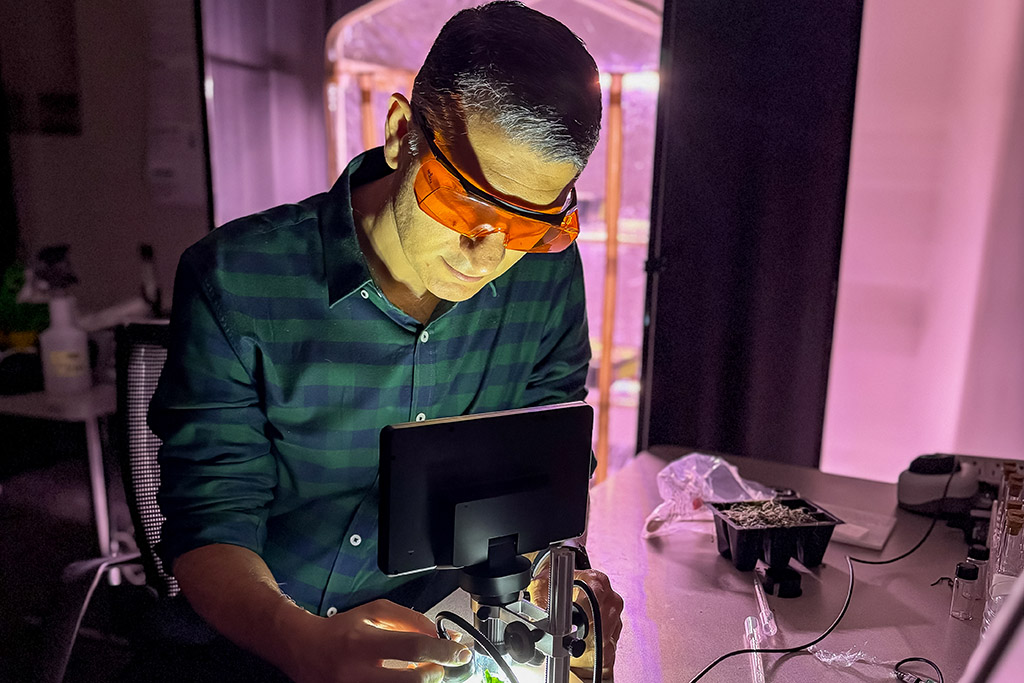
A UND researcher and a pair of graduate students are hoping to shed a little “MoonLight” on how plants are grown in space.
The researchers have teamed up with Grand Forks-based SafetySpect Inc. on a NASA-funded Small Business Innovation Research (SBIR) Phase I project aimed at transforming how crop health is monitored in space. The project, titled “MoonLight,” will develop an autonomous plant sensing platform designed for extraterrestrial environments such as the International Space Station, Lunar Gateway and future Mars habitats.
The $150,0000 award was granted to SafetySpect Inc., the small business lead organization, with UND serving as a research partner through a subaward. The initiative brings together SafetySpect’s innovation in optical sensing and artificial intelligence with UND’s nationally recognized strengths in autonomous systems, sensor technologies and space science.
Hossein Kashani Zadeh, assistant professor of Mechanical Engineering, is UND’s principal investigator in the project. Through their technical input, doctoral students Abdolrahim Zandi from Biomedical Engineering and Gilbert Cauthorn from Space Studies are bringing an interdisciplinary perspective to the project.
“We’re proud to support this groundbreaking effort in collaboration with SafetySpect,” said Zadeh. “The project leverages UND’s expertise in advanced sensing technologies and aligns with our broader research goals in environmental monitoring and space systems engineering.”
The MoonLight platform integrates hyperspectral reflectance imaging, hyperspectral fluorescence imaging, Light Detection and Ranging or LiDAR and real-time environmental sensors measuring carbon dioxide, humidity, temperature and light intensity. This multi-modal sensing system enables early, non-invasive detection of plant stress, disease and nutrient deficiencies, with the overall goal of supporting sustainable food production in controlled space environments.
“An early plant stress sensing system can have a transformational impact on space agriculture, where growing conditions are extreme, resources are limited, and failure is costly,” Fartash Vasefi, chief technology officer of SafetySpect.
“We are grateful for UND’s partnership and the exceptional expertise their team brings to this mission. From cutting-edge sensor research to access to one-of-a-kind facilities such as the inflatable lunar habitat, UND provides an unparalleled environment for innovation. Their interdisciplinary approach and commitment to advancing space agriculture are essential to helping us deliver a system that can meet the rigorous demands of extraterrestrial food production. We believe these developments can have a significant positive impact in vertical farming here on earth.”
UND’s participation in the project builds on the University’s recent establishment of a Space Agriculture Laboratory within the BioInnovation Zone (BiZ), which serves as serves as a hub for cutting-edge research and development in the field of BioEngineering.
This Space Agriculture lab is dedicated to developing sustainable food systems for space and extreme environments and further strengthens North Dakota’s growing role in this emerging field.
***
Media contact: Adam Kurtz, adam.kurtz.1@UND.edu