Your home for FAA-recommended Spatial Disorientation training: UND
UND Aerospace ready to host pilots from around the country for unique and newly relevant training
A recent Federal Aviation Administration recommendation is shining a spotlight on one of aviation’s most persistent safety challenges: spatial disorientation.
And at UND’s John D. Odegard School of Aerospace Sciences, faculty and staff have for decades been training pilots to recognize and manage the condition — long before the issue gained national attention.
“This is something we’ve been teaching for a very long time,” said Tom Zeidlik, aerospace physiologist at UND. “The big deal about this is that now the FAA has recognized that this training has to happen.”
The FAA’s Information for Operators (InFO) 26003 encourages operators and training programs to incorporate spatial disorientation training into standard pilot education. The guidance applies primarily to training pilots, general aviation, corporate, charter and helicopter operations — not scheduled airlines — and reflects growing concern over the role of human factors in aviation accidents.
At UND, that training is already well established and exceeds what the FAA now recommends, Zeidlik said.
Supporting student and professional pilots
UND Aerospace provides spatial disorientation training to pilots at multiple stages of their careers, from students learning the fundamentals of flight physiology to experienced pilots returning for recurrent training.
“We’ve been teaching this for decades,” Zeidlik said. “Our training here not only meets this, but it exceeds it by a great deal.”
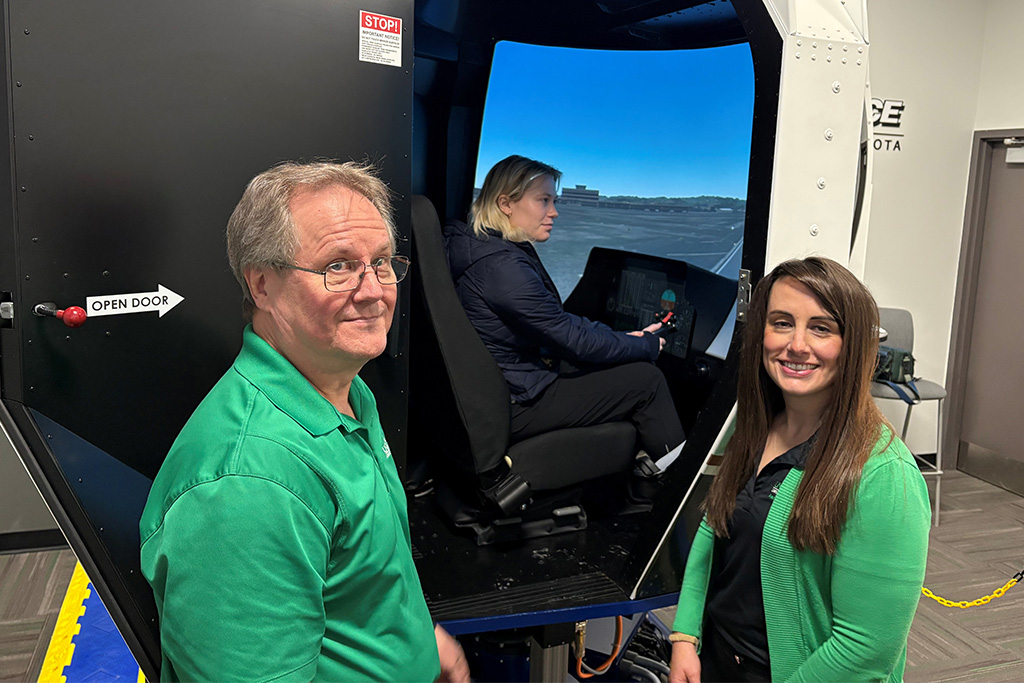
UND’s corporate aerospace physiology course, offered since the late 1980s, combines classroom instruction with hands-on experience in full-motion spatial disorientation simulators and hypoxia training, where pilots enter an altitude chamber to refamiliarize themselves with a potentially dangerous low oxygen environment. The two-day course attracts pilots from across the United States and Canada, many of whom attend as part of company-sponsored recurrent training cycles.
“When they come here, they’ll experience everything that the FAA is now recommending, plus the chamber flight; the hypoxia training,” Zeidlik said. “That’s unusual.”
Zeidlik said the experiential nature of the training is what makes it effective.
“Normally, classroom training might be a flight instructor sitting at a table somewhere,” he said. “Here, we go through the hows and the whys, and then they actually experience it.”
Why spatial disorientation is so dangerous
Spatial disorientation occurs when a pilot’s perception of the aircraft’s position or motion does not match reality. It most often happens when visual cues are lost — in clouds, haze, snow, smoke or at night.
“About 90 percent of how we orient ourselves to the planet is through vision,” Zeidlik said. “Now let’s say a pilot’s flying along and they go into the clouds. They can’t see the planet anymore.”
When vision is removed, pilots rely on the vestibular system in the inner ear as well as cues such as pressure and G-forces — but their bodies are easily fooled.
The vestibular system refers to the balance organs in the inner ear that help people sense motion and orientation. These structures detect movement by sensing fluid motion inside tiny canals in the ear. While the system works well on the ground, it can send misleading signals in flight — especially during prolonged turns or when visual references disappear — causing the brain to misinterpret the aircraft’s actual movement.
“If I go into a turn, the G-forces in a turn feel exactly like gravity,” Zeidlik said. “After about 20 seconds, I don’t feel like I’m turning anymore.”
When a pilot exits that turn, the sensation can be overwhelming.
“In my mind, I just rolled into a turn in the other direction,” Zeidlik said. “That’s where pilots get themselves in trouble.”
According to Zeidlik, spatial disorientation affects every pilot at some point in their flying careers.
Realistic, safer training
Traditional spatial disorientation training often involves pilots wearing what are called “foggles,” or hoods, while flying an actual aircraft — a method Zeidlik said is both cost prohibitive and risky.
“That’s really expensive, and frankly it’s dangerous,” he said. “You’re flying in an airplane — you’re actually flying.”
UND takes a different approach by using full-motion spatial disorientation simulators that physically move while presenting realistic visual environments.
“That’s the one thing that our simulators do,” Zeidlik said. “They marry the visual with the vestibular.”
The realism can be intense, even for experienced aviators
“We’ve had pilots come out just sweating bullets,” Zeidlik said. “It’s so real, because they feel what they see.”
Zeidlik added that the controlled environment allows pilots to experience severe disorientation safely and repeatedly.
“We can do it over and over and over,” he said. “Nobody gets hurt.”
Renewed national attention
While spatial disorientation accidents occur regularly, the issue gained renewed national focus following the 2020 helicopter crash that killed Kobe Bryant and eight others.
According to Zeidlik, FAA data shows that human factors — particularly spatial disorientation — contribute to the majority of aviation accidents.
“The FAA says about 80 percent of all aircraft crashes have to do with human factors,” he said. “And much of that is spatial disorientation.”
The FAA’s new guidance is aimed at pilots operating under Parts 91, 91K and 135, which include general aviation, fractional ownership (shard ownership of a single aircraft), corporate and charter operations, as well as helicopter pilots.
“This was really aimed at helicopter pilots because of the Kobe [crash],” Zeidlik said.
Preparing pilots for the unexpected
Although the FAA recommendation is not yet a requirement, UND faculty believe broader adoption of spatial disorientation training is likely.
“That’s what we’re hoping,” Zeidlik said. “That this becomes a requirement.”
In the meantime, UND continues to train pilots using methods that already exceed federal guidance.
By exposing both student and professional pilots to realistic disorientation in a safe environment, UND Aerospace is helping pilots recognize the threat before it becomes fatal.
“That’s what spatial disorientation is,” Zeidlik said. “You think one thing is happening but it’s not reality.”
Pilots interested in spatial disorientation and hypoxia training course can find more information online on the UND Aerospace Physiology website.
****
Media contatct: Adam Kurtz, adam.kurtz.1@UND.edu
Caption: Tom Zeidlik, aerospace physiologist at UND, and Jennifer Watne, aerospace physiology technologist, stand in front of UND student Christianna Janisse, who is demonstrating a helicopter spatial disorientation simulator. Photo by Adam Kurtz/UND Today.