From Capitol Hill, UND fireside chat examines national security and space
President Armacost talks with Iridium Communications’ Senior VP John McNiff about space, security and UND’s burgeoning role in both
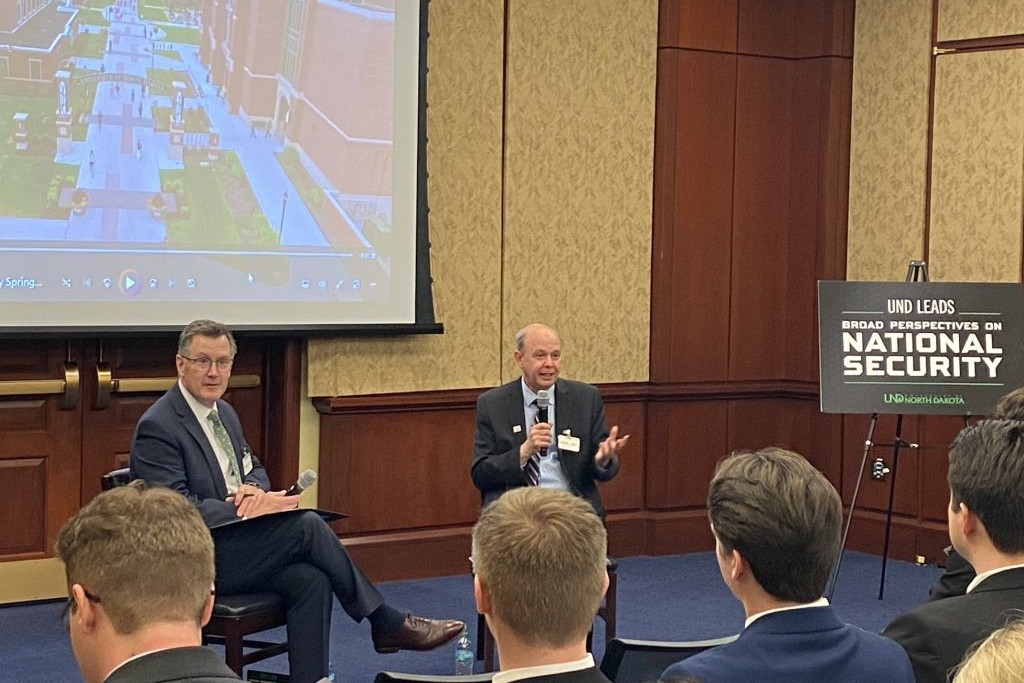
WASHINGTON — From the evolution of satellite communications to the future of missile defense and artificial intelligence, defense industry leaders, consultants, alumni and other friends of the University of North Dakota gathered at the U.S. Capitol on Tuesday, March 10, for a wide‑ranging discussion on national security and space.
Hosted by UND President Andrew Armacost, the fireside chat featured John McNiff, senior vice president of national security missions at Iridium Communications, as part of the UND LEADS: Broad Perspectives on National Security speaker series. The event, which alternates between settings on campus and the nation’s capital each fall and spring, drew about 75 people.
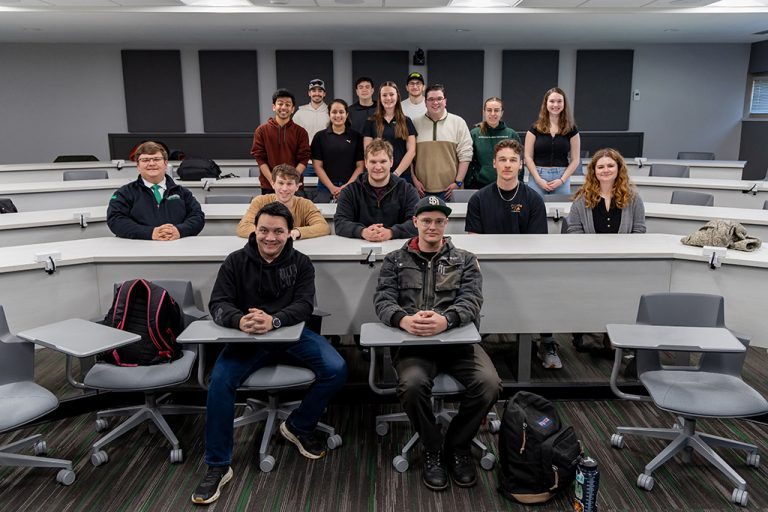
The audience included 13 master’s students from UND’s Nistler College of Business & Public Administration. The students were in Washington for spring break for visits with business consultants, accountancy professionals and regulators, and government relations specialists, as well as other networking opportunities.
The event underscored UND’s growing role as a national convener on security and space issues, bringing together higher education, industry and government leaders.
“This is one of those vital and precious opportunities for the University of North Dakota to connect to the national security enterprise,” President Armacost said.
From philosophy to space systems
McNiff’s career path offers a case study in interdisciplinary thinking. A philosophy major at the College of William & Mary, with early interests in artificial intelligence and computer science, he began his career in telecommunications before moving into national security aerospace leadership roles at Iridium Communications, Northrop Grumman and Microsoft Federal.
“What philosophy gave me was systems thinking,” McNiff said. “Understanding how people think and how belief systems interact is incredibly valuable in national security.”
That systems‑level perspective shaped McNiff’s early work at Iridium Communications during its launch of one of the world’s first large low Earth orbit satellite constellations — an ambitious effort that laid the groundwork for today’s expanding commercial and defense‑focused space economy.

Iridium and national security
During the chat, McNiff highlighted what sets Iridium Communications apart in modern defense operations: global coverage, including polar regions; strong signals and resilient communications; and a constellation architecture that does not rely on dense ground infrastructure.
“We were designed from the beginning to be global,” McNiff said. “That’s why we’re relied upon in some of the most challenging environments in the world.”
That design has positioned Iridium as a key contributor to the U.S. Space Development Agency’s Proliferated Warfighter Space Architecture, an effort to deploy resilient satellite networks on much faster timelines than traditional defense acquisitions.
“This is about changing the way defense systems are built — moving faster while taking advantage of commercial innovation,” McNiff said.
Rather than 15‑ to 20‑year development cycles, McNiff said the new approach emphasizes rapid deployment, iteration and adaptation, reflecting the pace of commercial technology.
A crowded, complex orbit
As satellite traffic accelerates in low Earth orbit, McNiff emphasized the growing importance of safe operations, automation and autonomy.
“Space is big, but it’s not that big anymore,” he said. “You have to fly these satellites very carefully.”
McNiff described how collision avoidance, autonomous flight rules and operational experience are now central challenges in space operations. He also discussed emerging technologies such as satellite docking, refueling and on‑orbit servicing — areas where UND students and researchers are already contributing.
Armacost highlighted hands‑on UND satellite projects, including collaborations with SpaceX on autonomous rendezvous and docking experiments, as examples of how UND is preparing students for real‑world space missions.
‘Systems of systems’
The conversation also touched on broader defense initiatives, including the concept of a Golden Dome — an integrated approach to homeland missile defense that connects sensors, satellites, command systems and interceptors across domains.
“At its core, this is a systems‑of‑systems problem,” McNiff said. “You’re dealing with very short timelines, enormous complexity and the need for seamless decision‑making.”
On artificial intelligence, McNiff offered a balanced assessment, acknowledging its growing role in defense systems while stressing caution in safety‑of‑life applications.
“AI is a powerful tool, but when lives are at stake, autonomy has to be approached with care and responsibility,” McNiff said.
Advice for students and future leaders
In closing, McNiff shared advice for students interested in defense, space and national security careers: pursue internships, build experience, take risks and stay focused.
“Nobody can stop you if you know what you want to do,” he said. “Be specific, build experience and don’t be afraid to take risks — even when things don’t work out the first time.”
Armacost echoed the importance of university‑industry partnerships, noting that collaboration is central to the University’s UND LEADS Strategic Plan as well as its National Security & Space Initiative.
“That’s exactly what UND LEADS is about,” Armacost said. “Connecting students and alumni to real‑world challenges while creating opportunities for UND to make a difference.”
What’s next?
The UND LEADS: Broad Perspectives on National Security series continues this fall on the UND campus in Grand Forks, with featured guest Patrick “Mike” Shortsleeve, vice president of strategic development for General Atomics Aeronautical Systems, Inc., on Nov. 5.
The semiannual event — dating back to the fall of 2024 and attracting guests such as U.S. Air Force Gen. (ret.) Lori Robinson, former commander of U.S. Northern Command and NORAD; Gen. Adrian Spain, current commander of the Air Force’s Air Combat Command; and Benjamin Davis, corporate vice president and president of Northrop Grumman Defense System — have reinforced the UND’s role as a national gateway for conversations on security, space and leadership.