Mission control, the capsule has landed
Historic NASA space capsule ‘splashes down’ at UND for refurbishment and, ultimately, permanent display
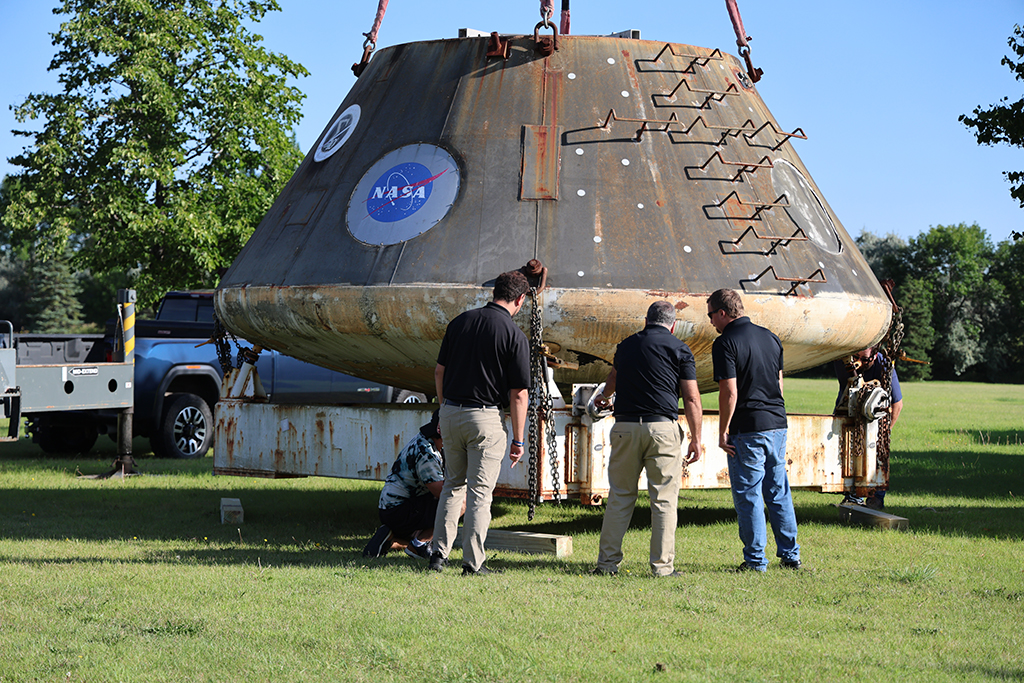
A journey spanning seven days, 30 states and 2,057 miles came to an end on Monday, Aug. 28, after a piece of NASA history was unloaded at UND’s Inflatable Lunar-Mars Analog Habitat (ILMAH), just west of Interstate 29.
That piece of history is an immense space capsule, used during a “launch abort” test at the NASA Wallops Flight Facility on Wallops Island, Va. The capsule was launched on July 8, 2009, as a trial run of the system that would eject it from the larger spacecraft, much like an ejection seat could be powered out of a fighter jet. Pablo de León, department chair of Space Studies, said he had been asking NASA for the capsule for several months, and that he is delighted now that it is on campus.
“The fact is, we are so far away from NASA centers, and we very seldom get pieces of historic significance,” de León said. “This is a major one.”
Shortly after 9 a.m. on Monday, a group of people gathered near the habitat to watch the capsule being unloaded by a 60-ton crane (not an easy thing to organize during construction season). A pair of Space Studies graduate students helped de León and UND staff members, along with Landstar (the Texas-based transportation company) employees and a crane operator, set up a wooden base to hold the capsule.
And there it will likely stay through the winter, as de León and his graduate students work to sandblast and restore the 18,000-pound capsule to its original paint scheme. Despite the object’s degraded exterior, anyone visiting the site can see the NASA logo, carefully positioned by the crane operator to face the road leading to the Lunar Habitat.
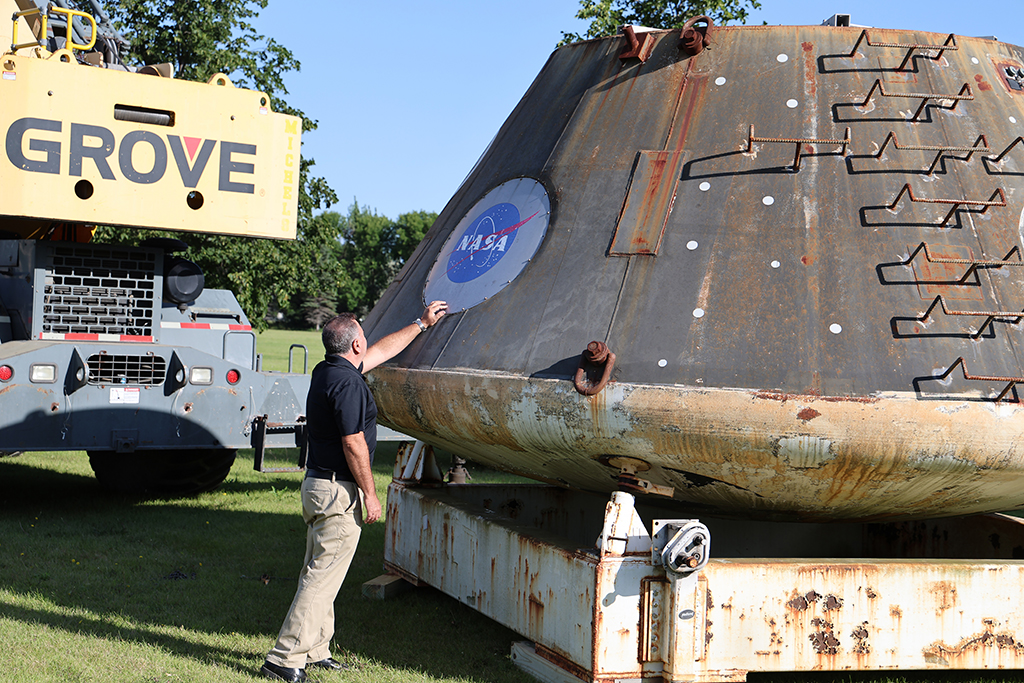
Because it splashed down into the Atlantic Ocean after the test, de León said he needs to inspect it for saltwater damage as well, which means getting a peek inside. As to what could be in there, de León said he wasn’t exactly sure.
“NASA built it to be a weight simulator of the capsule,” he said. “Chances are, it’s just metal.”
Once it has been refurbished, the plan is to place the capsule in a more visible location on campus, where one can easily imagine it becoming a site visited by class after class of public-school students from across the region.
De León said he is hoping to provide students with additional educational material about the capsule.
“We are seeing if we can, with the help of NASA, get a kind of a documentary produced on the capsule’s flight and why it’s important for the Artemis program, so kids can learn about the history of it and why it’s important for the future,” he said.
A link to NASA’s past, and its future
The capsule isn’t the only piece of NASA history on campus. About three months ago, de León managed to secure a Saturn I rocket engine — one that was used during the Apollo Program era, between 1968-1972. The engine is being refurbished at a Grand Forks company and will then be used as an instructional tool for students studying rocket propulsion.
Despite having been launched in 2009, the capsule is a link to NASA’s future. It was created to test elements of NASA’s Artemis missions, the first of which was an uncrewed lunar flight test that blasted off on Nov. 16, 2022. That capsule splashed down about a month later.
Artemis II will be the first crewed flight test of the Space Launch System and the Orion spacecraft around the Moon; Artemis III will send the first humans to explore the region near the lunar South Pole. After that, the goal of the Artemis Program is to pave the way for a human mission to Mars.
A long road from Virginia to North Dakota (with onlookers!)
Shipping company Landstar picked up the capsule in Langley, Va. The company had to secure permits for 30 states in order to transport the capsule to North Dakota. The company was even required to have a pilot vehicle in front of the semi, with another escort vehicle following behind.
Driver Tim Woodruff said people followed him for miles on his way north, and when he stopped, he was frequently asked what the capsule was and where it was heading. He joked with one family that it came from Roswell, N.M., and it contained “green aliens,” encased in concrete, he said.
Mostly, people wanted photos and videos of the capsule, but some even pulled over on highway off ramps to get a better look, Woodruff said. Some even turned around on two-lane roads to follow him.
And the best part? During a stop in Sioux Falls, S.D., Woodruff encountered a group of children involved with Special Olympics of South Dakota. The young people were enamored with the capsule and gathered around to see it.
“That was the most amazing part of the trip,” he said. “Seeing the smiles on those kids’ faces.”

****
Media Contact: Adam Kurtz, adam.kurtz.1@UND.edu or 701.777.4304
Caption 1: “The NASA space capsule, as it is slowly lowered to a base on the ground. Photo By Adam Kurtz/UND Today.”
Caption 2: “Pablo de León, department chair of Space Studies, inspects the NASA space capsule. Photo by Adam Kurtz/UND Today.”
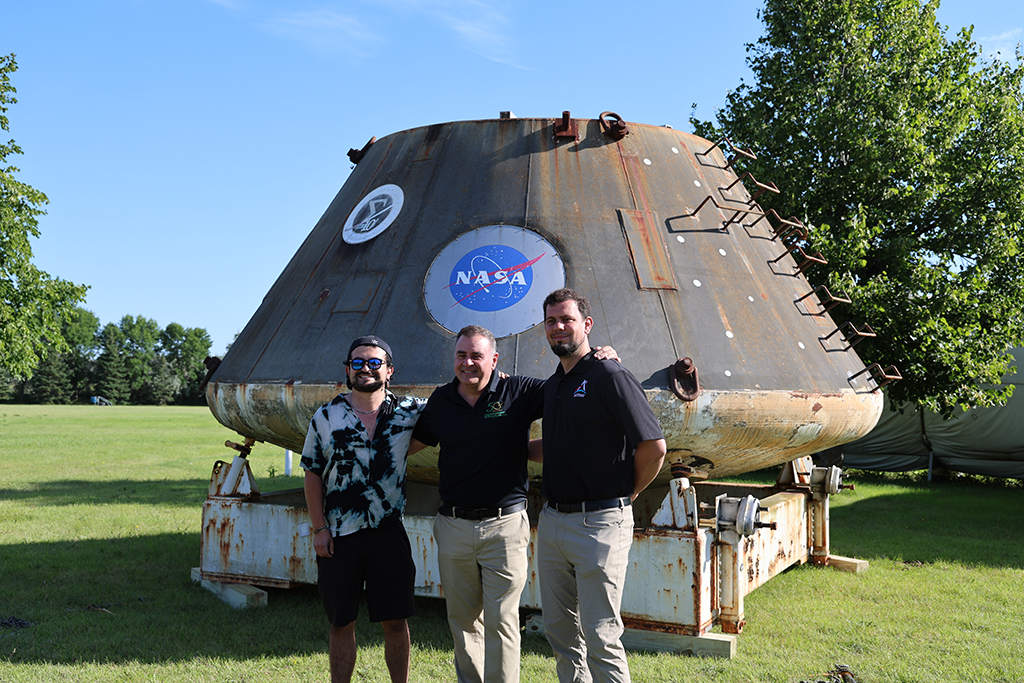
Caption 3: “Pablo de León, department chair of Space Studies, center, stands with Jurie Visagie, right, and David Mateus Jiménez, both graduate students, in front of the NASA space capsule. Photo by Adam Kurtz/UND Today.”
Caption 4: “People take photos of a 60-ton crane lifting a NASA space capsule on Monday, Aug. 24. Photo by Adam Kurtz/UND Today.