From the North Dakota prairie to the mountains of Peru
As UND doctoral student Anaí Caparó Bellido can testify, research can take UND graduate students to far corners of world
By Averie Eixenberger
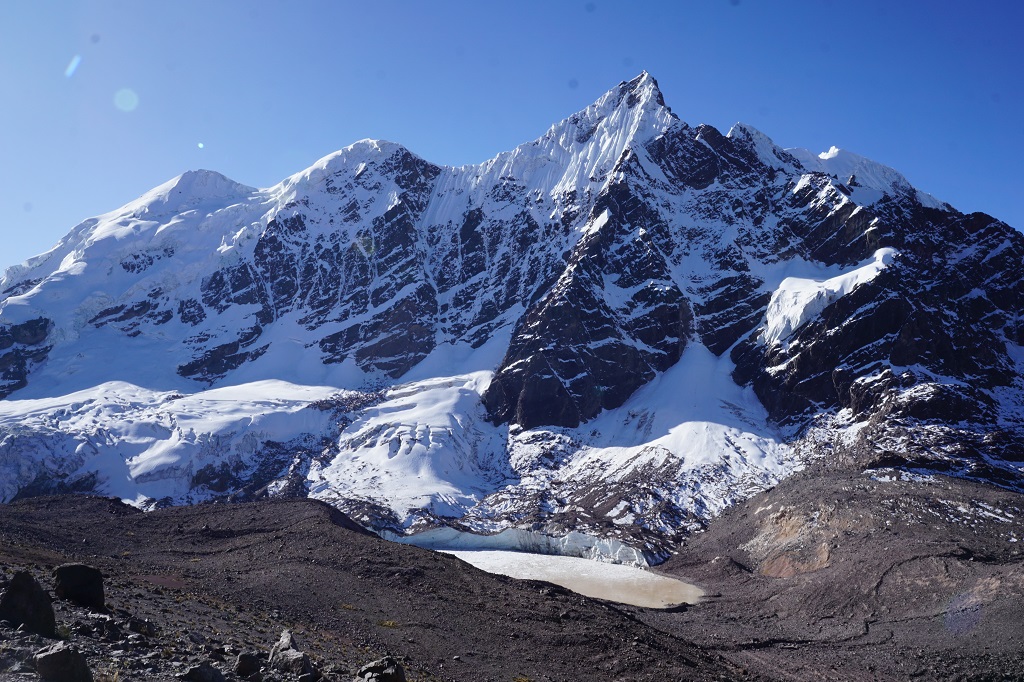
In the last 60 years, Peru has lost more than 520 square miles of glacier area with its second largest glaciated mountain range, the Cordillera del Vilcanota, losing over 96 square miles. Currently, Cordillera del Vilcanota has 438 glaciers and 578 glacier lakes with its highest peak, the Ausangate mountain, serving as the focal point of UND graduate student Anaí Caparó Bellido’s research.
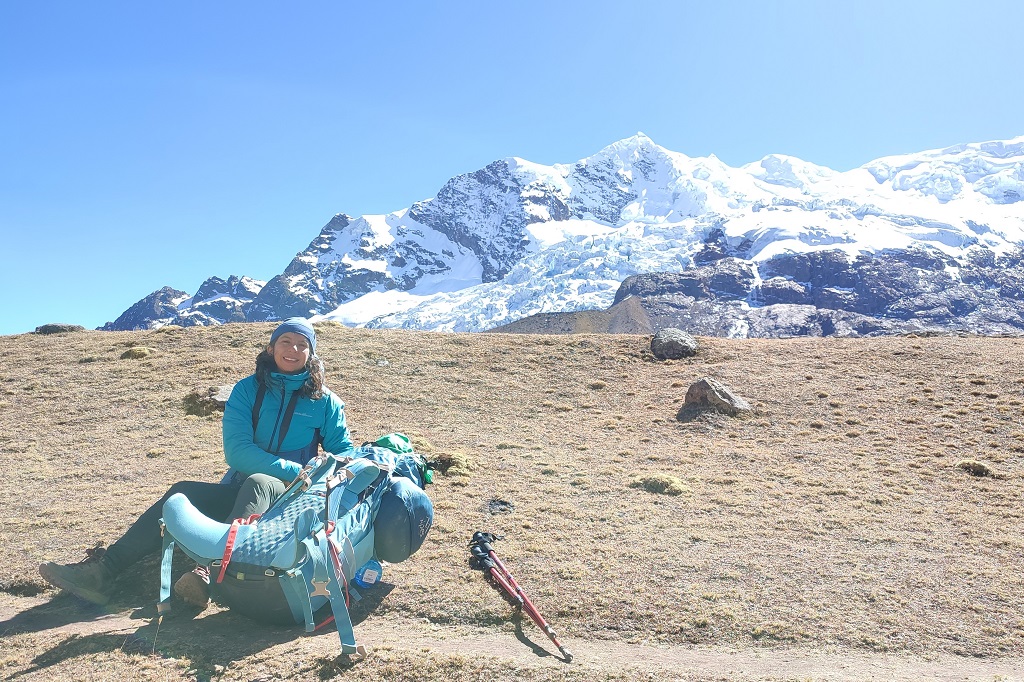
This past July, Caparó Bellido spent seven days in Peru to study the glacier in person as part of her research for her doctoral degree in Earth System Science & Policy. Her research uses satellite images to see the effects of climate change in the Cordillera del Vilcanota range.
During the trip, Caparó Bellido camped out on the edge of the glacier, conducting measurements and taking imagery. This was an exploratory trip to see the area of study and evaluate the feasibility of data sampling.
“This initial trip was to learn about the area,” said Caparó Bellido. “We took pictures with a temperature-sensitive camera and compared it to satellite imagery. We want to be able to compose a 3D image of the glacier.”
Originally from Peru, Caparó Bellido said she has always been attracted by mountains. When choosing a place to research debris-covered glaciers, Peru seemed to be a perfect spot.
“Just being there in person is amazing,” she said. “The trip was tiring but beautiful. It was very different from the photos on Google Earth.”
Caparó Bellido plans to travel back to the glacier this upcoming July or August to continue her research. Her hope is to take water samples from the glacier to see how much water runoff contributes to a nearby river.
“These kinds of field trips are better during dry season and in the Cordillera del Vilcanota, this is between June and August,” said Caparó Bellido. “However, this is also winter in Peru. When you are walking more than 4,000 meters above sea level, you don’t know what to expect from the weather conditions. Altitude sickness affects everyone differently, and just walking at that altitude is different than walking at the altitude of Grand Forks.”
Caparó Bellido’s original background is as an environmental engineer. She received her master’s in Geography and is now working towards her doctoral degree as part of the Earth System Science and Policy Department of UND Aerospace.
“When we talk about glaciers, usually we imagine these white and shiny masses of ice,” she said. “However, there are some glaciers that are under a layer of soil or rocks; these are debris-covered glaciers. There is not too much research on them in the Cordillera del Vilcanota. I feel really confident in my research, and the support from my department has been wonderful.”
 About the author:
Averie Eixenberger is a Commercial Aviation and English major at UND. After graduation, she hopes to pursue a career as an airline pilot and work within aviation journalism.