Remembering NASA’s Pearl Young, UND ’19 — 1919, that is
Physics, Math and Chemistry major was first female technical employee at NASA’s precursor agency
Editor’s note: In the UND LEADS Strategic Plan, the Discovery core value calls on the University to foster “facilitate and enhance connections, where new and existing partners ― including industry, government, and inter-institutional collaborations, among others ― can easily engage, and where internal efforts to foster partnerships can be supported and flourish.”
As the story below suggests, UND has been fostering connections with NASA and its precursor agency for a very long time.
****
By Averie Eixenberger
Today, UND Aerospace is known for its aerospace educational programs. But UND started playing a role in the aerospace industry many decades before that, as shown by UND alumna Pearl Young beginning her career more than a century ago with NACA: the National Advisory’ Committee for Aeronautics, the precursor to NASA.
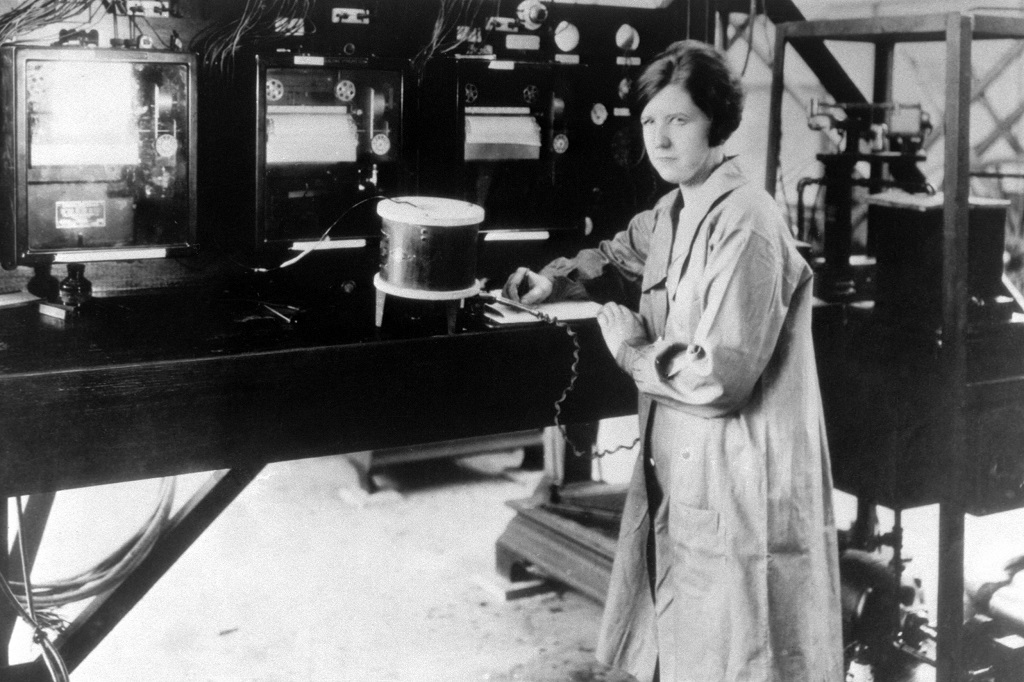
Pearl Young was originally from Taopi, Minn., and graduated from UND in 1919 with majors in Physics, Mathematics and Chemistry. In 1922, Young became the first female technical employee at the NACA.
“She was the only woman in a technical position for over a decade,” said Caitlin Milera, director of the North Dakota Space Grant Consortium and research assistant professor at UND. “She started as a physicist and moved around through different divisions within the NACA.”
As Young continued her career at the NACA, she saw flaws in the way that technical reports were made — they lacked consistency and accuracy, and were communicated poorly. Young knew that this would prevent scientific progress and proposed that the reports be edited.
“She’s most known for her technical editing,” said Milera. “It’s a position that requires knowledge of multiple STEM fields, as well as English skills. She helped start divisions at NASA for technical editing.”
As part of her work in technical editing, Young published the “Style Guide for Engineering Authors”, which was used by all of NASA, several federal agencies and universities across the globe.
“It was instrumental for World War II efforts,” explained Milera. “Especially with the technology they were developing with airplanes at the time, knowledge had to be communicated quickly to help in the war.”
An advocate and editor
As new centers were created within NASA (which succeeded the NACA in 1958), Young helped establish and run new technical editing offices. As her career progressed, Young continued working at NASA and taught university courses. She retired from NASA in 1961.
“She had to be an advocate,” said Milera. “Not only was she an advocate for herself, but she also had to be one for others, too. She had to stand up for her team and work to get a place at the table for women and technical editors.”
During her time at the NACA and NASA, Young fought against barriers for women in technical positions, advocating for better pay and recognition for work. In addition, Young was recognized for her networking skills, and used her connections to persist in her efforts.
“Through her scrap books, she seems to be someone who stayed true to herself,” said Milera. “She had a mentality that ‘this is the right thing to do, and this is what I want to do’. I don’t think she would necessarily code herself as rebelling against the system; she was just trying to live her life in a time that wasn’t the norm.”
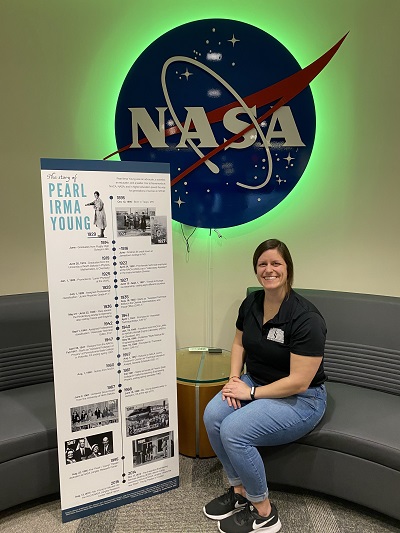
Milera completed her dissertation on Pearl Young’s life and career. She recently gave the keynote address at NASA’s Diversity, Equity, Inclusion and Accessibility (DEIA) Day on her research.
“Pearl was at NASA Langley,” said Milera. “She made a really huge impact there. We got to make a whole thing about Pearl that day, which was a lot of fun.”
When asked about her research, Milera explained that she found Young to be inspirational and that the culture she promoted could be felt at NASA’s Langley Research Center today.
“One of my favorite things about her is that in letters when discussing advocacy, she would refer to it as ‘raising hell’,” Milera said. “She recognized that some of her actions were against the grain, but they needed to happen in order to make progress.”
****
>> QUESTIONS OR COMMENTS about the UND LEADS Strategic Plan? Your thoughts are welcome! Please contact Angie Carpenter, UND’s director of Special Student Populations, and/or Ryan Zerr, associate vice president for Strategy & Implementation, the co-chairs of the UND LEADS Implementation Committee.
You also may offer your thoughts by visiting the UND LEADS Strategic Plan home page and clicking on the “Provide your feedback” link that you’ll find there.
Thank you for your support of the UND LEADS Strategic Plan!
****
About the author:
 Averie Eixenberger is a Commercial Aviation and English major at UND. After graduation, she hopes to pursue a career as an airline pilot and work within aviation journalism.