Student history project raises new voices
Students’ 150-word essays tell new stories of heartbreak and joy from Grand Forks’ first 150 years

Editor’s note: In the UND LEADS Strategic Plan, the “Discovery” core value calls on UND to “foster innovative teaching, applied learning and transformative research that exemplifies discovery, as shown by experimenting, researching, drafting (and) writing,” among other activities. This story describes a project in which UND faculty members “foster innovative teaching” by asking students to write short essays on Grand Forks history that are being collected and published in book form.
* * *
They say history repeats itself, but that’s exactly what historians William Caraher and Nikki Berg Burin didn’t want to do when they set out with their students on a project to commemorate Grand Forks’ first 150 years.
Associate Professor Caraher and Assistant Professor Berg Burin, both of UND’s Department of History & American Indian Studies, said much of the city’s early historical accounts tended to follow more of a “top-down narrative.”
“They focused a lot on all the great men who came to the prairie to do great man things like founding cities, piloting steamboats and building railroads,” said Caraher, exaggerating his point with gruff inflection. “That seemed a little dated to us because that’s just not the narrative many of us in the community can relate to any longer. There are so many more stories to tell.”
“Grand Forks at 150: The First Fifty,” now available on The Digital Press, is just the start to some of those stories.

A different kind of North Dakota history
The collection of 50 short essays — each appropriately 150 words long and written by students, faculty and other community members — is a collaboration between the Department of History & American Indian Studies and the Grand Forks Historic Preservation Commission.
All told, Berg Burin said the eventual collection of 150 essays will weave a textured legacy that goes far beyond the community’s traditional timelines and historical markers. Rather, these stories will give readers a front-row seat to the people who lived that history.
“I think we all know some of that big, broad narrative of North Dakota, but by looking at the local level, we get to see some of the nuance and diversity of experience,” Berg Burin said. “Exploring the plurality of voices and experience can give us insight into who we are today, where we’ve been and, perhaps, where we’re going.”
How do you rewrite the history?
Well, that’s a good question, said Caraher, before explaining moments later how the project didn’t exactly begin at UND but actually evolved from a conversation he had with his wife.
You see, Susan Caraher is the city’s historic preservation coordinator.
She had been looking through materials from the city’s 1974 centennial celebration when she observed the 150th was right around the corner, prompting her to wonder out loud what the city might do to mark the milestone.
“She wanted to create something new and something lasting,” Caraher said. “So, Susie and I were just talking and thought, ‘Hey, before we go any further, we really should rope in other people who are interested in the plurality of stories in our community.”
That immediately led Caraher to seek out his colleague Berg Burin. The pair soon sat down with department Chair Cynthia Prescott, more brainstorming ensued and the public partnership was born.
Looking back and looking forward
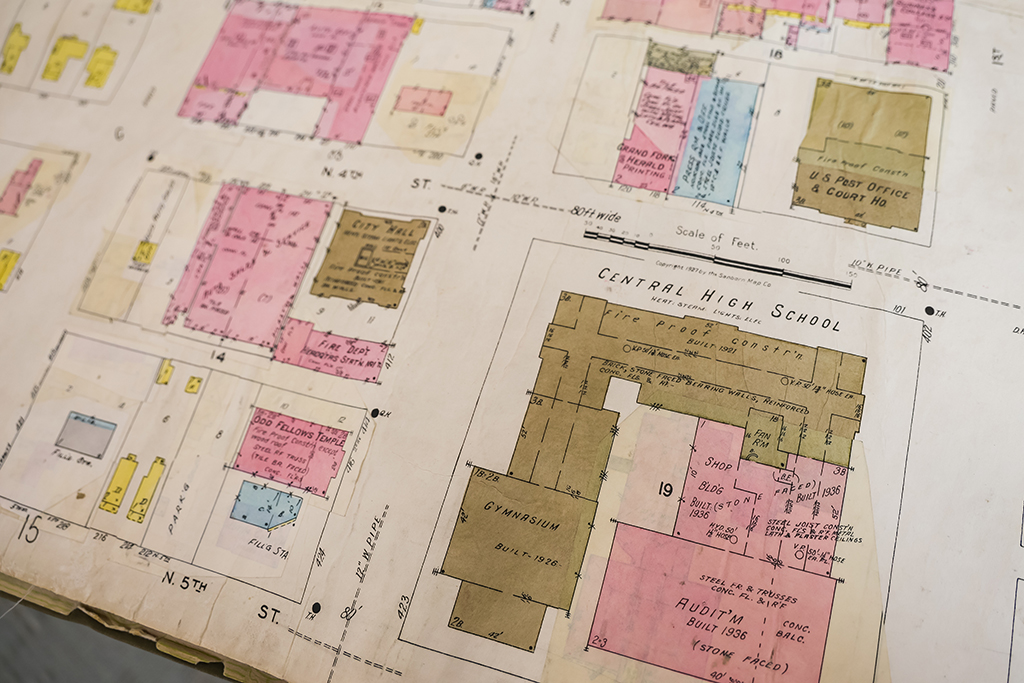
Turns out that white settlers first platted the city of Grand Forks in 1874, but the town wasn’t officially incorporated until seven years later — giving the historians two dates and some extra wiggle room to create something special for the sesquicentennial.
From start to finish, they would guide 14 undergraduate students to research, write, workshop, edit and publish essays that would be turned into a book and made available to the public.
“I was raised in Grand Forks, so this is a real honor and responsibility to be able to help tell these stories,” Berg Burin said. “And from Day One, my students also were very excited. It was hard work, but once we finally got that first edited version out, they were thrilled to see it.
“They were published by a legitimate press, and that’s not something that happens very often for undergraduates.”
The students were able to choose their own topics, but they knew all along that this would be a very different writing assignment. They would begin by crafting 300-word essays and then go through a series of peer reviews and edits to whittle that by half while still keeping their stories meaningful.
“Counting to 150 is more challenging than you might think. We’re humanities people,” Caraher said with a chuckle. “You can’t just go through it and cut all the adjectives. It doesn’t work that way.
“Plus, in history, you’re always asking students, ‘What’s the significance of this?’ The students knew they weren’t just telling a story — they also were telling why the story mattered. That was Nikki’s guidance. She really worked with them to bring that out.”
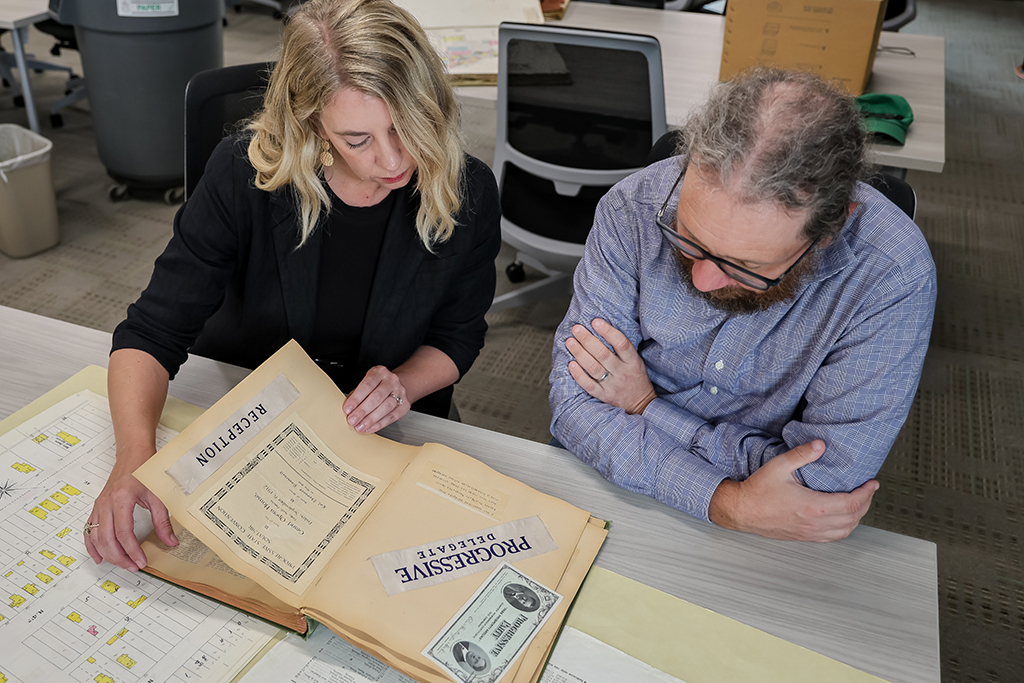
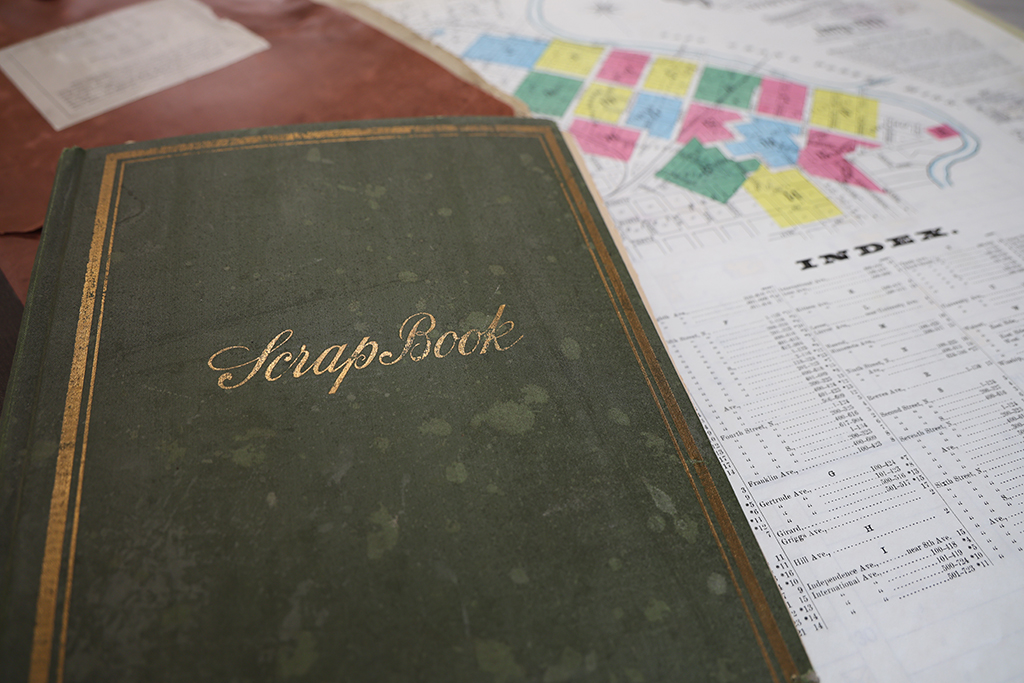
Over one semester, the students untangled bits and pieces from digital resources and pored over newspaper clippings, scrapbooks, photographs, institutional records and even World War I-era dance cards in UND’s Elwyn B. Robinson Department of Special Collections.
In the end, they each contributed three essays that, together, begin to chronicle 150 years of both joy and sorrow, love and contempt, adversity and triumph.
“We were very clear that this project wasn’t just about celebration. When you’re looking at the past as a whole, you’re seeing the good and the bad, the happy and the sad. At least in the first 50, there’s really a nice balance of that,” Berg Burin said. “I also encouraged the students to look for the mundane, the eclectic or odd story that might be interesting. I wanted to really give them freedom to focus on the big or the small and just see where they landed.”
A mix of big days and everydays
Take for instance, the strange story of Grand Forks surgeon and one-time mayor, Dr. Henry Wheeler, who claimed to possess the skeleton of Clell Miller, a member of the outlaw Jesse James gang. Wheeler said he shot and killed Miller in 1876 as the gang attempted to escape after a bank robbery in Northfield, Minn. It’s speculated that Wheeler retrieved the body from a shallow grave and used it as a cadaver while studying medicine in Michigan.
Or the heartbreaking story of Adelaide Chapman, a young woman who was brutally raped in 1917 by five of the city’s most prominent young men. The men faced little consequence, and the judge was said to blame Chapman for the attack simply because she was guilty of having a mature figure and had accepted a ride from the men at night.
And who could forget — but for maybe those who were there — the night of “New Beer’s Eve” when 17,000 locals shared 100,000 bottles of beer to celebrate the official end to Prohibition in 1933.
The stories go on … A Jewish neighborhood is lost. Crowds watch horses, not cars, race around the track. A roller rink doubles for dancing, wrestling — and Sunday church services. There’s even an essay that reveals the Golden Hour’s secret recipe for deep-fried halibut. The downtown delicacy was worthy of urban legend before there was such a thing as urban legend.
“Some of the most brilliant essays are the ones the students wrote,” Caraher said. “And I’m not just saying that to make our students look good. Their essays really are that good.”

You can believe it or not
One such essay was written by UND senior Carsen Grave, who shared the tale of “Anna Eva Fay(ke)’s Cloudy Crystal Ball.” The nationally proclaimed psychic apparently was so believable that she sold out the town’s Opera House night after night.
Grave was enthralled, too, but for another reason. The History major said he found “Grand Forks 150” to be both challenging and inspiring.
“I loved so many aspects of this project that I don’t know that I could pick a favorite part,” Grave said. “Doing the archival research was just fascinating. I was holding real historical documents in my hand that in some cases were more than 100 years old. That’s such a surreal experience and so different than opening a textbook written by a scholar.”
He said the project also taught him a lot about himself as he gravitated toward topics that revealed and reflected some of his own values.
For example, he pointed to his research on the Unitarian Universalist Fellowship of Grand Forks, which “built an alternative community in small-town America.” During a time of great racial and religious divide in the country’s tumultuous 1960s and ’70s, Grave said the group stuck to their guiding principles of wisdom and compassion.
“If you live a life based on wisdom and compassion, you won’t do anybody wrong. I love the simplicity and appeal of that,” Grave said. “Just try to learn something new every day and be kind to others. I now feel motivated to capture that same energy in my own life.”
And the untold stories are told
Emily Bruer, who earned her History degree in May — along with minors in Nonprofit Administration and Women & Gender Studies — was another fan of the project.
She said she enjoyed both the independent research and the collaborative teamwork.
“The process felt strange at first, but I genuinely appreciated having the opportunity to regularly discuss my work with my classmates,” she said. “By the end of the semester, I trusted their advice and felt that we had built a strong partnership based on the desire to publish something meaningful.”
Bruer, who’s now updating the Lee Mohr Photograph Collection as an intern with the State Historical Society of North Dakota, focused her attention on some of history’s most unsung heroes: women.
“While I found plenty of information about the prominent and influential men who contributed to the community, I struggled to find meaningful accounts about the women who did the same,” Bruer said. “I saw this project as a chance to elevate the stories of previously overlooked and undervalued people.”
Two of those people she elevated were Mathilda and Gina Taugbol, sisters who ran a department store that specialized in tailoring and millinery services. Fighting the norm at the turn of the century, the women used their economic and social connections to provide a suitable place for women to publicly gather outside their homes — and they also encouraged other women to be entrepreneurs.

Bruer said her biggest takeaway from the project was that “local history matters.”
“Investing in local history — whether it’s casual interest or professional motivation — can empower a person to use that past to better understand the present and better prepare for the future,” she said. “Stories like the ones we uncovered also can inspire a community to take pride in its history and encourage growth beyond its previous shortcomings.”
>> Do you have a story idea? Berg Burin and Caraher say “Grand Forks 150” will be a work in progress over the next couple of years. If you have an idea or would like to contribute an essay, contact Berg Burin at nikki.berg@UND.edu or Caraher at william.caraher@UND.edu.
>> Stay tuned for an upcoming exhibit. Jeremy Kingsbury, teaching assistant professor in History & American Indian Studies, also is working to develop an exhibit that ties into the project.
>> Questions or comments about the UND LEADS Strategic Plan? Your thoughts are welcome! Please contact Mike Wozniak, coordinator of Leadership & Programming, and/or Ryan Zerr, associate vice president for Strategy & Implementation, the co-chairs of the UND LEADS Implementation Committee. You also may offer your thoughts by visiting the UND LEADS Strategic Plan home page and clicking on the “Provide your feedback” link that you’ll find there.