Teagle Foundation awards $250,000 to Arts & Sciences
‘Cornerstone: Learning for Living’ grant will help create minor in Applied Humanities at UND
‘The unexamined life is not worth living for a human being.’
* * *
UND Philosophy & Ethics Chair Lucian Stone says the quote attributed to the famous Greek philosopher Socrates means “that to be human is to have an insatiable sense of wonder and to critically examine the world, our communities and ourselves.”
It may sound like lofty language from a long-ago age, but the chairs of UND’s four humanities departments — Philosophy & Ethics, English, History & American Indian Studies and Languages & Global Studies — say it should be the way of life for all new college students.
After it first received a starter $25,000 grant last spring and now a $250,000 “Cornerstone: Learning for Living” grant, the College of Arts & Sciences is backing that ideology by developing a new 16-credit Applied Humanities minor.
“University education ought to be more than vocational training. A college-educated person ought to be broadly or more holistically educated in such a way that they are better equipped to exercise free choice as democratic citizens,” Stone said. “Humanities is an integral part — some might say the cornerstone — in the education of free, yet rigorous, thinkers with a commitment to ethical responsibility.”
Building better leaders at UND
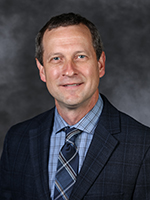
Ryan Zerr, associate vice president for Strategy & Implementation and co-chair of the UND LEADS Implementation Committee, was associate dean in Arts & Sciences when he and the department chairs began working on the grant application process and new degree program nearly three years ago.
Today, some of the new classes already are in session. And the formal degree — once it passes final approval — could be available as early as next fall.
“This program is very strongly connected to our strategic priority within the learning core value that begins by saying, ‘serve the whole student,’ ” Zerr said. “We are engaging students in ways that help them grow and understand themselves as individuals and in ways they might not have otherwise.”
The program also is closely aligned with UND’s core value of affinity because of its unique first-year student experience, Zerr said. For instance, students take two classes in tandem — one a composition course, and the other, a humanities seminar.
In the latter, students are assigned to read relevant literature as homework to prepare for open dialogue with instructors and peers within class. The course titles themselves say a lot: English 100: Humanities Seminar in Self, Citizenship & Community and English Composition II: Leadership Through Public Writing.
Finding your place in community, world
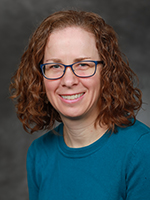
The University long has stressed the importance of the humanities through its general education requirements in Essential Studies, but History & American Indian Studies Chair Cynthia Prescott says the new Applied Humanities program takes it to another level.
“As a historian, I recognize opportunities to learn from the past to help me understand the present and consider what I would like to see happen in the future,” Prescott said. “The humanities teach us to think critically about our place in our community and the larger world. We emphasize critical reading and persuasive writing that helps us understand people who think differently than we do — skills that are necessary to overcome the partisanship that divides our society.”
Prescott shared an example of how students are encouraged to “think deeply” about their responsibilities to their community.
“In ‘History 260: Slaves, Citizens and Social Change,’ students will role-play individuals living in the mid-19th century and early 20th century who had to choose whether to pursue their individual desires or to act on behalf of the working poor or enslaved,” she said. “Debating that tension between individual desires and others’ needs — and supporting their decisions with the writings of those whose lives they depict — prepares students to make more informed decisions in their own lives.”
Further, the grant allows faculty to develop other stimulating new courses with small class sizes — 18 is the target for the humanities seminar — allowing students the extra time and structure to build stronger relationships with faculty and peers.
Students also hone their communication skills, laying the groundwork toward becoming informed citizens capable of challenging misinformation as they seek solutions to common problems, Prescott said.
It sticks with you throughout life
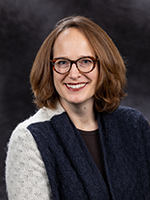
English Chair Lori Robison relayed how she and Melissa Gjellstad, chair of Languages & Global Studies, traveled last year to Stanford University, where they listened to a panel of students talk about their experiences in a Cornerstone humanities seminar there.
Robison recalled how one young woman felt she was in a “very contemplative state of mind” as a first-year college student. The woman shared that she appreciated the Cornerstone class because it “seemed designed to help her think about herself, her education and who she wants to become.”
“That’s what we want students to understand,” Robison said. “An education in humanities doesn’t just give you some knowledge you didn’t have before — it actively shapes and changes you. When you become more contemplative, your whole life — no matter what career you choose — is enriched.”
And to live enriched lives, she added, “is to interpret and to reflect on the human condition. We all have moments in our lives when we need to make difficult decisions, when we experience loss and grief, when we need to consider our own identities, when we want to reflect on our values or on our relationships with others.
“Reading, analyzing and discussing how human beings — across a variety of cultures and throughout time have dealt with these issues — prepares us to face them, with complexity and thoughtfulness in our own lives.”
While campuses nationwide have made significant cuts to humanities programs in recent years, the chairs hope the Cornerstone program’s emphasis on bringing more students — no matter what their major — into the humanities classroom will encourage a continued investment at UND.
Said Gjellstad: “I’m excited about the faculty development opportunities that the Cornerstone program has catalyzed. Our work has been collaborative and productive as we’ve gathered humanities faculty from all ranks and departments to envision this program as a standout feature of the College of Arts & Sciences.
“We’ve strived to augment our strengths, to distill the best of what we do in the classroom, to make space for blue-sky thinking in our course design and to translate the innovation into tangible takeaways for our students. This program displays the breadth of our disciplines and value that goes far beyond graduation.”
Added value for every career path
The minor in Applied Humanities is a good fit for every student in every field, Stone added.
“Graduate admissions committees such as those for medical schools and law schools are looking for well-rounded students — those who demonstrate a mature approach to those fields by examining them from multiple perspectives, including the humanities,” he said. “It doesn’t require a stretch of the imagination to consider the importance of bedside manner or empathy in the medical field. Employers want to hire people with more than technical knowledge. They want to invest in employees who are mindful of how their industry fits within society. They want employees equipped with forethought to anticipate outcomes and reactions, as well as the critical thinking skills to adapt to change and problem-solve.”
Certainly, a college degree can be a graduate’s ticket to making a good living, but that is not the only prize or measure of success.
“Today, there is a strong emphasis on universities as a path to high-paying jobs, and we tend to look at starting salaries as an indicator of how successful one’s education has been — but that focus can be shortsighted,” Prescott said. “Shiny new technologies can be exciting and profitable in the short term, but that doesn’t necessarily mean a strong career outlook in the long term. Computer programming may pay well today, but what if artificial intelligence eventually replaces entry-level coders? What then? We need to prepare our students — not just to earn a good salary right after graduation — but to be prepared to be nimble, lifelong learners who can embrace new opportunities and careers that don’t even exist yet.”
>> Lunch at the Cornerstone Launch will be from 12:30 to 1:30 p.m. Tuesday, Oct. 29 (location TBD). All UND advisors, administrators and faculty are welcome to attend to learn more about the program. Students currently taking the humanities seminar also will be there to talk about the experience.