Tobacco use on campus: ‘No’ means ‘no’
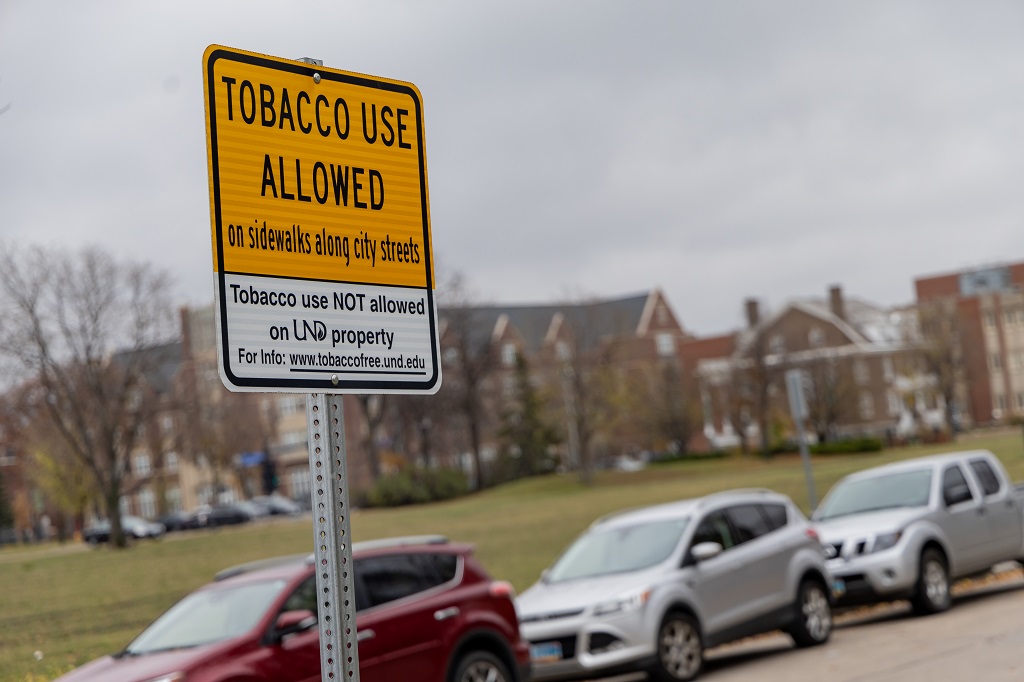
UND policy prohibits tobacco use on campus property, including the Quad, UND Police Chief Rodney Clark affirms
Editor’s note: In the UND LEADS Strategic Plan, the Affinity core value calls on UND to “cultivate physical and online campus environments that are welcoming, safe, healthy and inclusive.”
With that in mind, we’re reprinting the story below, which ran originally on Nov. 7. In the story, UND Today interviewed Rodney Clark, associate vice president for Public Safety and chief of the UND Police, about the rules regarding tobacco use on campus.
Comments or questions? Contact Tom Dennis, UND Today editor, at tom.dennis@UND.edu. Thank you for reading!
****
UND Today: Let’s start with what the basic rule is. How do you understand the rule or rules about tobacco use on campus?
Chief Clark: The basic rule or policy is kind of self-explanatory; and, as you know, it derives from state statutes and North Dakota University System policy, which then works its way down to the individual university itself.
And it is a policy of, “No” – meaning zero – “tobacco use.”
Plus, the word “tobacco” extends to not only the traditional forms of smoking, but also to e-cigarettes and things like that on any university property.
So that’s why I say it’s kind of self-explanatory: “No” means “no.” And there are no exceptions. So, if I’m standing out by a dumpster on a loading dock or someplace like that, or if I’m outdoors and walking across the Quad, I’m still on university-owned property – and that means no tobacco use.
UND Today: And that would be the case at the other 10 campuses, as well?
Chief Clark: I believe it would be, because the rule is derived from a systemwide policy that tobacco use would not be allowed on any state college or university campus.
UND Today: What’s your sense of people’s understanding of the rules? For example, do you still see people violating the rule?
Chief Clark: Yes. All of our officers do, and I do, too, when I’m out and about. I find people smoking on occasion. It’s usually a matter of convenience for them; typically, they’re smoking outside of their building, like back by a dumpster or someplace like that.
I’ve even seen more blatant behavior – for example, people just walking across campus while they’re smoking. So, I’ve seen it in a variety of forms, and we have noticed, I would say, during the past six months or so, that it seems to be happening more than it used to.
UND Today: How about in vehicles – what are the rules in that regard? And also, if somebody is a smoker and they’re in, say, the Memorial Union, what can they do? For example, is the sidewalk an alternative?
Chief Clark: As for vehicles, any vehicle would be considered a person’s personal property. So, if a person wanted to get into their vehicle and smoke, that would be acceptable.
Regarding the Memorial Union or any of our buildings that are along University Avenue, the rule is that the berm and the sidewalk are not University property. Instead, those areas belong to the city.
So people who want to smoke are entitled to do so there, and that’s what some people do. They’ll just walk out to the sidewalk or the berm close to University Avenue, and smoke.
And again, they are free to do that, because that’s where the line is drawn. They’re fine if they stay on the sidewalk or berm while they’re smoking, but once they step off the sidewalk toward the buildings of the universities, they’re on University property.
Part of our effort to get the word out about this is to publish a map. It delineates where University and non-University property is, so that people would be free to smoke in those non-University areas.
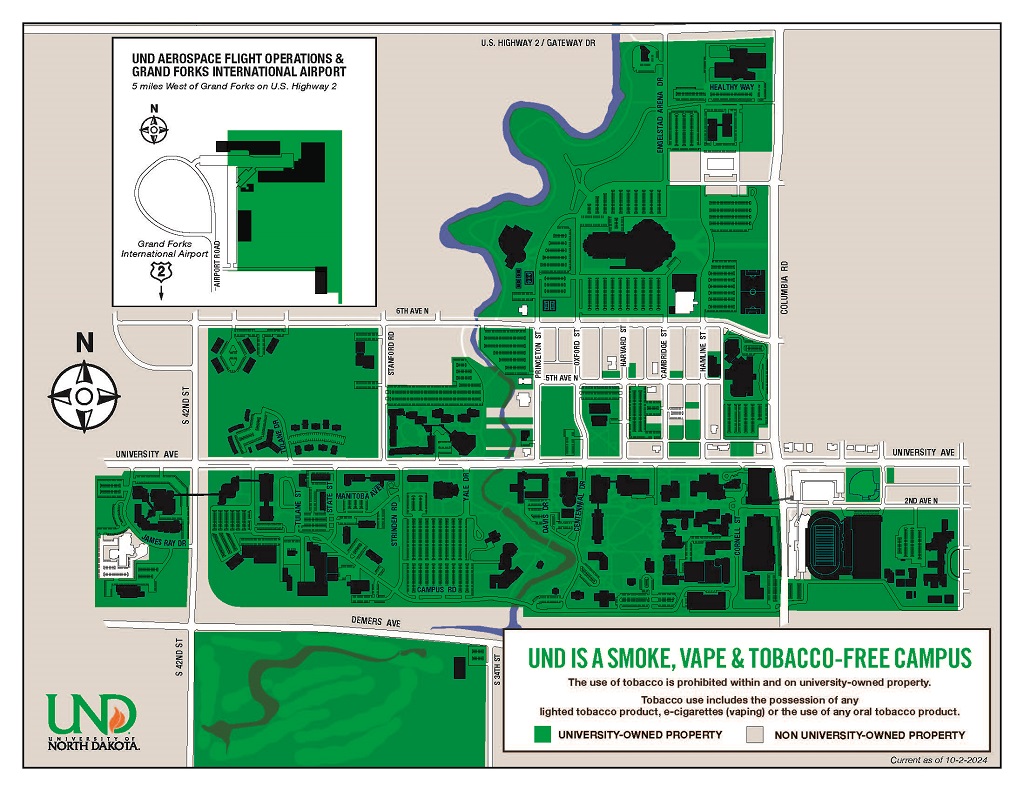
UND Today: So as the map shows, for example: From Columbia Road, all the way west to North 42nd Street and a little bit beyond, everything between University Avenue and the railroad yard – except for the Hilton Garden Inn – is University property, correct?
Chief Clark: Yes, that’s correct. Once you get on the east side of Columbia, in particular with the new Memorial Villages One and Two, it gets a little bit dicier, because some of those apartments are actually privately owned. So UND rules would not apply there.
But as a general rule, all the way from 42nd to Columbia down University Avenue, the sidewalk and the berm is where you can smoke.
UND Today: And as you mentioned, this applies to vaping as well?
Chief Clark: It would apply to all traditional tobacco forms, as well as e-cigarettes, which are considered tobacco products because they typically contain nicotine, which comes from tobacco.
UND Today: How about chewing tobacco?
Chief Clark: Technically, it would be tobacco, so it would be prohibited. The policy says “tobacco free,” so it would include smokeless forms of tobacco, too.
UND Today: On balance, this seems to be the sort of policy that most people get used to and ultimately approve of. I’d guess that if you surveyed people on campus, they’d be glad that the policy is in effect. That would be a big change from, say, the 1960s, right? I bet smokers were everywhere on campus back then.
Chief Clark: I think you’re right about society’s attitudes; we have shifted so much in a generation or two, regarding smoking’s culture and acceptability. And now that medical science has shown that second-hand smoke is harmful to people as well, that’s why the change now extends to bars and other places that used to be filled with smoke.
It’s much harder to find a place to smoke in public now than it was even 20 years ago – and on military bases and everywhere else, too, not just college campuses.
UND Today: How about enforcement. What happens when an officer encounters a smoker on campus? Does the smoker get a ticket of some kind?
Chief Clark: We do have the ability to ticket. But instead, we try and take more of the approach of just turning the case over to Human Resources in the case of a faculty or staff member, or Student Affairs for students. Then the traditional rules come into play, such as, maybe you’re given a warning and then a letter of reprimand, if the person repeats the offense.
I know we want to come at this from an education perspective, and in that way, we hope that we’ll see it happening less often over time. We really don’t want to be the “smoking police”; we’d much rather see people just learn and follow the rules.
UND Today: Any final thoughts that you’d like to pass along?
Chief Clark: Just to reinforce the message that No means No, when it comes to tobacco use on campus. If you’re a smoker, then please learn about the places where you can smoke, and just understand that none of those places will be on University property.
>> Do you have questions or comments about the UND LEADS Strategic Plan? Your thoughts are welcome! Please contact Mike Wozniak, coordinator of Leadership & Programming, and/or Ryan Zerr, associate vice president for Strategy & Implementation, the co-chairs of the UND LEADS Implementation Committee. You also may offer your thoughts by visiting the UND LEADS Strategic Plan home page and clicking on the “Provide your feedback” link. Thank you for your support of the UND LEADS Strategic Plan!