In Lake Placid, N.Y., UND students conduct brain-health research
By attaching sensors to USA Luge Team members’ helmets, Biomedical Engineering students study G-forces athletes endure
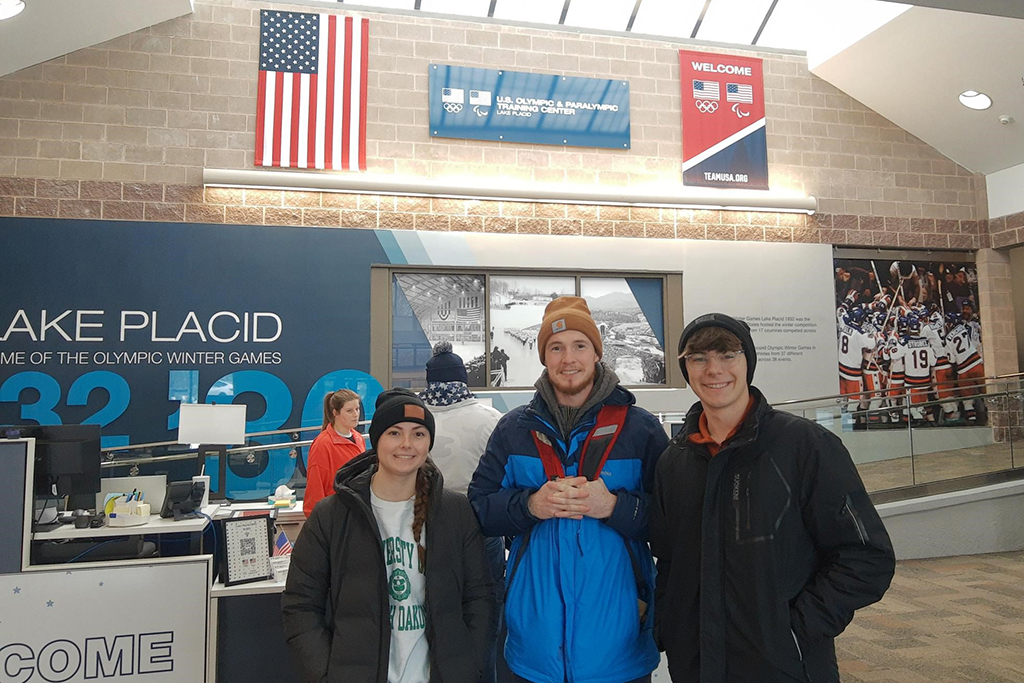
Editor’s note: In the UND LEADS Strategic Plan, the Learning core value calls on the University to “infuse dynamic learning approaches, environments and student-centered pedagogy (e.g. competency-based, project-based, high impact practices, etc.)” in the University’s curriculum. This story reports on a research project that is enabling UND students to conduct studies with members of the USA Luge Team on site at the Mt. Van Hoevenberg Olympic Bobsled Run in Lake Placid, N.Y.
This story was originally published in UND Today on Dec. 17.
****
A group of UND Biomedical Engineering students have entered into a research partnership with the USA Luge Team (USA Luge) on a project that could lead to improved brain health for some Olympic athletes.
What’s more, the project was conceived by a UND student who just happens to be a member of the U.S. Ski Jumping Team.
That student is Paige Jones, who last summer began wondering what effects inertial forces may have on winter sliding athletes competing in events such as luge, skeleton and bobsled. She discussed her ideas with athletes from those sports and, ultimately, secured a research agreement with USA Luge, to gather data about those inertial forces.
Back at UND, she put a research proposal together and secured the help of four other UND students. And she accomplished all of this as an undergraduate student — a sophomore.
(Editor’s note: Normally, UND press releases or articles include quotes from the people introduced therein. That was not possible with Jones, however, as she is currently competing at the FIS Ski Jumping World Cup in Zhangjiakou, China. An article about her and her athletic accomplishments will be forthcoming.)
On Dec. 2, members of the student engineering team traveled to Lake Placid, N.Y., which has a U.S. Olympic training facility. They stayed there for four days to attach sensors to the helmets of athletes as they went on their practice runs. Luge athletes often exceed 60 mph on the track; bumps, twists and turns on the track produce large G-forces that may impact brain health.
The Biomedical Engineering students are hoping the data collected in Lake Placid will point to improved equipment or training practices that can better protect the athletes.
For Dan Ewert, professor of Biomedical Engineering at UND, the research project is but one example of the department’s approach to education, which is referred to as “Innovation-Based Learning.”
IBL classrooms teach students how to engage in their own learning process, and offer a way to participate in hands-on, experiential learning, which is a strategic priority of the UND LEADS Strategic Plan. IBL also encourages interdisciplinary collaboration, and it prepares students for the fast-paced field of biomedical engineering.
Each student in the department is required to take part in a research project that is unique. Measuring how much force a luger’s head is being exposed to fulfills that requirement.
“The University of North Dakota is a pioneer in the innovation-based learning educational process, which gives a lot of freedom to students to envision what they want to do,” said Ewert. “Students form teams to do something that has never been done before. What I think is truly fantastic is this is a team of undergraduate students, and they’re working at an international level.”
One member of the research team is Gabriel Hanson, a UND freshman. Hanson said the team now is working to analyze the data they collected. They plan to submit a paper to an academic journal about their research and present it at conferences as well.
Plus, he found the work enjoyable (even though he said he decided not to give luging a try, while in Lake Placid).
“This project highlights the capabilities that you get with an innovation-based learning classroom,” Hanson said. “It was super exciting to actually go to Lake Placid to do the project that we worked on in the classroom. We got to meet real Olympic athletes and, hopefully, our research will produce something that will help them in their training and competitions.”
Conducting research on humans (not to mention Olympic athletes) is strictly governed. First, Jones had to work to secure an agreement with USA Luge. Then, the students had to receive permission from UND’s Institutional Review Board. IRBs at research universities govern research on humans. Their role is to protect human research subjects, as well as assure adherence to best practices for data storage and security, among other things.
Finally, the students had to generate an informed consent document for athletes to sign.
That’s a lot of work for a group of students.
“They did an awesome job on this project,” Ewert said. “I’m just so proud of them.”
Members of the research project include Jones, Hanson, Rachel Francis and Daniel Voxland. Caitlin Lambert, a Systems Engineering graduate student, also assisted with the project. Advising the student team are Ryan Striker, assistant professor of Biomedical Engineering and Enrique Alvarez Vazquez, also an assistant professor of Biomedical Engineering. The professors accompanied the students to Lake Placid.
Media contact: Ryan Striker, ryan.striker@UND.edu or 701.777.5649.

>> Questions or comments about the UND LEADS Strategic Plan? Your thoughts are welcome! Please contact Mike Wozniak, coordinator of Leadership & Programming, and/or Ryan Zerr, associate vice president for Strategy & Implementation, the co-chairs of the UND LEADS Implementation Committee. You also may offer your thoughts by visiting the UND LEADS Strategic Plan home page and clicking on the “Provide your feedback” link.
Thank you for your support of the UND LEADS Strategic Plan!