Report describes trends in N.D.’s health, health workforce and more
Among report’s conclusions: Healthcare Workforce Initiative continues to have ‘significant positive effect’
Editor’s note: In the UND LEADS Strategic Plan, the Service core value calls on UND to “address the health, educational, safety, cultural, economic, and workforce needs of our community, state and region via research and educational collaborations.” This story describes an ongoing project through which the UND School of Medicine & Health Sciences updates lawmakers and the state on North Dakotans’ health status and the state’s health-workforce needs.
This story, which was published in UND Today on Feb. 11, first appeared in For Your Health, the newsletter produced by the UND School of Medicine & Health Sciences.
****
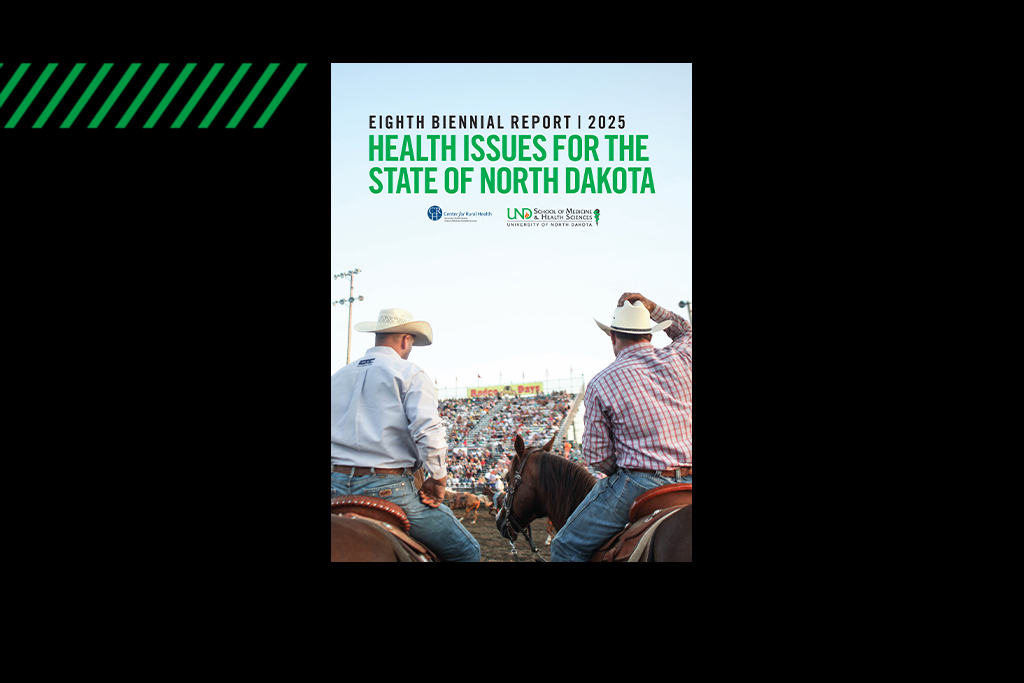
As the North Dakota Legislative Assembly continues its 69th session, the UND School of Medicine & Health Sciences and its partners have been hard at work preparing the Eighth Biennial Report on Health Issues for the State of North Dakota.
The 2025 Report, required of the School’s Advisory Council per North Dakota Century Code, updates legislators and health care leaders on the current state of the health of North Dakotans and their health care delivery system, along with an analysis of the steps the state can take to ensure that all North Dakotans can access high-quality health care at an affordable cost now and in the future.
Featuring new chapters focused on women’s and children’s health, Indigenous health, and the impact the SMHS has on health in North Dakota, the Report’s bottom line is that the health of North Dakotans is good overall. As the Report’s executive summary notes, North Dakotans are relatively healthier than citizens elsewhere in the country: North Dakotans are less likely than most Americans to report either fair or poor health and have a lower prevalence of both asthma and diabetes.
That said, North Dakota has a higher percentage of overweight and obese individuals compared to the U.S. average, and the state’s birth rate per capita again declined, with North Dakota recording fewer births in 2022 than it had in each of the previous 10 years. North Dakotans also tend to have a higher risk of some types of cancer and – given that the state hosts a very high number of persons age 85 and older – has led the nation in the number of deaths attributed to Alzheimer’s disease.
Furthermore, the Report emphasizes the statewide problem of unmet behavioral health needs.
Workforce
On this last note, part of the challenge North Dakota continues to face is not only a shortage of health providers but a maldistribution of providers. While the state’s urban areas tend to have a relatively adequate provider-to-population ratio, the state’s rural areas continue to face a significant shortage of health care workers compared with its urban areas – from nurses to physicians to therapists of all types.
The need for additional health care workers is particularly important in rural and western parts of North Dakota, noted the Report’s lead author Mandi-Leigh Peterson, where there has been a chronic shortage especially of primary care providers for decades.
“The deficit of North Dakota physicians is in rural areas, where we fall behind both the Upper Midwest and the nation in the number of physicians per 10,000 persons,” Peterson said. “The numbers are going in the right direction, though. We’ve seen a large expansion in the number and types of medical doctor residency training programs in North Dakota, with a doubling of slots since 2011. This will increase the likelihood that young physicians will complete residency programs in-state and thus practice in-state after their residency.”
The nursing workforce picture is trickier.
As the Report notes in its chapter on nursing in North Dakota, despite the positive overall nurse volume in the state as compared to the nation (145 nurses/10,000 population in North Dakota vs. 130 nurses/10,000 population nationwide), the state saw a decrease in nurses licensed in North Dakota between 2022 and 2024 (313 fewer).
Furthermore, even fewer of those nurses who have remained in North Dakota are working full time. Since 2020, nurses working 75%-100% full time equivalent (FTE) status have dropped seven percentage points, with most apparently shifting to working less than 25% FTE.
“This eighth Report is a great example of collaborative work at UND and helps highlight the essential role nurses play in shaping health care in North Dakota,” added Maridee Shogren, dean of UND’s College of Nursing & Professional Disciplines. “The Report explores key demographics, challenges, and opportunities, showcasing how the rural nature of our health care systems drive innovation and collaboration to improve patient outcomes. The chapter on nursing in particular is a valuable resource for nursing leaders, academic institutions, clinical partners, and legislators, recognizing the vital contributions of North Dakota’s nurses to our overall health care system.”
To that point, continued Peterson, the health care workforce news is generally good for North Dakota in 2025.
“North Dakota’s efforts to train our own appears to be working,” Peterson said. “In previous reports, North Dakota had fewer physicians per capita than our Midwest and U.S. peers. While this still holds true, we’ve narrowed the gap in the provider-to-population ratios. Our number of in-state graduates practicing in the state has gone up. Another area where we’re going in the right direction is that we’ve seen an increase in the overall number of psychologists and licensed addiction counselors in North Dakota, relative to 2018.”
Health care Infrastructure
In terms of infrastructure, health care is delivered through more than 300 ambulatory care clinics, 52 hospitals, 75 skilled-nursing facilities, 55 basic-care facilities, and 71 assisted-living facilities. Such facilities are supported by an array of emergency medical service (EMS) providers, trauma centers, and pharmacies. Behavioral health services delivered via the state system include eight Human Service Centers and six outreach/satellite locations, the State Hospital in Jamestown, and a Life Skills and Transition Center.
Notable here is the fact that despite often razor-thin operating margins and often inconsistent reimbursement protocols for area providers, North Dakota has seen the opening of several new hospitals in the past decade, including facilities in Rugby, Minot, Grand Forks, West Fargo and elsewhere.
“This infrastructure will help solidify North Dakota’s health care system for the next generation,” said Dr. Joshua Wynne, former vice president for Health Affairs at UND and former dean of the SMHS. “The Report demonstrates how the effective partnerships that have developed over the years between providers, health care organizations, the university system and the Legislature can have a very positive impact on health care workforce numbers as well as various support functions, such as modern health care facilities. Both of these components are necessary to improve health and health care delivery.”
Health care dashboard
Perhaps the most notable addition to this year’s Report is the new publicly available Health care Dashboard that Peterson’s team developed. Chock full of county-level demographic data and detail on the variety and quantity of primary care providers in the state, the dashboard gives health care leaders, policymakers, and the public a chance to understand better their region’s health care assets and possible needs.
“This new platform will allow us to move beyond fixed content and images to be able to provide more frequent data updates,” said Kristen Leighton, research analyst for the UND Center for Rural Health, who helped build the dashboard. “It will make data accessible via a dynamic platform that will allow users to focus on areas of interest for their decision-making needs.”
Far from being a static platform, the dashboard remains in development, said Leighton, meaning more information is forthcoming, including data on health conditions across the state.
The dashboard can be accessed via the SMHS website.
“The publication of the Eighth Biennial Report underscores the critical importance of maintaining a regular, data-driven dialogue about the health and health care workforce landscape in North Dakota,” said Dr. Marjorie Jenkins, UND’s vice president for Health Affairs and dean of the SMHS. “Given how this report is published every two years, it provides crucial information to help ensure that our strategies and policies are grounded in up-to-date, evidence-based insights, empowering our state to meet its evolving health care needs and foster a healthier, more resilient future for all North Dakotans.”
****
>> Questions or comments about the UND LEADS Strategic Plan? Your thoughts are welcome! Please contact Mike Wozniak, coordinator of Leadership & Programming, and/or Ryan Zerr, associate vice president for Strategy & Implementation, the co-chairs of the UND LEADS Implementation Committee. You also may offer your thoughts by visiting the UND LEADS Strategic Plan home page and clicking on the “Provide your feedback” link.
Thank you for your support of the UND LEADS Strategic Plan!