Rasmussen Lecture brings comics to life
Studying comics means studying the humanities, says Justin Wigard, assistant professor of English at UND
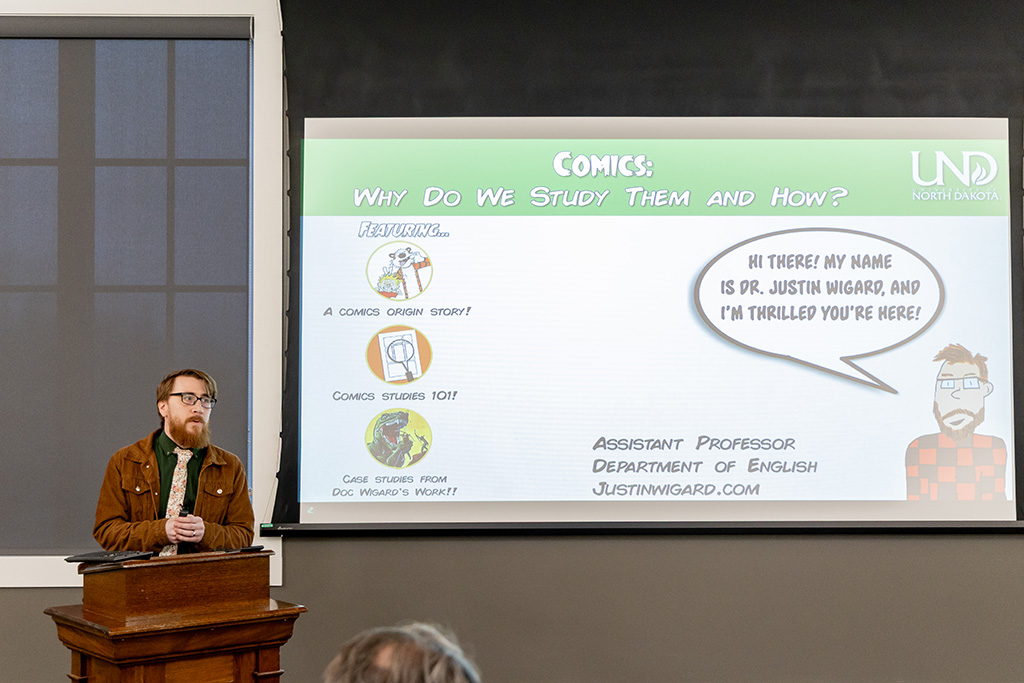
On the surface, comics may appear to be a relatively simple form of entertainment – a combination of images and text intended to amuse.
Delve deeper however, and there is a boundless medium to explore, one that encompasses a wide range of disciplines across the humanities.
That’s according to Justin Wigard, assistant professor of English at UND, who earlier this month delivered the latest installment of the Randy Rasmussen Memorial Lecture Series.
Conceived in 2023, the lecture series honors the late Rasmussen – an employee of the Chester Fritz Library, and connoisseur of the arts and sciences.
A native of Houghton Lake, Mich., Wigard initially aspired to be an art teacher, before taking literature courses at his alma mater of Central Michigan University.
“I was like, ‘Oh, this is where I should have been all along,’” he said. “I had some incredible professors at Central Michigan, who exposed me to not only the rigors of studying literature, but also the breadth of it. I learned that I could do work on pop culture, games, comics, digital humanities and more.”
Wigard then earned a bachelor’s, master’s and doctoral degree in English – the latter from Michigan State. He is also the co-author of a book titled “Attack of the New B Movies,” a compilation of essays discussing films broadcast on the Sci-Fi Channel.
Why study comics?
Comics lend themselves to scholarly study, due to their multimodality, accessibility and popularity, Wigard said. They’re also ubiquitous, appearing on everything from newspapers and candy wrappers to cereal boxes.
One comic strip – Garfield, authored by Jim Davis – has appeared continuously for more than four decades in over 2,500 newspapers, Wigard said.
“They’re really powerful vehicles of representation. It matters who gets to see themselves represented within a comic, and who doesn’t,” he said.
How to study comics
Wigard encouraged attendees new to the genre to “start with what you know” when studying comics – drawing on personal experience and preference. Most everything visible within a comic strip is worth dissecting, and open to many interpretations.
However, he recommended following comics’ basic organizing structure: the panel.
“If you take away nothing else from this, pay attention to the panel,” Wigard added. “The panel is the primary vehicle for trying to figure out and follow comics. Think of it as the Swiss army knife of comics.”
Wigard and his co-authors elaborated on that point in a 2023 article they wrote in the Journal of Cultural Analytics. “In comics studies, analyzing panels reveals how narrative is created and organized through visually ordered sequences of time and space,” the article notes. “For comics theorists Paul Karasik and Mark Newgarden, each comic strip panel offers a wealth of visual, textual, and narrative evidence to dissect because every drawn line, shape, word balloon, and letter matters in a comics panel.”
The test of time
Importantly, Wigard said, humans have been telling stories through sequential imagery since the end of the Paleolithic Era, some 20,000 years ago. He cited the Lascaux Cave in the Dordogne region of southwestern France – with its vivid artwork depicting animals and civilizational rituals – as one of the earliest examples of the medium.
“We can see that there is a story that humans drew to convey and pass down to future generations, to preserve history and simply tell a shared story,” he said. “I think that’s wonderful that they’ve stood the test of time.”