Space Studies to make splash with new underwater facility
‘Dream come true’ tank beneath Altru Sports Complex’s new pool will let UND train astronauts, test space suits underwater
Editor’s note: In the UND LEADS Strategic Plan, the Discovery core value calls on the University to “enhance and deepen UND’s Grand Challenge areas,” including National Security and Space. This story reports on one of the University’s most exciting initiatives in that regard: the effort to allow researchers to simulate the weightlessness of space.
This story originally appeared in UND Today on July 22.
####
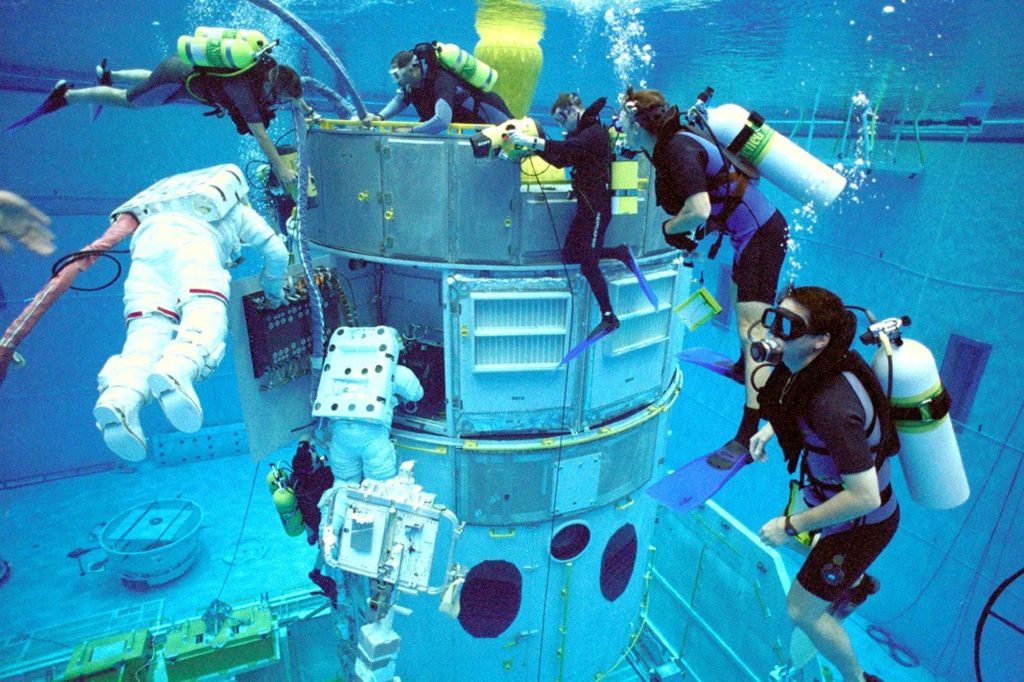
How do earthbound astronauts learn to move in zero gravity?
The answer lies underwater.
And soon, at the bottom of an Olympic-sized pool inside the Altru Sports Complex, UND researchers will have their own place to explore it.
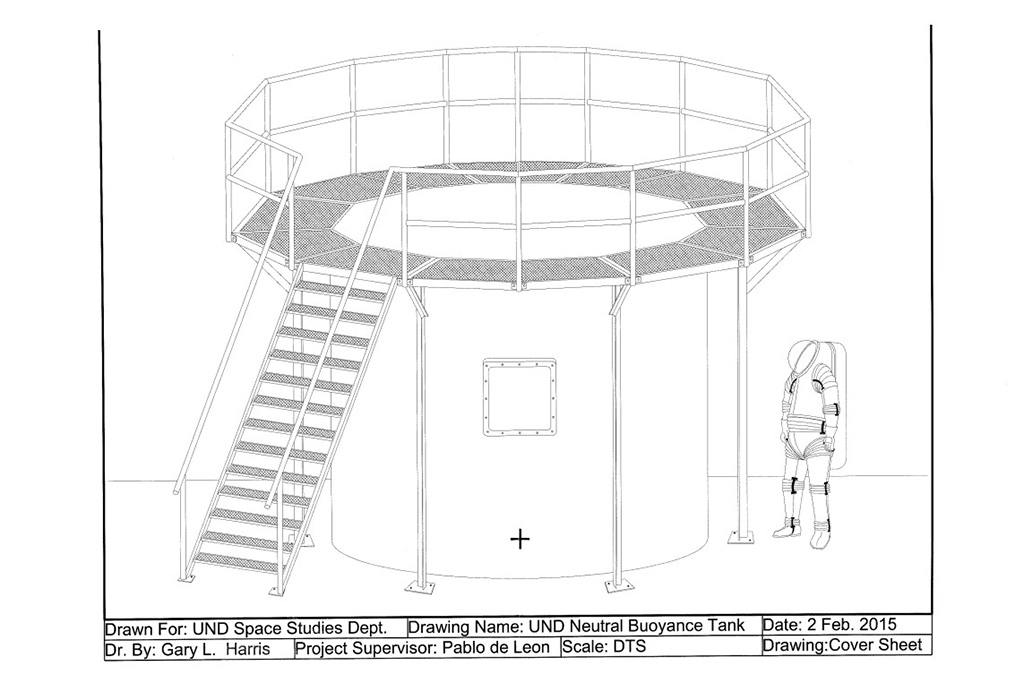
A 13-foot-deep, 18-by-34-foot well — formally known as a neutral buoyancy facility — is currently under construction beneath the floor at the deep end of the Sports Complex’s pool. When complete, the chamber will allow researchers, students and astronauts-in-training to simulate the weightlessness of space. It will also be used for equipment testing, unmanned vehicle deployment and motion analysis — all thanks to UND’s Department of Space Studies.
For Pablo de Leon, professor and chair of the department, the project marks the culmination of decades of dedication to enhancing UND’s space research capabilities.
“In 1990, I started doing underwater extravehicular training with space suits in Huntsville, Ala.,” de Leon said. “I came to UND in 2004, and since then, I have been an advocate of having our own underwater training facility.
“So, this feels like a dream come true after these many years. The planets had to align for this to happen, and this includes all the organizations that were involved in this project.”
De Leon hopes that the underwater facility will open doors for not only UND, but also national and international researchers looking to experience an environment similar to space without leaving the planet. The facility was carefully designed with experts at UND to be safe, effective and multi-faceted.
From zero to one-fifth to one-third G
Keith Crisman, assistant professor of Space Studies, avid diver and certified rescue diver, was also a designer of the facility. A specialist in human-centered design for space systems, Crisman has long seen the potential for using water as a testbed for life in orbit.
“The correlations between being in a space suit and being underwater are so close to each other,” he said.
Like de Leon, Crisman has been dreaming of neutral buoyancy facilities since he arrived at UND. In fact, one of the first things he did after settling in at the University was draw up a rough concept for a neutral buoyancy facility on his office whiteboard.
Now, years later, he’s helping the University design its own neutral buoyancy facility. What makes the facility particularly powerful, Crisman said, is its flexibility. By adjusting how much weight is added to a diver’s suit on the shoulders, hips, or ankles, researchers can simulate not only zero gravity, but the gravity of other celestial bodies.
“By changing the amount of weight that we put on the person, we can go from a neutral buoyancy situation — zero G — to one-fifth G for lunar operations and one-third G for Martian operations,” he said.
The chamber will be covered by panels when not in use; the panels, in turn, will be able to be lifted off using inflatable airbags. The team chose this approach because of its simplicity, as opposed to hinges or other mechanical options, Crisman said.
“We kept asking, how can we make this safe, but operable by just a couple of divers?” he said. “The answer was to keep it simple.”
The depth of the neutral buoyancy facility was also considered before construction. The 20-foot depth will prevent divers from getting the bends — a sickness that can happen when divers surface too quickly from too deep in water, Crisman said. The depth will also let divers stay underwater for longer.
“We wanted less than 30 feet for the risk. Because, again, after 30 feet, we start to worry about nitrogen build up in the body’s tissues,” Crisman said. “We wanted hours of time underwater, not just 20 minutes or 30 minutes.”
Other measures to ensure safety include requiring safety divers in the water and an overhead hoist to lift divers out in an emergency.
The neutral buoyancy lab will also enable new kinds of research. Crisman is working with UND’s BiPed Lab to explore motion tracking in submerged environments — a capacity that will likely give more accurate data than virtual simulated models.
“We’re looking at ways to use motion capture in an underwater environment, which is something that I don’t think anybody has done,” Crisman said. “Instead of using cameras, we’re working with sensors that track movement directly. It’ll help us see how the body moves when neutrally buoyant, and how that compares to Martian or lunar gravity, versus just running virtual models.”
A not-so-sunken treasure in North Dakota
While the neutral buoyancy facility will provide vital training opportunities for UND students and faculty, it’s also expected to draw researchers from across the country — and beyond.
“We will not only do equipment testing — sometimes for NASA, sometimes for private companies or for other universities — but also extravehicular activities training will be an important capability we will be acquiring,” de Leon said. “We will be able to provide courses on how to perform operations in open space, and this will be a strategic asset for the university.”
De Leon said that, while UND has been developing spacesuits for awhile, one critical piece of the puzzle has been missing — until now.
“At UND we build the spacesuits, we work with NASA on a variety of projects related to advanced spacesuits,” he said. “But, the thing that we’ve never had was the ability to test the suits in this neutral buoyancy environment.”
The new facility will change that and promises to put Grand Forks and UND on the celestial map for space-related research.
“There is only one other university in the United States with this type of neutral buoyancy facility, and they do not provide extravehicular training,” de Leon said. “I am certain that people will come from all over the U.S., as well as from other countries, to use the capabilities we will have in Grand Forks.”
####
>> Questions or comments about the UND LEADS Strategic Plan? Your thoughts are welcome! Please contact Ryan Zerr, associate vice president for Strategy & Implementation, or Anna Marie Kinney, coordinator of the University Writing Program, the co-chairs of the UND LEADS Implementation Committee. You also may offer your thoughts by visiting the UND LEADS Strategic Plan home page and clicking on the “Provide your feedback” link.
Thank you for your support of the UND LEADS Strategic Plan!