The Fulbright Pangaea
Three Fulbright scholars share their experiences in the program — and how academics can benefit from crossing borders
Editor’s note: Pangaea was once a supercontinent that united nearly all of Earth’s landmass. Though Pangaea split apart some 175 million years ago, scholars today continue to find new ways to connect across the oceans that separate them.
One of those ways is the Fulbright Program — an international academic and cultural exchange that pairs scholars with host institutions, giving those scholars the chance to live and learn in another country.
In this story, UND Today highlights the journeys of three UND Fulbright scholars, each of whom describes their experiences in the Fulbright program, why it’s valuable and why other scholars at UND should consider applying, too.
* * *
When O’Dane McKoy first saw a U.S. Embassy advertisement for the Fulbright Program posted in a WhatsApp group, he didn’t think much of it. He passed it along to a few friends and went about his day.
At the time, McKoy was working as a geologist in Jamaica’s public sector, having earned a bachelor’s degree in geology and a master’s in natural resource management. Life was moving forward, and “I thought it was a long shot,” McKoy said.
“I had a job, I had responsibilities, I was about to get married and I knew Fulbright was competitive and difficult to get into.”
What changed everything was a conversation with his then-fiancee, Keilah.
“She asked me, ‘Why not you?’” McKoy recalled. “We were about to get married, but she said, ‘Wherever you go, I’ll go.’ That meant everything to me.”
That simple question set McKoy on a path over 2,000 miles north, to North Dakota — and to a transformative academic and cultural experience that he hadn’t anticipated.
“The Fulbright Program is an international academic exchange program founded in 1946 with an ambitious goal — to increase mutual understanding and support friendly and peaceful relations between the people of the United States and the people of other countries,” the program’s website states.
“Today, the U.S. government oversees an extensive suite of fellowships and scholarships in partnership with more than 160 countries worldwide.”
In McKoy’s case, his innate curiosity about the way the world works — plus his wife’s encouragement — sparked his Fulbright journey, which became a bridge between his government work and a new chapter in academia.
The process wasn’t easy. It involved months of preparation: standardized tests, interviews, transcript requests and interviews with university representatives. But eventually, the path led him to UND.
The Fulbright Pangaea
Studying in North Dakota wasn’t part of McKoy’s original plan. That changed only when a Fulbright interview connected him with Taufique Mahmood, associate professor of Geology and Geological Engineering at UND, whom McKoy clicked with immediately.
“The other schools were pushing me in different directions,” McKoy said. “But Mahmood said, ‘Let’s see what works for you.’ That openness made the difference.”
McKoy arrived in Grand Forks last year and, shortly after, experienced his first North Dakota winter.
“I’d never seen snow before. The lack of sun was an adjustment and at times, it was rough — but I got through it,” he said. “It’s sort of a different experience, but now I can come back and say ‘I survived the North Dakota winter. I can do anything.’”
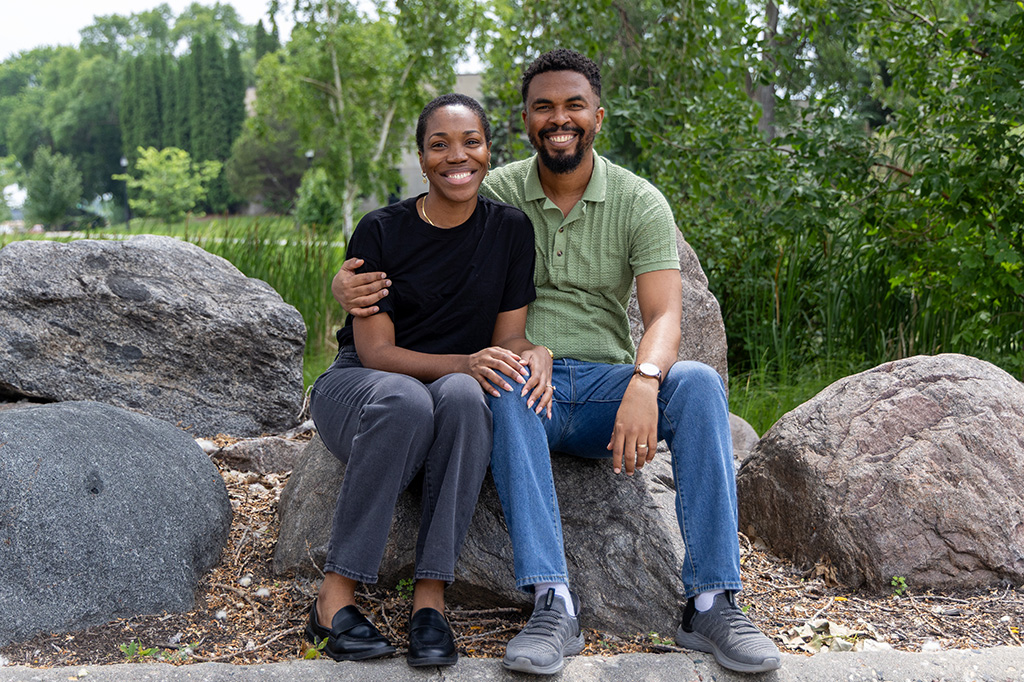
By spring, his wife, Keilah, had joined him in Grand Forks. Now together, they’ve found it easy to acclimate to the rhythm of life in North Dakota.
“My wife and I are quiet people. We like nature, tranquility and peace,” McKoy said. “North Dakota kind of fits us.”
Now in his second year of doctoral study, McKoy spends most of his days in Leonard Hall, conducting research on the effects of wildfires on a small basin in California. His work involves advanced hydrological modeling and environmental data, but what he values just as much is the sense of community he’s found through the Fulbright experience.
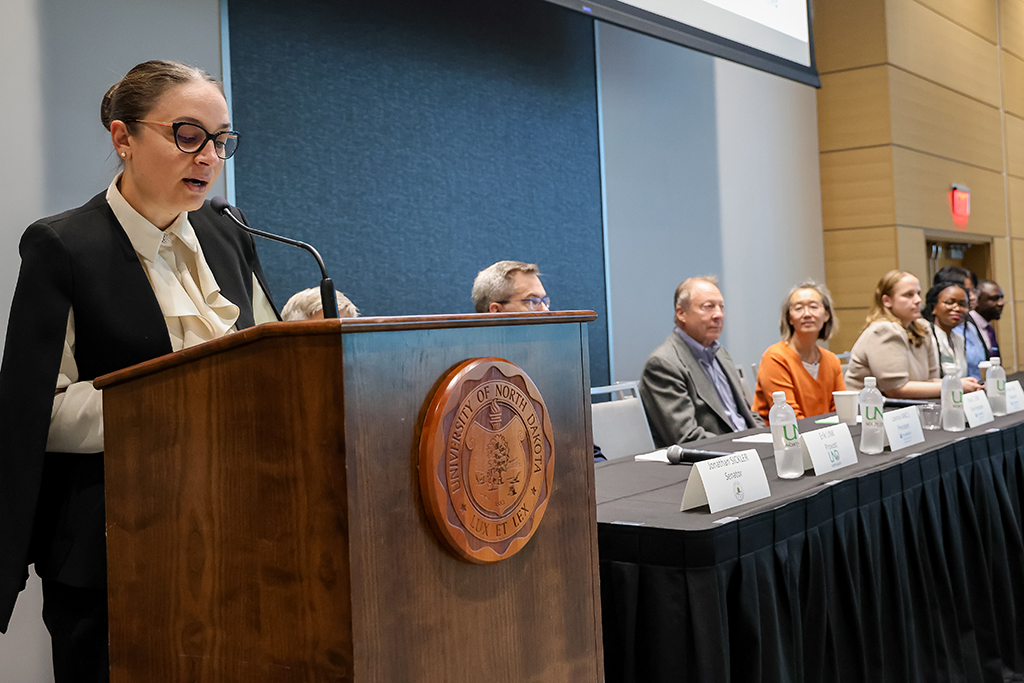
“Fulbright is not 100 percent research,” said Lavinia Iancu, director of UND’s Forensic Science Program and president of the North Dakota Chapter of the Fulbright Association. “It’s also about the cultural exchange, the life experience.”
Iancu, who traveled from her native Romania to Sam Houston State University as a visiting scholar before becoming director of UND’s flourishing Forensic Science program, believes that Fulbright’s cultural exchange component fosters more adaptable and open academics.
In line with McKoy’s geological focus, one may think of Fulbright as a Pangaea — as mentioned above, the large supercontinent that connected most of the world before it split apart, forming the continents that exist today. In the same way, Fulbright removes boundaries for scholars, if only for a limited time.
McKoy has experienced this in many ways. While science remains his central focus, the cultural experiences and personal connections have been highlights of his first year living in the United States.
“You tell people you’re a Fulbright scholar, and they perk up. They want you to share,” he said. “But it’s more than that. It’s about humanity and the connection between people.”
McKoy credited faculty and staff such as Sven Egenhoff, Art Malloy, Emanuel Grant, Manuela Gabriel, Amy Vein, Darin Buri and Nick Macleod for making his transition to UND a pleasant one. And throughout his time in North Dakota, he’s encountered cultures he never expected to learn about.
For example, after seeing Native American art in the Memorial Union Gallery, McKoy became interested in learning about Indigenous history.
“What really got me interested was the Native American population,” he said. “I’d never known much about Native Americans. Now, I’ve met students here and they’re telling me about their culture, and that history is something I think is unique about this state. This gave me the chance to meet people I never would have known otherwise.”
Instruments and avalanches
UND faculty also are making the most of Fulbright opportunities. Aaron Kennedy, associate professor of Atmospheric Sciences, recently returned from a nine-month Fulbright stay in Isafjordu, Iceland — a town of just 3,000 near the Arctic Circle.
“We didn’t see the sun for 2½ months,” Kennedy said with a laugh.
While in Iceland, Kennedy studied mountain snowpack and avalanche risk. He also field-tested two custom-built weather instruments originally developed at UND to measure snowflakes and hail. The extreme climate allowed him to refine his tools and gain valuable data.
“This was a good test for them,” he said. “Now I know what I need to do to improve them so they can work wherever I put them — not just in North Dakota.”
Kennedy’s Iceland experience isn’t over. This fall, he’ll return with two UND doctoral students to reinstall upgraded equipment and continue international collaborations.
Further, Isafjordu’s proximity to the University Centre of the Westfjords make the town a place where scholars from around the world congregate. This, Kennedy believes, offered him valuable exposure to alternate approaches.
“Science isn’t limited to just one country,” he said. “This allowed me to build an international network and see how others do things differently.
“I worked at the Icelandic Meteorological Office where researchers from other parts of the world were working. Just seeing the world from outside the lens of the United States is huge. I think that’s very important.”
Iancu said that the state Fulbright chapter is working on ways to lead other students and faculty in North Dakota to similar experiences. The chapter is planning to hold outreach events this year to help students and faculty understand how to apply — and why Fulbright is worth it.
“It’s not just about publishing papers — you return more open-minded and collaborative, and that benefits UND,” she said. “Once you’re here, you’ll find people at UND who will support you through the application process.”
‘What we need now more than ever’
True to Iancu’s words, McKoy has found that the Fulbright experience is transformative not only as an academic, but also as a citizen of the world. He hopes that he can bring his growth back to Jamaica when he finishes his doctoral program.
“Fulbright isn’t just an investment in me — it’s an investment in my country,” he said. “I’ll get to pass on the knowledge and training I gain here to younger folks back in Jamaica, whether it’s in academia or industry.”
Ultimately, this exchange of ideas — both culturally and academically — is the foundation of Fulbright. McKoy said that the experience has enlightened him and that programs like Fulbright are necessary bridges in an increasingly cloistered world.
“Programs like this allow humanity to understand each other,” McKoy said. “And that’s what we need now more than ever.”
And, to anyone at UND considering following the Fulbright path, McKoy offers the same words of encouragement that started his own journey.
“Why not you?” he said. “You don’t have to have it all figured out. You just have to take the first step.”