Growing our own physicians and physician assistants
With ND85, UND hopes to raise the number of North Dakota residents enrolled in the School of Medicine & Health Sciences’ M.D. and P.A. programs
By Brian James Schill
Facing an audience of physicians at a recent North Dakota Medical Association meeting, Dr. Marjorie Jenkins, dean of the UND School of Medicine & Health Sciences and the University’s vice president for Health Affairs, paused to let the figures on the screen behind her sink in.
“We saw more than 1,800 total applicants to our M.D. program last year, just over 100 of whom were North Dakota students,” she explained. “The delta between total and North Dakota applications was more than 1,600.”
Seeing these numbers, she tells her colleagues, the medical college’s admissions team got to work on narrowing that gap.
After the SMHS Admissions Committee screened applications and offered interviews to about 10% of those 1,800-plus applicants — more than 80 of whom were from North Dakota — today’s M.D. Class of 2029 consists of nearly 50 North Dakotans out of a class size of nearly 80, Jenkins said.
Translation: UND’s team reduced the in-state/out-of-state enrollment gap from far more out-of-state applications to a majority of North Dakota matriculants on-site at UND today.
‘North Dakota 85’
As Jenkins’s audience of physicians understood well that night, this gap-narrowing matters profoundly for North Dakota’s health care future.
The state is, after all, in the midst of a physician shortage.
According to the School’s 2025 Report on Health Issues for the State of North Dakota, UND’s namesake is already short more than 200 physicians.
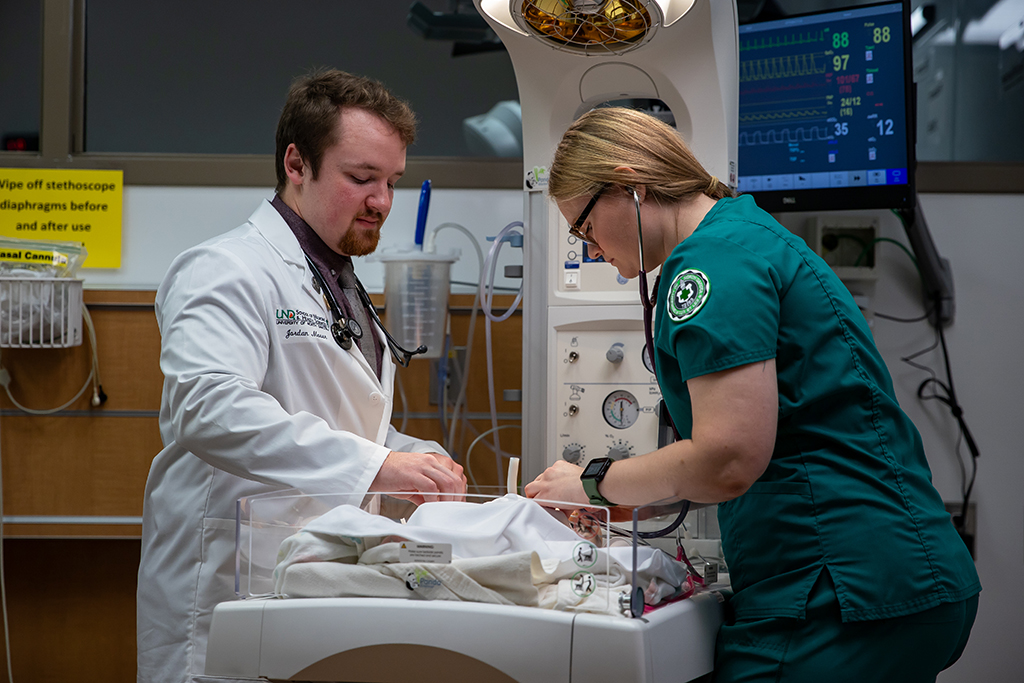
The case is similar — if better — for UND’s physician assistant program, whose first-year class went from only 7% of all applicants last year hailing from North Dakota to more than 70% North Dakotans for the cohort matriculating at UND this fall.
Part of the challenge, Jenkins tells UND Today, is that North Dakota traditionally has lagged behind other states in the number of college students it sends to health care education programs of all types.
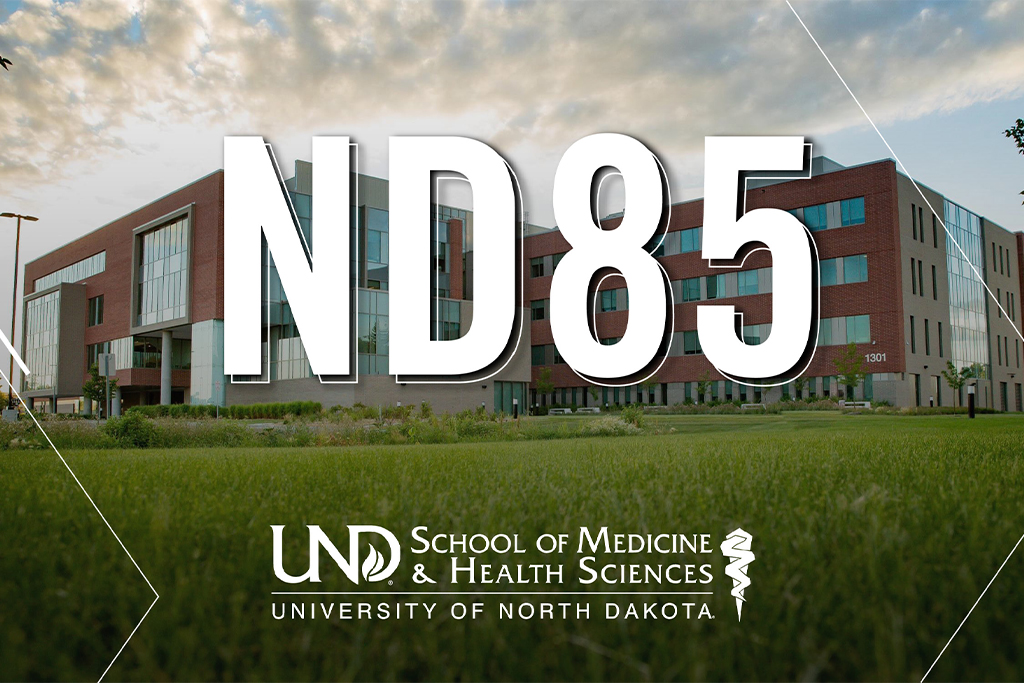
Fortunately, her team has a plan: North Dakota 85 or “ND85.”
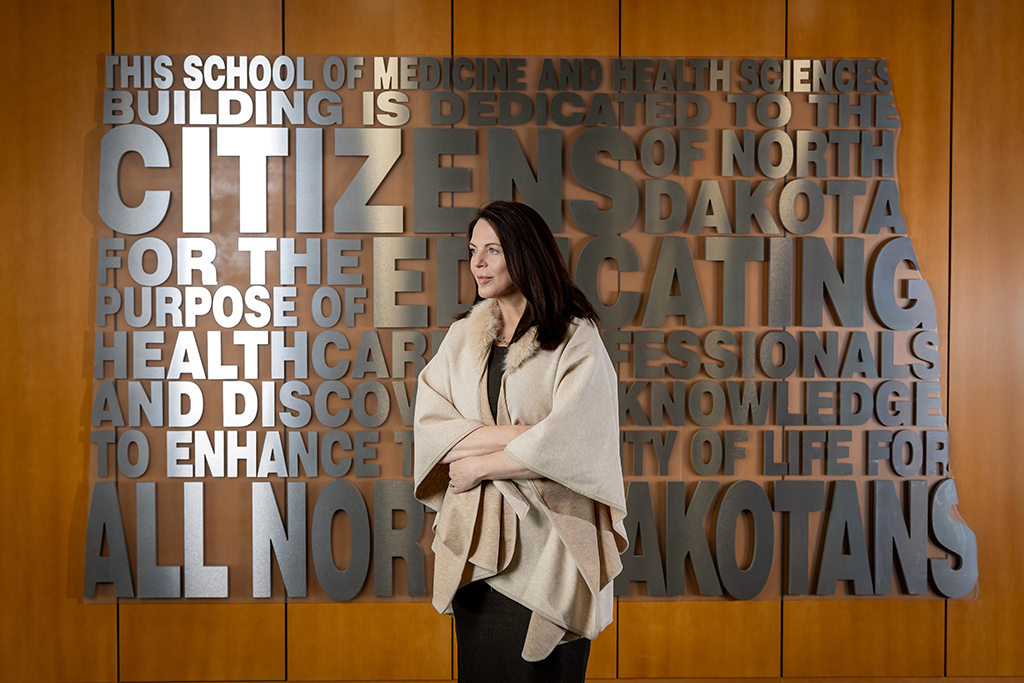
“The question arose during my first couple of visits to Bismarck, when one of our representatives asked me why we don’t have more North Dakotans in our medical school,” Jenkins said, explaining how the North Dakota Legislative Assembly’s most recent higher education funding bill (SB2003) includes a statement encouraging the SMHS to shoot for 85% North Dakota students in its M.D. and P.A. classes.
So Jenkins promised the Legislature that she and her team would get to work on boosting the number of North Dakotans applying to and getting through the School’s M.D. and P.A. programs.
“I said, ‘We are the one of the best-funded public medical schools in the country, and you’re right. We should do better.’”
School ties
Although students with “indirect” ties to North Dakota already constitute a vast majority of this year’s first-year M.D. and P.A. cohorts, the School is looking to ensure that even more North Dakotans with direct ties to the state get to and through UND’s health care education programs.
Why? Because one of the major factors determining where health providers end up practicing is family. In other words, most physicians and physician assistants prefer to practice close to where they’re from and/or where their extended family resides.
“The Legislature graciously gave us five years to get this done,” the dean added of the 2030 date listed in SB2003. “We aim to get there faster than that. It’s a huge benefit to be part of a university with record-breaking enrollment — 15,844 students in fall 2025. UND’s recruitment strategies have already greatly benefited ND85.”
To that end, the UND and SMHS student recruitment teams have built a series of strategies into ND85 that should both better prepare North Dakota middle school, high school and undergraduate college students for professional-level study in medicine and the health sciences and entice them to apply to the state’s only M.D. and P.A. programs.
Such efforts include more in-person visits to N.D. high schools, greater participation in the state’s health care-focused Scrubs Camps and Scrubs Academies, improving partnerships with local health care institutions and undergraduate college advisors, more outreach to pre-med student organizations in the state, supporting UND’s Indians Into Medicine (INMED) program and better outreach to ND HOSA advisors and HOSA events. (HOSA, formerly known as Health Occupations Students of America, is an international career and technical student organization.)
Plus something called PCAT.
“We’re actively planning a Primary Care Accelerated Track that would place graduates into our state’s family and internal medicine residencies more quickly,” Jenkins said. “There’s a lot of enthusiasm in the Legislature around ‘pathwaying’ students into our rural communities.”
As Jenkins outlined, she and her leadership team at the University of South Carolina School of Medicine at Greenville developed a similar fast-track program. And she’s confident it can happen in North Dakota.
“This way, students save a year, they get tuition and fees reimbursed if they enter one of our North Dakota residency programs, and communities in the state get a minimum five-year commitment from these doctors to practice in one of North Dakota’s health care provider shortage areas,” she said.
On the road (again)
Such outreach efforts include not only the dean herself but UND’s Alumni Association & Foundation.
Having already taken one trip to central and western North Dakota with Jenkins, Peter Johnson, director of Government Relations & Public Affairs for the UNDAAF, added that his group is encouraged by ND85.
Since the legislation became law in May, Johnson and Jenkins already have visited with nearly two dozen state lawmakers on the school’s ongoing provider recruitment efforts.
“We had 21, 22 legislators we connected with,” Johnson said of one recent trip he and Jenkins undertook, a trip that brought them to Rugby, Minot, Velva, Bismarck and Jamestown. “She’s making a very positive impression.”
Adding that “there’s always been a very positive feeling around UND’s School of Medicine & Health Sciences,” Johnson noted that legislators have been “very impressed” with Jenkins to date.
Policymakers “all understand the value of providing opportunities for our own students — keeping them here and keeping trained physicians in the state,” Johnson said.
‘Win-win for everybody’
One such legislator is Fargo-based Rep. Steve Swiontek.
A veteran lawmaker, Swiontek says that he’s heard from both physicians and legislators about the need for the entire state to do more to retain health providers of all backgrounds in North Dakota.
“We want to support and fund the Medical School to where it should be,” Swiontek said. “And legislators understand that if more of those individuals who apply to Medical School here are North Dakotans, the odds are higher that they’ll stay in North Dakota [to practice].”
Recognizing that there always will be graduates who leave the state, Swiontek added that he is “seeing that more and more people want to stay in North Dakota. They want to reside here. Or sometimes, when they’ve left North Dakota, they come back.”
The bottom line, said Swiontek, is that ND85 “is going to be a win-win for everybody.”
State Sen. Tim Mathern agreed. Although even if it’s true that the proportion of North Dakota-based M.D. and P.A. students has dropped a bit at UND, this isn’t automatically a “bad” thing, the lawmaker added.
“Another way of looking at it is: we made an investment in the School of Medicine & Health Sciences — the new building — which is positive,” he said. “So people in our neighboring states got more interested in sending students here. This can help increase overall quality.”
The medical school’s upgraded physical space in Grand Forks has helped recruit more applicants from around the region. That has made the admissions process more competitive and boosted the School’s national reputation.
Besides, Mathern pointed out, more than a few of these out-of-state recruits end up practicing in North Dakota after they graduate.
“I, for one, have always felt that getting out-of-state students here is actually positive in that we have the potential to increase the health workforce [in North Dakota],” Mathern said, noting how a large percentage of the 1,700 physicians practicing in North Dakota are not originally from the state.
Grassroots effort
Back in Grand Forks, Jenkins called ND85 “very much a grassroots effort” that spans counties, stakeholders and institutions.
“It will reach down even into middle schools and get our students who are from those areas back to those areas to speak to younger students,” she said of tapping SMHS students as ambassadors to help UND foster connections with local communities. “When I told some of our students about this idea, they said ‘Oh my gosh — I’d love to go back and talk to my community about UND.’”
Because that’s how news travels fastest in North Dakota: word of mouth.
“It’s really going to be very much like most things that happen in North Dakota,” Jenkins smiled. “With everyone coming together to make it happen.”
Don’t miss the full series …
>> UND is on the case. While North Dakota’s workforce shortage is serious, it’s also the kind of problem that UND can and will help solve.
>> The North Dakota magnet of online education. UND’s online programs keep North Dakotans rooted and thriving in-state, while drawing people and positive attention from far and wide.
>> STEM U: New buildings promise to engineer student success. How UND’s STEM Complex and proposed Health Professions Collaborative Facility will grow key components of the state’s workforce.
>> STEM U: How UND educates the workforce of the future. Workforce preparation takes place in labs, classrooms and the Alaskan Arctic, among other locations across UND and beyond.
>> Growing our own physicians and physician assistants. With ND85, UND hopes to raise the number of North Dakota residents enrolled in M.D., P.A. programs at its School of Medicine & Health Sciences.
>> VIDEO: How UND is leading the way in STEM. The deans of UND’s College of Engineering & Mines and College of Arts & Sciences join President Andy Armacost for a conversation about STEM training.
About the author:

Brian James Schill is director of Alumni & Community Relations at the UND School of Medicine & Health Sciences.