STEM U: New buildings promise to engineer student success
How UND’s STEM Complex and proposed Health Professions Collaborative Facility will grow key components of the state’s workforce
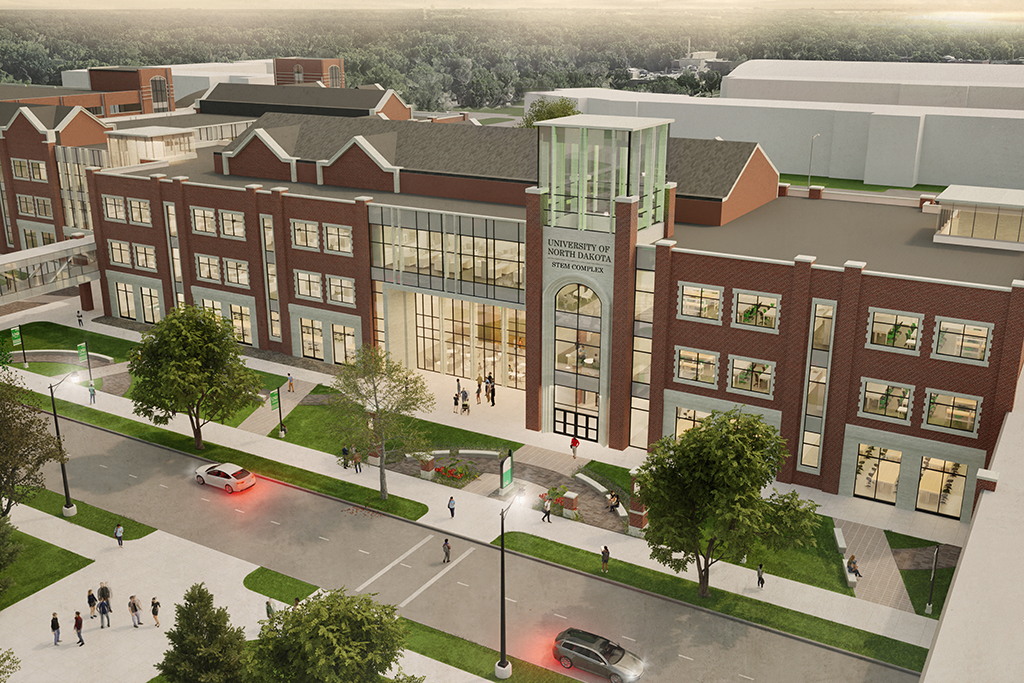
Let’s start with just how striking the new buildings will be.
When UND’s new $163 million STEM Complex is complete, its very location by the Columbia Road overpass will be a recruiting tool, said Ryan Adams, dean of the UND College of Engineering & Mines.
“One of the things this will do for Engineering is that it’ll give us a central and prominent location on campus that is easy to get to,” Adams said. Couple that with the building’s state-of-the-art facilities and massive scale, and the result will be UND’s STEM fields drawing more students than ever — the future scientists and engineers that North Dakota needs, Adams said.
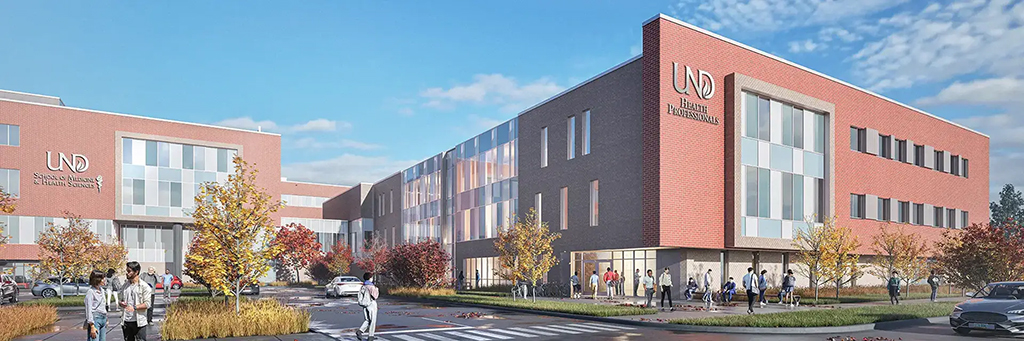
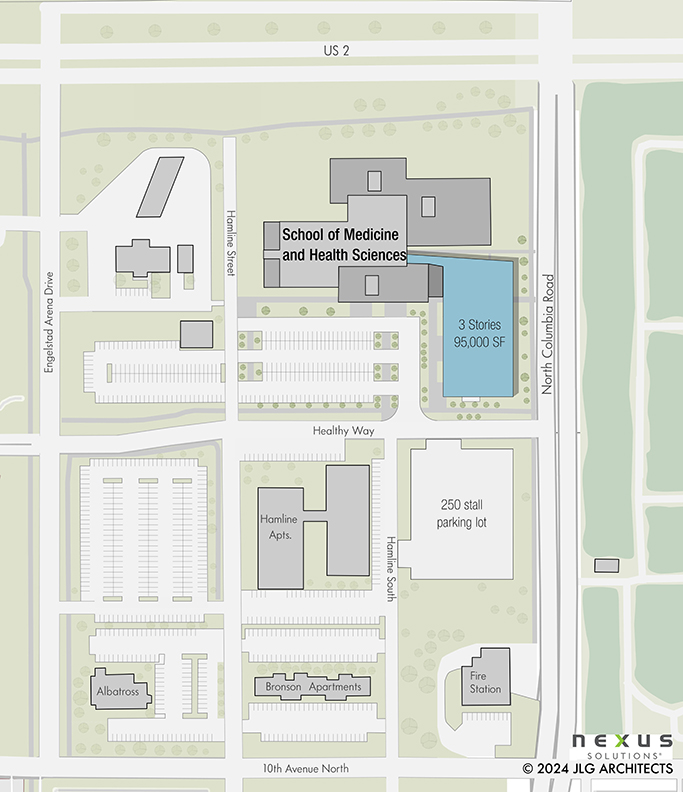
Likewise, the proposed Health Professions Collaborative Facility will be attached to the School of Medicine & Health Sciences, itself already a landmark structure farther north on Columbia Road.
But the addition not only will make the facility even more impressive, it’ll also serve as the new home of the UND College of Nursing & Professional Disciplines. That’s huge, said Dr. Marjorie Jenkins, the School of Medicine & Health Sciences’ dean and UND’s vice president for Health Affairs:
“When the building is complete, we will be one of the few universities in the country that has almost every health profession under one roof,” she said.
“And I think that psychologically, even subconsciously, this will tell our students and faculty alike that we are working together. We’re training together, we’re learning together, we’re doing research together; it’ll be an amazing opportunity that will let everybody learn from each other.”
As the deans’ comments suggest, UND proposed and is planning the above projects with North Dakota’s workforce needs in mind. In this story, we’ll describe those workforce impacts in more detail; Part 1 is about the STEM Complex, while Part 2 will center on the Health Professions Collaborative Facility.
Part 1: The STEM Complex

When UND broke ground this fall on the STEM Complex — STEM for Science, Technology, Engineering and Math — the celebration marked more than just the start of construction. For University leaders, state lawmakers — who very generously provided $110 million of the building’s cost — and industry partners, the new facility represents a step toward solving one of North Dakota’s most pressing challenges: building and keeping a skilled, homegrown workforce in science and engineering.
“This project has been in the works for a long time,” said Brad Rundquist, dean of the College of Arts & Sciences. “The whole philosophy behind the building is student success in science and engineering. Everything about it — the design, the mix of programs, the spaces for teamwork — is meant to recruit and retain students in those fields, because the state needs them.”
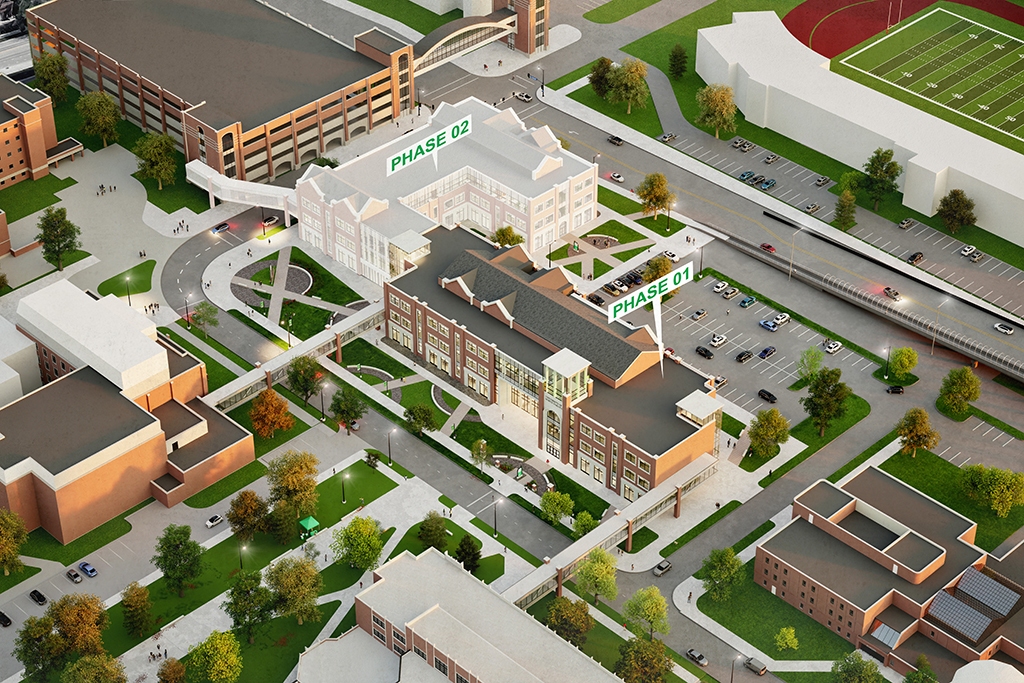
The new complex will rise on the former Hyslop Sports Center site along Columbia Road. Phase One, scheduled for completion in 2027, will house Chemistry teaching labs, Forensic Science facilities and Engineering spaces designed for collaboration. Phase Two, to be completed a few years later, will add classrooms and offices for Physics, Mathematics and other programs.
When completed, the new building will become UND’s largest investment yet in STEM education, and a highly visible centerpiece of campus life.
Collaboration across disciplines
That visibility is key, and not only for prospective students, Adams said. Alumni and industry partners also are excited, given that they’ll be able to park in the ramp across the street and walk right over.

As important, the complex’s design will encourage interdisciplinary learning in ways UND hasn’t seen before. “When I was an undergrad, Engineering students stayed in their own building. I almost never interacted with people outside my discipline,” Adams said.
“This facility changes that. It brings chemistry, physics, math and multiple engineering disciplines together in one place.”
The entryway itself will be a mixing zone. Students are going to bump into each other — literally — and that’s how great ideas start, Adams said.
The collaborative spirit extends beyond campus, Rundquist said, noting that UND faculty have been meeting with industry partners to help shape the building’s design. “People are excited about the possibilities,” Rundquist said. “They see UND’s colleges working together on a single project, and that focus on student success really resonates.”
Stacie Bell, a 1991 graduate and member of the College of Arts & Sciences Advisory Board, noted UND’s reputation for strong scientific programs that have enabled graduates to impact their chosen STEM fields.
“The new STEM Complex will grow opportunities not only for students but for the broader UND community through multidisciplinary collaboration across departments and with various research partners,” said Bell, who currently serves as chief clinical research officer for Lupus Therapeutics.
“Cross-functional training and research in a state-of-the-art facility will ready students for dynamic careers in STEM and also result in advances that keep UND on the cutting edge.”
Hands-on learning, workplace readiness
Inside, the STEM Complex will be filled with spaces designed for hands-on, team-based learning — a shift from traditional classroom instruction. A new maker space will give students access to advanced tools for personal and group projects. Adjacent innovation spaces will host engineering clubs, rocketry teams and cross-disciplinary design groups.
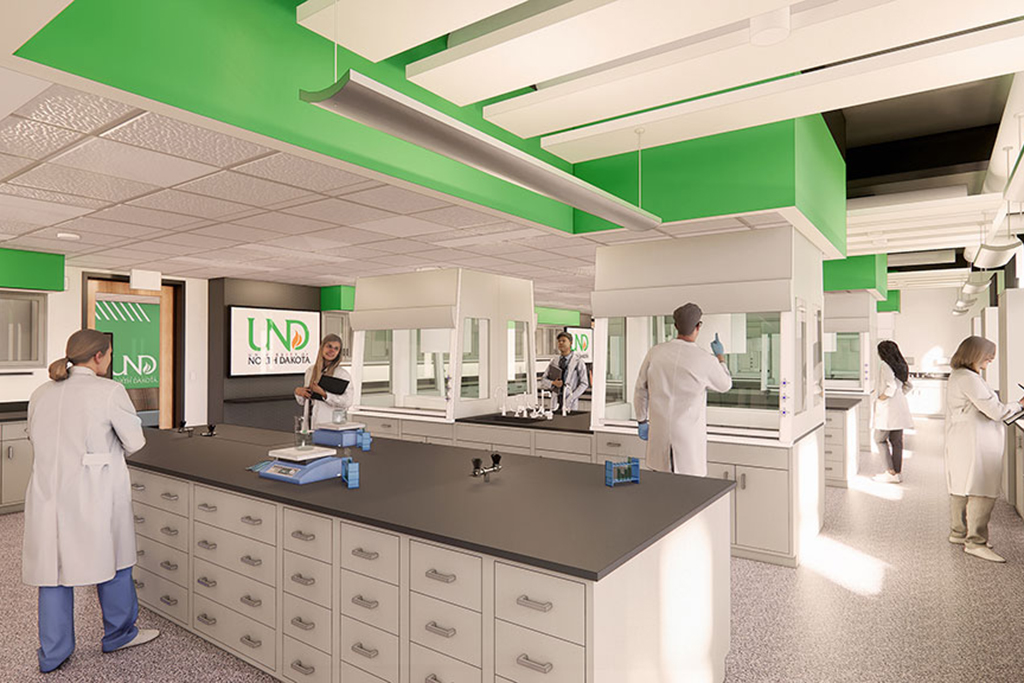
“Even the Chemistry labs are being designed to reflect real-world workplaces,” Rundquist noted. The Forensic Science program, for example, will move from old, repurposed medical labs into modern teaching and research labs. Along with modernization comes safety improvements and room to grow.
“It’s going to be a safer, more comfortable environment for students — and a more inspiring one,” Rundquist said.
For Adams, the point is to prepare students for the kind of interdisciplinary teamwork they’ll find in industry. And the new complex’s adaptability will allow UND to evolve with technology: “We saw how quickly things changed when AI tools like ChatGPT arrived,” Adams said.
“This building is designed to flex with those changes — to stay relevant as new technologies emerge. That’s what will make our students competitive in the workforce.”
A statewide investment in the future
For State Rep. Mark Sanford, R-Grand Forks, who serves on the Legislature’s Interim Higher Education Institutions Committee, the project also represents smart long-term planning by both UND and the state.
“We graduate about 7,500 high school students a year, and even if we kept all of them, it wouldn’t be enough to meet North Dakota’s needs,” he said. “That means we have to attract students from outside the state and keep them here.” And facilities like this — modern, collaborative, exciting — are a big part of how you do that, he added.
Building momentum
The benefits will ripple far beyond Grand Forks. As Sanford pointed out, every North Dakota campus has seen facility improvements in recent years, part of a systemwide effort to strengthen the state’s educational backbone. But the UND STEM Complex, he said, stands out for its scope and timing.
These are key fields — science, technology, engineering and math — that are central to almost every sector of our economy, he said. “When you give students modern places to learn and work together, you’re not just improving education; you’re improving North Dakota’s future.
“And when I think about what the STEM Complex will accomplish, given the way it’ll give students the ability to work together with others from various disciplines, and what that will add to the student learning experience?
“I mean, the sky’s the limit,” Sanford said.
Rundquist agreed. “When I look at the 3D renderings of the labs and imagine students in those spaces — seeing their excitement, working together, learning safely — it’s a great feeling,” he said. “This project is about giving students what they need to succeed and to stay in North Dakota when they graduate. That’s the real payoff.”
Part 2: The Health Professions Collaborative Facility
Picture this: A scenario gets underway in the proposed Health Professions Collaborative Facility, which will include — among other teaching spaces — a simulated hospital. (Not just a simulated hospital room, mind you. A simulated hospital.)
During the scenario, as student doctors, nurses, physical therapists, lab technicians and other practitioners work together to care for the “patient,” the physician in the role-play secretly is told to make a mistake.

What happens then?
Ideally, a nurse, therapist or other team member will interrupt the proceedings to say, “Wait, Doctor, I believe that’s the wrong dosage,” said Dr. Marjorie Jenkins, the School of Medicine & Health Sciences dean.
Because that’s what’s supposed to happen in real life, but often does not — because health professionals too seldom train and re-train on teams, she said.
They’ll get that training and more in the new building, which is being designed with exactly that instructional style in mind.
The proposed facility — a joint effort between UND’s College of Nursing & Professional Disciplines and the School of Medicine & Health Sciences, and a project for which the Legislature generously authorized $5 million for an architectural design — is meant to serve as a state-of-the-art training hub, one where students from all health-related fields learn, practice and problem-solve together.
The goal: a health care workforce that’s not only larger, but also more resilient, better prepared and more productive to meet North Dakota’s evolving needs.
Learning together to work together

Maridee Shogren, dean of the College of Nursing & Professional Disciplines, says the idea of educating students collaboratively isn’t new. But what is new is creating a facility designed for that from the ground up.
“Our students have learned about teamwork for years,” she said. “But having a dedicated space where they can truly work side by side is a game-changer.”
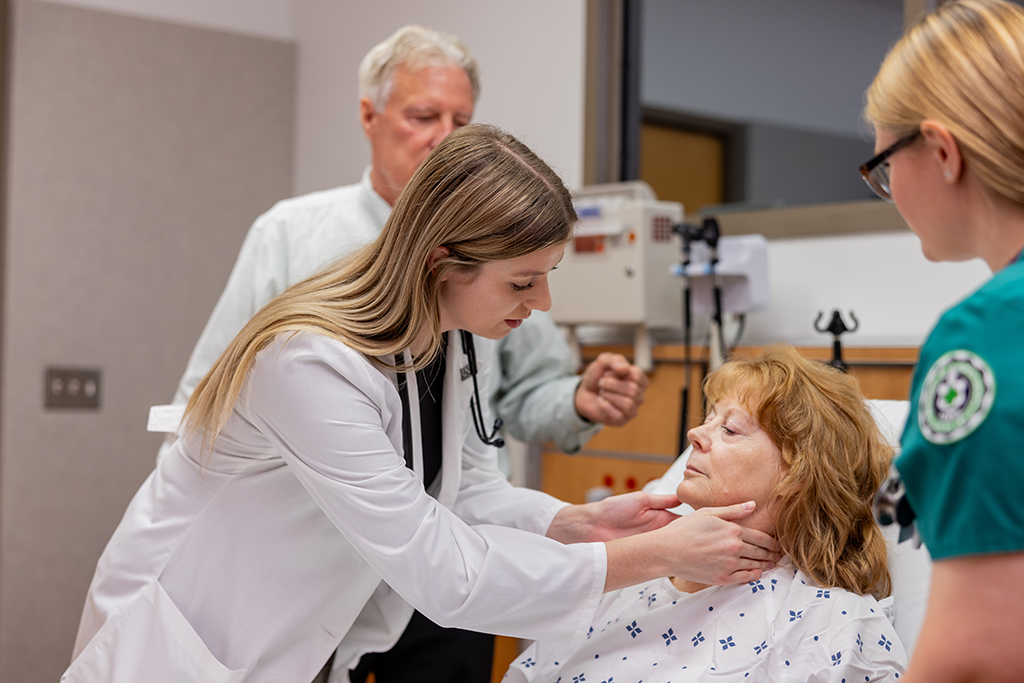
That space will include a fully simulated hospital environment, complete with high-fidelity mannequins, patient rooms and observation areas. Students from nursing, medicine, occupational and physical therapy, medical lab science, nutrition and social work will learn how to function as a coordinated team.
“Simulation lets them make mistakes, analyze what went wrong, and try again — before they’re caring for real patients,” Shogren explained.
Jenkins agreed, calling the building an “incubator for teamwork.” Jenkins envisions UND graduates entering the workforce already experienced in team-based care — a skill set employers increasingly demand.
“Health systems across the state tell us they want ‘workforce-ready’ graduates,” she said. “This building will let us provide exactly that.”
Meeting a critical workforce need
The workforce stakes could hardly be higher. According to Jenkins, one in two physicians and eight in 10 family doctors practicing in North Dakota are graduates of the UND Medical School. Yet despite that legacy, shortages persist across the health professions — especially in rural and underserved regions.
By expanding their physical spaces, both the CNPD and SMHS will be able to increase class sizes in multiple programs. The undergraduate nursing program, for example, recently grew to 72 students per cohort admitted twice yearly, Shogren said. “For us to grow efficiently and creatively, we need more space in a building that supports enrollment, technological growth and innovative pedagogy.”
The SMHS likewise aims to raise its Medical School class size from 78 to 100 over the next five years. That expansion, Jenkins emphasized, will coincide with the integration of new technologies — including artificial intelligence — into teaching and care delivery.
“AI won’t replace clinicians,” she said. “It will augment their ability to care for more patients, especially in rural areas.”
A proven model for better care
The educational approach guiding UND’s plan is backed by extensive research from the Interprofessional Education Collaborative, a national consortium of 22 professional organizations spanning medicine, nursing, pharmacy, public health and more. Shelley McKearney, IPEC’s administrative director, said studies consistently show team-based practices improving several key quality health measures, including length of stay, medical errors, patient satisfaction, patient or caregiver education, and mortality.
“At its core, interprofessional education is about learning with, from and about each other,” McKearney explained. “When students respect and understand each other’s roles, they communicate better — and that directly translates into safer, higher-quality care.”
Increasingly, accrediting agencies are incorporating these collaborative competencies into their standards. “We’re seeing a national and even global shift toward teamwork as a fundamental skill,” McKearney said. “UND’s investment will position North Dakota at the forefront of that movement.”
A statewide impact
The building also will extend its reach far beyond Grand Forks. Jenkins notes that UND already operates mobile simulation units that deliver hands-on training to rural hospitals and clinics. In the new building, practitioners from those facilities will be able to train even more comprehensively, then take their newly refreshed skills back home.
Dr. Joshua Wynne, former dean of the School of Medicine & Health Sciences, underscored that point in testimony before the North Dakota Legislature earlier this year. He called Senate Bill 2286 — which authorized planning for the building — a critical investment in health care capacity for the state.
Wynne reminded lawmakers that UND’s Medical School expansion a decade ago directly reduced physician shortages. This next step will ensure not only more providers but also better prepared ones: “If we can empower each health care worker to be more efficient and thus productive, there should be a meaningful reduction in the need for more and more providers,” he said.
The net result could help resolve, at last, “the residual challenges standing in the way of truly effective, affordable and accessible health care throughout the state.”
Tim Blasl, president of the North Dakota Hospital Association, offered similar support, noting that hospitals are eager for graduates who can hit the ground running in team-based settings.
“Offering collaborative, team-based approaches to health care could be helpful not only in meeting those goals but in attracting and retaining more health care professionals to study and work in our state,” Blasl testified.
Training the teams of tomorrow
Ultimately, both the new STEM Complex and the proposed Health Professions Collaborative Facility represent a new model of hands-on education — one rooted in teamwork, technology and the realities of North Dakota life.
In other words, the buildings represent the University doing its best to serve the state, Rundquist said. “It’s UND recruiting and retaining students so that they can fill workforce needs — in North Dakota and throughout the region,” he said. “We’re working hard to do a better job of that.”
Don’t miss the full series …
>> UND is on the case. While North Dakota’s workforce shortage is serious, it’s also the kind of problem that UND can and will help solve.
>> The North Dakota magnet of online education. UND’s online programs keep North Dakotans rooted and thriving in-state, while drawing people and positive attention from far and wide.
>> STEM U: New buildings promise to engineer student success. How UND’s STEM Complex and proposed Health Professions Collaborative Facility will grow key components of the state’s workforce.
>> STEM U: How UND educates the workforce of the future. Workforce preparation takes place in labs, classrooms and the Alaskan Arctic, among other locations across UND and beyond.
>> Growing our own physicians and physician assistants. With ND85, UND hopes to raise the number of North Dakota residents enrolled in M.D., P.A. programs at its School of Medicine & Health Sciences.
>> VIDEO: How UND is leading the way in STEM. The deans of UND’s College of Engineering & Mines and College of Arts & Sciences join President Andy Armacost for a conversation about STEM training.