A dynamic and multipolar challenge – and career
Ben Davies, Northrop Grumman corporate VP, at UND: There’s never been a more exciting or important time to be working in national defense

Earlier this month, UND welcomed a prominent executive in the aerospace defense industry, a person whose nearly three decades of experience have helped to secure the homeland.
Ben Davies, corporate vice president of Northrop Grumman, and president of the company’s Defense Systems sector, visited campus as part of the University’s series titled “UND LEADS: Broad Perspectives on National Security.” The series is devoted to wide-ranging discussions with national leaders on issues of national security.
Now in its second year, the series features two speakers each academic year – one event taking place on campus and the other in Washington.
Last year, UND hosted four-star U.S. Air Force Gen. Lori Robinson (ret.), former commander of the U.S. Northern Command – the first woman in U.S. history to lead a combatant command.
In his work at Northrop Grumman, Davies oversees the delivery of weapons systems such as intercontinental ballistic missiles (ICBM) critical to the United States’ land-based deterrence capabilities. His portfolio includes Sentinel, the new U.S. ICBM weapons system which, by 2030, is poised to replace the nearly 70-year-old Minuteman III ICBM infrastructure – modernizing a leg of the nation’s nuclear triad.
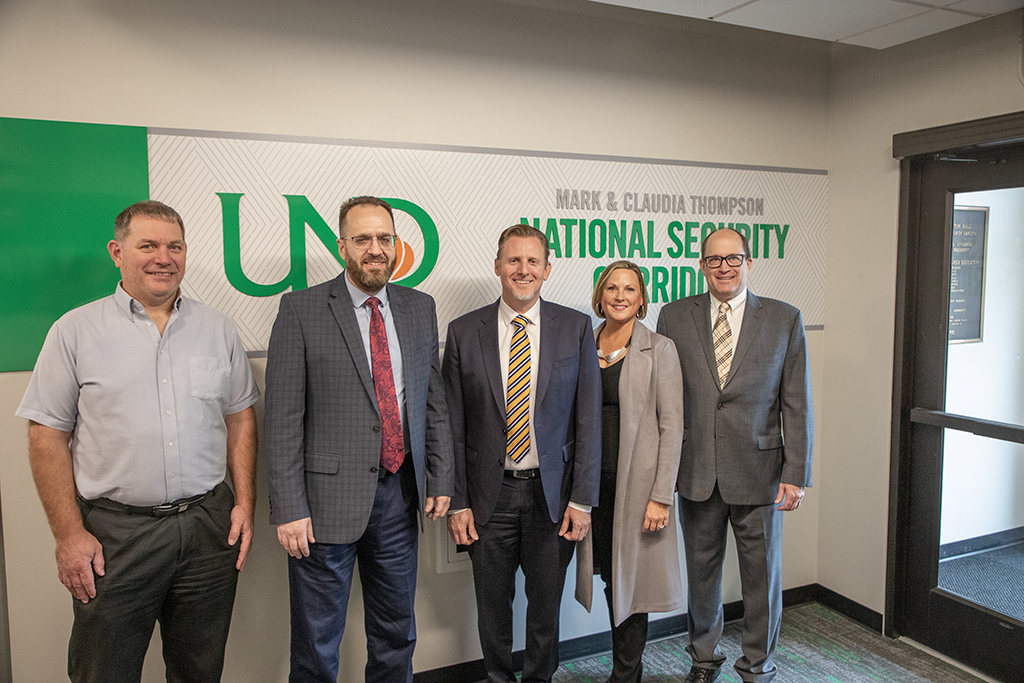
As part of his campus visit, Davies toured UND’s National Security Corridor with faculty members and university leadership. The facility has critical applications to the work Davies and his team of approximately 17,000 employees are doing.
Later in the day, Davies hosted a question-and-answer session with UND students, before appearing at the Memorial Union ballroom with President Andy Armacost for a fireside chat.
From intern to corporate VP
During his conversation with Armacost, Davies’ chronicled his journey across his now 28-year career at the aerospace giant. His work with Northrop Grumman began with an internship in the late 1990s, while earning his bachelor’s degrees in computer science and electrical engineering from the University of California, Berkeley. The tech boom in the San Francisco Bay Area and Silicon Valley was in full swing, as was the output of Northrop Grumman – formed in 1994 following a merger of previously independent firms Grumman Aerospace and Northrop Aircraft.
“That was during the dotcom boom in the Bay Area,” he said. “I saw an advertisement to take an internship at an aerospace and defense company, which ultimately became part of Northrop Grumman.”
Davies said his career has taught him the importance of an interdisciplinary approach to engineering – a practice he considers vital to addressing the myriad challenges of securing the homefront.
“When we think about national and global security, air and space have been and will continue to be the high ground,” he said. “It is contested, however, and evolving rapidly. The ability to take concepts and ideas of missions, develop solutions and test them is very much how we’re going to move forward.”
Despite enjoying “decades of a secure homeland,” Americans should guard against complacency, Davies said. He described the global security environment as dynamic and multipolar – citing Russia and China as the United States’ most prominent adversaries.
“We’re talking about adversaries who have been studying our warfighting techniques, systems and technologies, while developing their own,” he said. “I’d describe it as an acute threat from Russia and a pacing threat from China, but both are rapidly investing in upgrading their own deterrence capabilities.”
All the more reason, Davies stressed, for the United States to be diligent about maintaining its own military capabilities.
“Nobody actually wants conflict, because at the end of the day, nobody wins,” he said. “You’re dealing with two or more competent adversaries. Deterrence is about denying your adversary the opportunity or belief that they can quickly reach a decisive outcome.”
“It’s the backstop for everything we do,” Davies added. “Our ability to use diplomatic means to an end really rests on the backstop of those capabilities. I think a testament to the effectiveness of those systems is that we haven’t had to use them.”
A model for academic institutions
Davies cited space as another domain in which the U.S. previously enjoyed historic dominance but has recently shifted to a contested arena of state and non-state actors.
“Over time, because of the tremendous reach and benefits of space, we’ve moved many missions there,” he said. “Sensing, communications – the foundations for our global navigation capabilities. We have an interest in ensuring that we have resilient access to the capabilities that are in space, and that as threats emerge we can both project power and defend ourselves.”
Davies said UND serves as a model for academic institutions in developing the workforce that Northrop and other defense contractors need for the future. Additionally, the many partnerships in the region among academia, defense, industry, and government are vital assets.
“I’m extremely impressed with the awareness and alignment of national security as a career field for STEM students,” Davies said. “I think we are seeing a great example today of how it’s not just theoretical education but also applied education in critical technology areas. This work requires interdisciplinary, cross-functional teams.”
“UND really gets that and integrates it into the educational experience, which will prepare students to be effective,” he added.
And careers in the industry, he added, are in high demand.
“We see a growing shortage of technical talent, at a time when we probably need it most,” Davies said. “There is tremendous demand for the work we do. We have to think about bringing work to where people are and finding places where we can have organic relationships with institutions like UND, and partnerships with entities like Grand Sky.”