The making of a Special Education teacher
UND’s internships are vital in helping college students learn to lead K-12 classrooms, says Max Harris, graduate student in Special Education
By Madison Dame
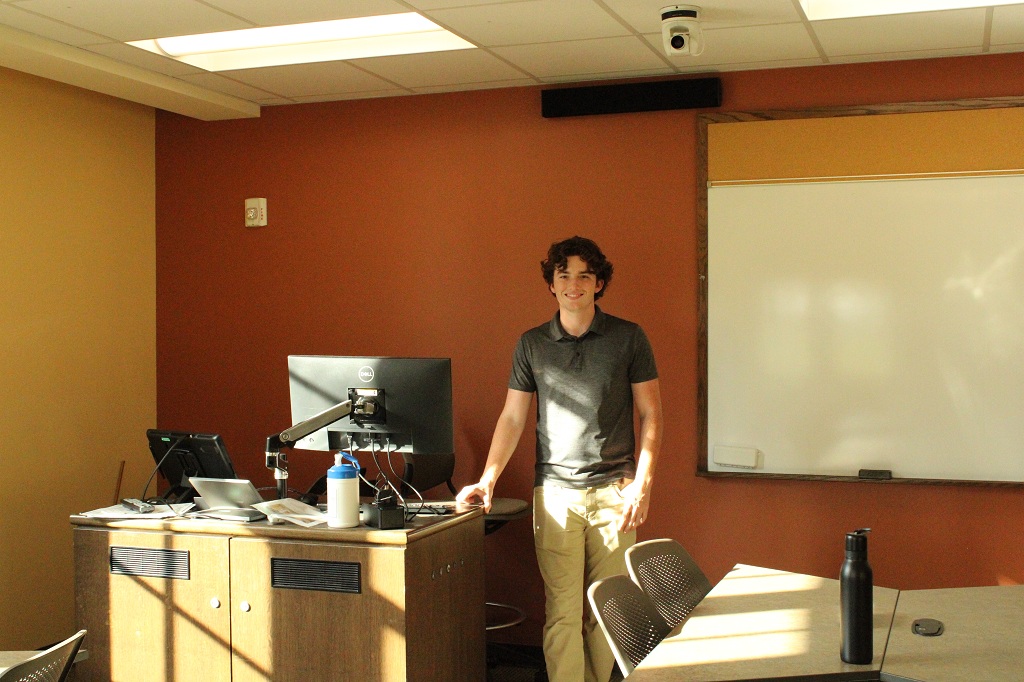
Educational gaps can and should be filled, says Max Harris, a UND School of Graduate Studies student.
And UND can help. “It’s changed my perspective on education,” said Harris, who’s in his first year of pursuing a graduate degree in Special Education. “There is, in my view, a gap between Special Education and General Education. And I feel like the more collaboration and community-building there is, the more beneficial.”
Despite being new to the program, Harris is already in the classroom, learning in real time not only how to handle the challenges that arise in Special Education, but also how to embrace the opportunities for learning. In this way, he’s experiencing how his UND graduate preparation can inform his hands-on experiences as a teacher, and it’s helping to build his confidence about succeeding in the field.
Harris is enrolled in the Special Education Resident Teacher Program, a program offered by the UND College of Education and Human Development. This program lets Special Education Master’s Degree students work full time in a classroom setting and obtain valuable professional experience while earning their degree.
In the summer, resident teachers take Special Education core coursework to learn foundational skills that will prepare them for working in the school right away in the fall.
“It’s a layered mentorship,” said Teaching, Learning & Professional Practice Instructor and Special Education University Mentor Bridgette Campoverde. “So there’s a University mentor who also serves as the advisor, and then there’s also a school mentor, and they’re boots on the ground.”
That layered mentorship “helps the student feel confident in their ability to become a Special Education teacher when they become independent that next year,” Campoverde added.
Carol Johnson, Special Education admission director, compared the mentorship to an apprenticeship model. Within the resident teacher program, students generally take a semester of coursework prior to working in the schools with the support of a mentor, she said.
The students have mentors within the school who help them learn day-to-day, Johnson said, and mentors at the University to help them be successful within the program.
Being in the classroom has taught him how not only academics but also social interactions affect children, Harris said. The two areas cannot be worked on as isolated issues but need to be combined to best support students with disabilities.
And that’s just one of the lessons he’s learned through UND’s asynchronous, online coursework and on-the-job experiences.
“At UND, the classes are very structured and teach you what you should know,” he said. “In contrast, when you get in the actual schools, at times it can feel like it’s not structured at all,” especially for a newcomer such as himself. “You kind of have to be creative and go with how the day is going.”
UND gives students the tools they need to succeed in the classroom, but there are some things students need to experience to understand, Harris said. That’s when internships become crucial.
Mentors advise as well as teach
For example, Harris’ mentor teacher, Sara McNally of the Grand Forks School District, uses a different set of lesson plans than the ones Harris has seen. This has shown Harris how to be flexible and to adapt to students’ needs when planning lessons.
Likewise, when it comes to Individualized Education Programs or IEPs, UND teaches students how to implement IEPs, assess students’ performance, track students’ progress and update the document throughout the year, among many other skills.
Preparing IEPs in a classroom setting under the supervision of the student’s mentor teacher elevates the student’s apprenticeship experience. UND ensures every Resident Teacher has this opportunity prior to graduation.
In those contexts, McNally’s mentorship is invaluable in helping Harris navigate the world of special education in addition to what he learned at UND.
“Being in person, in the classroom, it’s so beneficial to see how an actual teacher does things and works and adapts with their own ideas,” he said. “Learning in this way, I think, has been the most eye-opening.”
Finding ways to help the Special Education students overcome various challenges has helped Harris better understand disabilities and inclusion, he said.
“My knowledge has grown about different strategies that benefit different kids and just having that wider perspective of, ‘Oh, they may have this disability, but there’s ways of getting around it and of seeing everything they do know,’” he said. “Obviously, there are going to be different barriers for each kid, so just getting around each barrier – the classes have helped me find ways to do that.”
Campoverde said the Resident Teacher Program gives the students the opportunity to apply theory to practice. In other words, they can apply what they are learning immediately in their Special Education school placement.
Developing beyond education
There are things Harris believes the schools could do to further help Special Education students.
For example, “a lot of the curriculum and lessons they are doing nowadays in the schools are very fast-paced,” he said. “I want to create more accommodations and incorporate them into a curriculum that is inclusive for everybody, while still at a high level – in other words, adapting the curriculum so that it is inclusive for everybody.”
Doing so will help “bridge the gap” between the academic and social goals of K-12 education, he said.
Plus, the approach will give students the chance to study the same topics and concepts, but at a level each student can manage.
Interest took root and grew at UND
When Harris came to UND, he knew he wanted to teach, and “I really wanted to help people who couldn’t help themselves,” he said.
His initial interest came from a class he took in high school.
“My senior year, I took a class, and it was called ‘unified,’” he said. “It was 50/50 special education students and general education students, and we learned all about the opportunities that general education students are provided that special education students aren’t. That drew me to want to close the gap between them.”
Coming to UND, taking courses and learning about different opportunities from his professors allowed Harris to discover where his passions truly lie. He then decided to pursue a graduate degree in Special Education.
As a student teacher, Harris already has experienced and learned from life in the classroom and its complexities. For example, he recalled one student who had been struggling with aggression, and how Harris did his best to help.
“I set up a system in which the student could earn rewards and tickets to bring home to their parents,” he said. So, on those occasions this year in which the student has an “amazing” day with no behavioral incidents, “I gave them the ticket to bring home, and got to see the huge smile on their face, showing everybody as they ran back to class.”
His favorite memory so far this year is with this student, getting to interact with them and walk through the year together.
Harris has grown personally and professionally through his time in the classroom and the School of Graduate Studies, he said.
For example, he feels his confidence has grown, and his experiences “have also helped shape my perspective on what I want to do in the future.
“It’s given me options and a better view on the different areas of Special Education,” he said. “Everything is much clearer now on what I should be doing, where it was foggy when I was coming into it.”
In the future, Harris hopes to become a Special Education teacher and coach.
“I want to go to a town that doesn’t have Special Olympics or special needs sports,” and then start such programs up, he said. “That way, I can create opportunities for kids who don’t have those opportunities, like the general education students do.”
About the author:
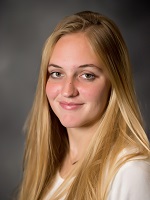
Madison Dame is a Communications and Journalism major at UND. After graduation, she hopes to pursue a career as a journalist.