Brains, birds and babies at UND’s Undergraduate Showcase
At UND, undergraduates research complex and fascinating topics, as the College of Arts & Sciences Undergraduate Showcase shows
Editor’s note: In the UND LEADS Strategic Plan, the Discovery core value calls on the University to “infuse creative expression, critical inquiry, and innovation across the students’ learning journeys by supporting comprehensive curricular and co-curricular participation in research.” This story, which was originally published in UND Today on Dec. 16, reports on a UND event that shows the result of this commitment to student research.
####
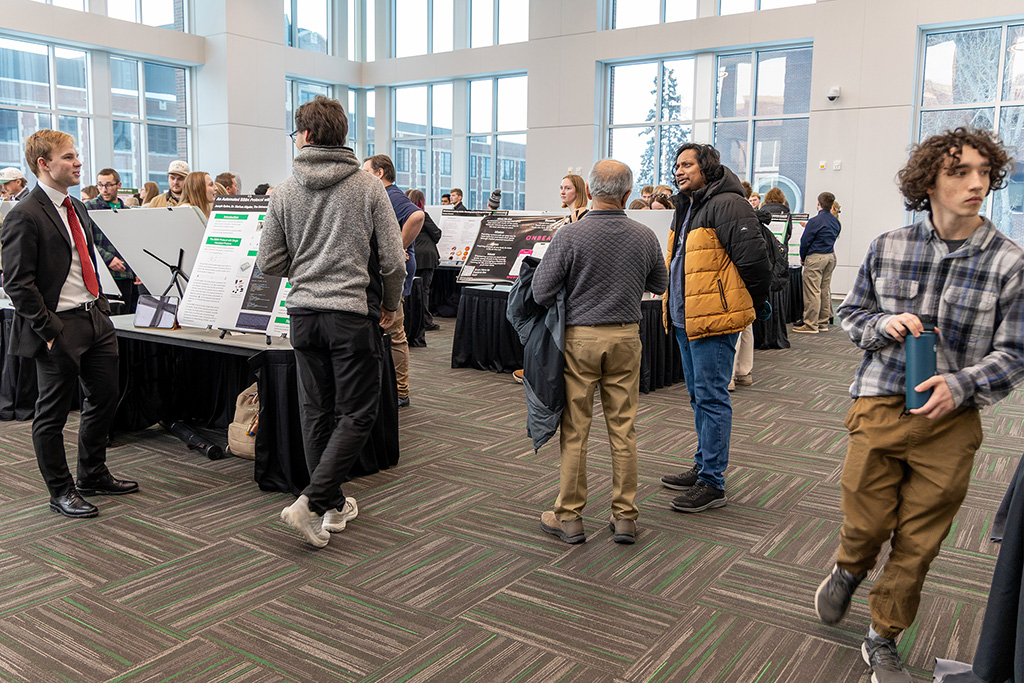
In the Henry Family Ballroom of the Memorial Union, the usual end-of-semester rush took a different shape: students, poster boards, and clusters of curious onlookers, the latter wandering from one presentation to the next. And questions — lots of questions.
“What does this mean?”
“How do you measure that?”
“How on earth are those two things connected?”
That spirit of discovery and discourse fuels the College of Arts & Sciences Undergraduate Showcase, held each semester to spotlight student research. This fall’s event on Dec. 11 featured multiple sessions showcasing research as diverse as the college’s degree programs.
For students, the showcase offers chance to practice communicating complex research to everyday listeners, showing them not just how they conducted their research, but why that research matters.
Here are just three projects that happen to capture the event’s range. They represent research that stretches from the circuitry of attention to the soundscape of prairie leks to the life-and-death chemistry of newborn health.
Your brain on flying
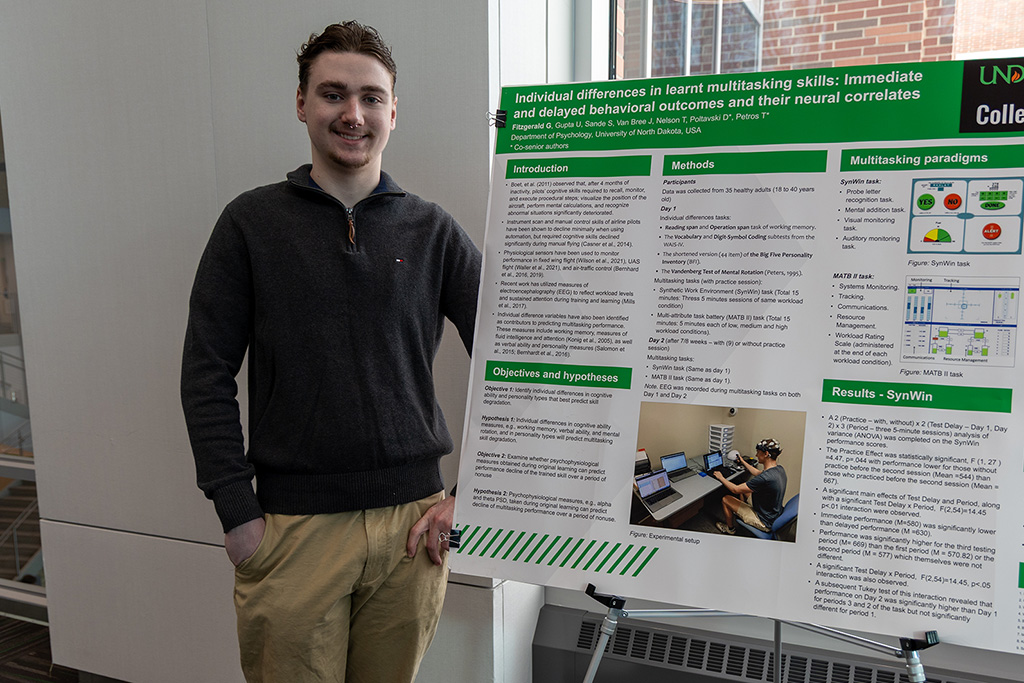
Gavin Fitzgerald, a third-year psychology major, presented research on multitasking skills and their neural correlates. The research asked a simple question: if you train people to juggle multiple tasks, do they get better at it over time?
To test it, Fitzgerald and his research partners used a demanding setup that included memorizing letters, solving quick number problems, managing a shrinking visual gauge, responding to audio cues, and centering a reticle using a joystick.
“We wanted to kind of mimic that experience of actually flying,” Fitzgerald said, pointing to a photo of himself going through the experiment, joystick in hand.
The results showed workload differences at the highest levels but no clear improvement or decline across the study’s timeframe. The next question: what happens over a longer time window?
Just as important, the research changed Fitzgerald’s trajectory.
“Oh my gosh, I want to do neuroscience, and I want to do neuroimaging,” he said, explaining how working with noninvasive neuroimaging reshaped his post-college plans.
Finding birds on the prairie … with a tech twist
Wildlife biology junior Ethan Halstead shared a project rooted in North Dakota’s birds and biodiversity. Halstead joined a group monitoring sharp-tailed grouse and greater prairie chickens in Grand Forks County — and detecting hybrids between the two species.
The hook is that rather than relying on traditional ground observers, they used acoustic recording units (ARUs) left on-site for extended periods. The ARUs can detect slight differences not always perceived by the human ear. For this reason, Halstead said he was even more enthusiastic about the research.
The advantage of ARUs is their continued presence. While observers visited the leks three times, the recording units captured sound for a full month — and found hybrids in spots that ground observers missed. Recordings run through BirdNET software produced sonograms that made hybrid calls stand out as distinctly different from either “pure” species.
What does a hybrid sound like? “They kind of sound like an owl … ‘hoo, hoo, hoo’ type of sound,” Halstead said.
But none of that matters if the ARUs aren’t accurate. According to Halstead, they are surprisingly accurate.
The broader implication, Halstead said, is that pairing human eyes with long-duration audio could make future monitoring more reliable and allow wildlife biologists to keep better track of North Dakota’s many birds.
A little K and a big impact for newborns
Senior biology major Summers Bachman brought the showcase into the world of patient care with research on vitamin K deficiency bleeding (VKDB) in newborns.
Newborns naturally have low vitamin K, and because it helps activate clotting factors, deficiency can lead to dangerous bleeding — sometimes in the brain or intestines. That’s why hospitals routinely administer vitamin K shortly after birth.
Bachman’s presentation tackled a modern challenge: parental refusal of the intramuscular vitamin K shot, often driven by fears about injections. But oral vitamin K requires multiple doses and strict consistency, while the shot is “one and done.”
One number landed with headline force: “Without the injection, babies are actually at an 81 times greater chance of developing vitamin K deficiency bleeding,” she said.
Bachman, who works as a CNA in pediatrics and postpartum and is headed to UND’s physician assistant program after graduating, said the project changed how she understood an issue she regularly sees patients misunderstanding.
“The questions I was getting from parents kind of sparked my interest in this research,” she said, explaining that presenting her research at the showcase can be translated to a hospital setting.
Beyond the showcase
Outside of the three students profiled above, many more enticing presentations were on display, including an entire section devoted to an immersive prison re-entry activity previously covered in UND Today last year.
The common thread, as always, remained that the showcase — and the research leading up to it — gave students a chance to expand their studies, dive deep into topics that piqued their interest, and even change their plans as they reach the end of their undergraduate careers.
####
>> Questions or comments about the UND LEADS Strategic Plan? Your thoughts are welcome! Please contact Ryan Zerr, associate vice president for Strategy & Implementation, or Anna Marie Kinney, coordinator of the University Writing Program, the co-chairs of the UND LEADS Implementation Committee. You also may offer your thoughts by visiting the UND LEADS Strategic Plan home page and clicking on the “Provide your feedback” link.
Thank you for your support of the UND LEADS Strategic Plan!