Light-speed science: UND leads nation with pioneering laser communications hub
State-funded facility positions North Dakota as national leader in next-generation satellite communications, research and workforce training
Editor’s note: In the UND LEADS Strategic Plan, the Discovery core value calls on the University to “foster innovative teaching, applied learning, and transformative research that exemplifies discovery, as shown by experimenting, researching, drafting, writing, prototyping, rehearsing, etc.” This story, which was originally published in UND Today on Dec. 2, reports on a UND project that’s the very definition of transformative research.
####
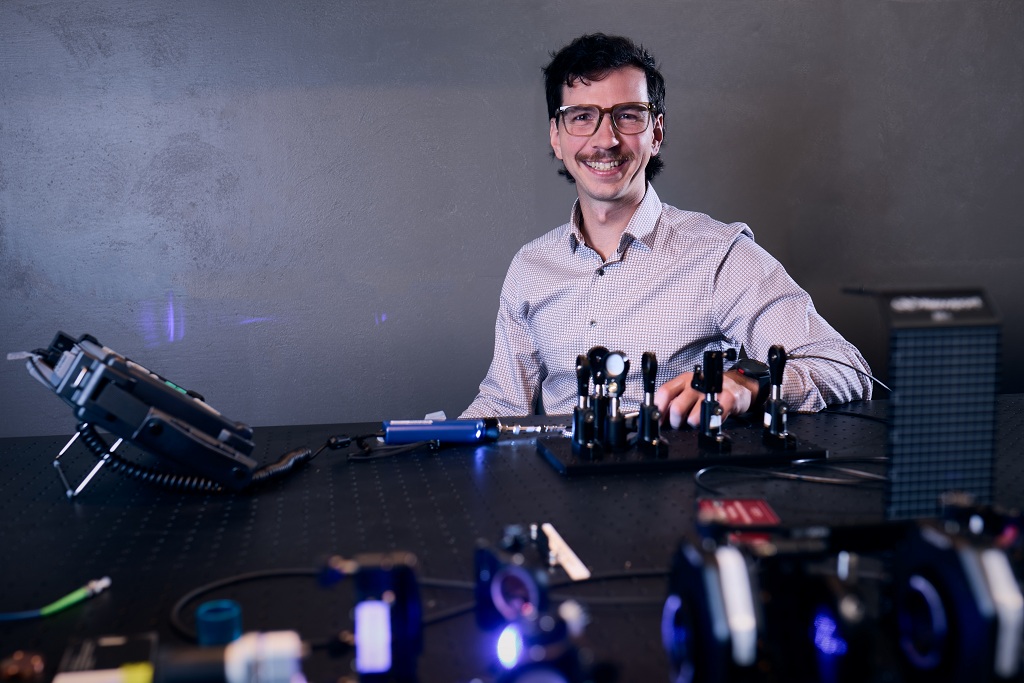
In a quiet basement room of Witmer Hall, between rows of stainless-steel optical tables and humming cryogenic equipment, UND Physics and Astrophysics Assistant Professor Markus Allgaier is helping build something unprecedented.
Supported by the North Dakota Legislature and set to begin operations in 2026, UND’s Free-Space Optical Communication Lab will house the first fully operational, university-operated laser communications ground station in the United States. More than a research venture, the facility is designed as a hands-on training environment for students and a testbed for government and industry partners.
If all goes as planned, UND will reach a landmark distinction. “When this is all operational, it will be the first civilian ground station that can use the new Space Development Agency standard,” Allgaier explained.
Brad Rundquist, dean of the College of Arts & Sciences at UND, agreed. “Thanks to the support of the North Dakota Legislature, the establishment of a laser communications ground station on campus puts UND at the forefront of next-generation space connectivity,” Rundquist said.
“It empowers our students and researchers to lead in the technologies that are the future of high-speed, high-volume, secure and resilient space-to-ground communication.”
Why laser communications matter
Today, nearly all communication between satellites and Earth relies on radio frequency (RF) signals. RF is reliable — but slow.
“Right now, the bandwidth you get with RF is about your internet connection from 20 years ago,” Allgaier said. “It’s a little better than dial-up, but not by much.”
Remote-sensing satellites collect terabytes of imagery and data every day, but they can only transmit “a couple gigabytes” to the ground over limited RF channels. “They can’t downlink all the data,” he said. “A lot has to get processed and thrown out on orbit.”
Laser (optical) communications, by contrast, operate at vastly higher frequencies and narrower beams. This enables data rates comparable to fiber-optic networks, even during the brief 5- to 10-minute window when a satellite passes overhead.
In principle, a laser link could transmit terabytes in minutes, giving scientists richer access to climate, weather, agricultural or national-security data.
NASA is already relying on optical links for its coming Artemis missions to the Moon. Streaming 4K video from lunar orbit — something impossible with RF — is only achievable with lasers, Allgaier noted.
The Space Development Agency has likewise written a national standard for optical communications to be used on its next-generation satellite fleet — a standard the UND station is being built to match. As the SDA is building its ground stations, hardware for the standard is becoming commercially available, making it attractive for other users. And NASA recently announced that it might also adopt the SDA standard.
Inside the facility: A state-of-the-art research array
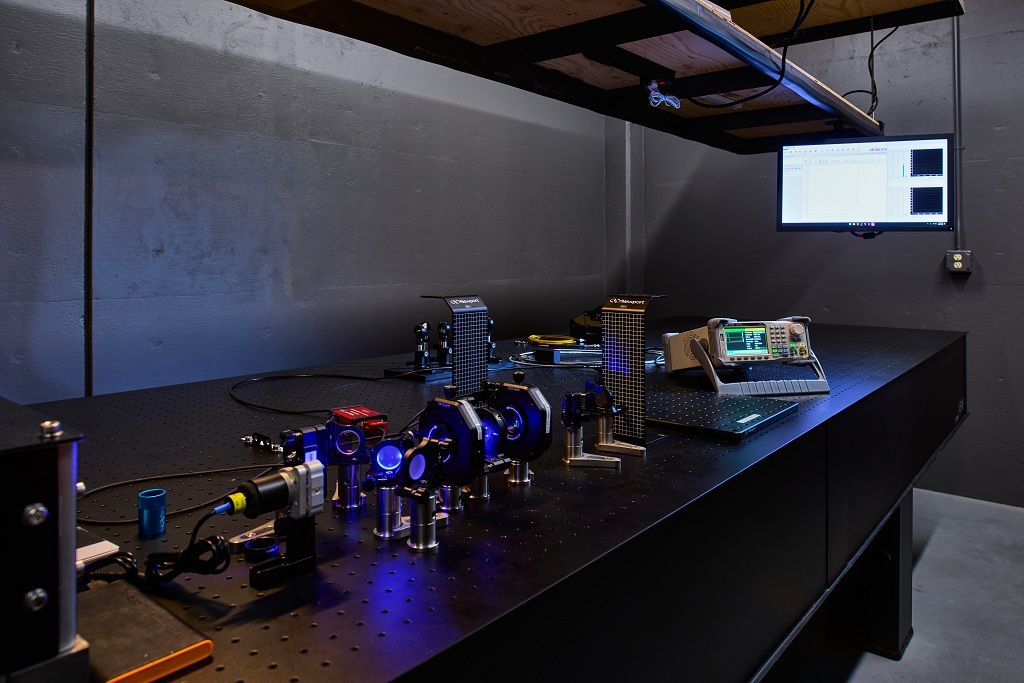
Although the station’s telescopes will sit housed in a weather-protected enclosure on Witmer Hall’s roof, the facility’s heartbeat is in the basement. That’s where laser systems, detectors, timing electronics and student workspaces fill the newly renovated lab.
Custom-built optics and precision hardware
UND’s setup will include:
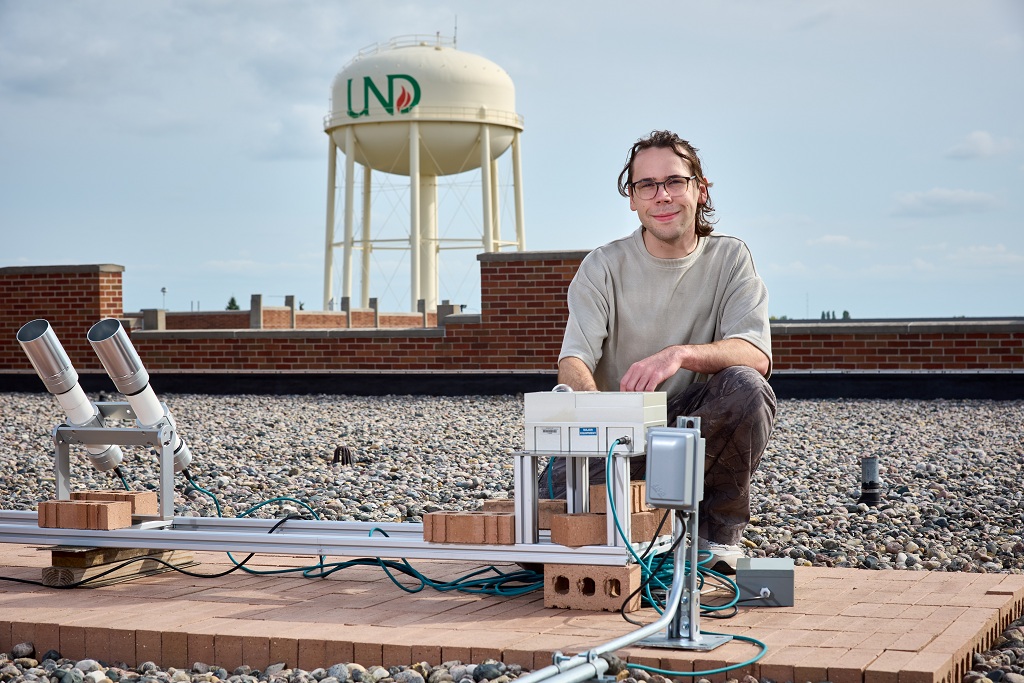
- A 70-centimeter receiver telescope — “about the weight of a small car,” Allgaier said — designed to collect faint laser signals from hundreds of miles above Earth.
- A 10-centimeter transmitter telescope stacked above it, optimized for pointing a tightly collimated beam at fast-moving satellites. (As a Web definition notes, “A collimated beam of light or other electromagnetic radiation has parallel rays, and therefore will spread minimally as it propagates.”)
- Adaptive optics that correct for atmospheric turbulence in real time, measuring distortions in starlight and compensating for building sway or thermal currents.
- Optical fibers that carry laser light from the lab to the rooftop telescopes.
World-class detectors — including a one-of-a-kind system
Underpinning the project is a suite of ultra-sensitive detectors cooled to just 2 degrees above absolute zero (-456 degrees Fahrenheit). “Superconductors need to be very cold,” Allgaier said, explaining how incoming photons break superconductivity in nanoscale wires, creating measurable electrical pulses.
UND also secured a unique 32-detector system developed through NASA’s Jet Propulsion Laboratory — equipment that may currently exist nowhere else in the world outside JPL. The device allows for photons to be measured at higher rates than ever before.
Timing electronics capable of trillionths of a second
Because atmospheric disturbances scramble laser light, optical communication relies not on color or phase — as in fiber networks — but on exquisitely timed pulses.
The lab’s “time taggers,” as Allgaier calls them, act as ultra-precise stopwatches with picosecond (trillionth-of-a-second) accuracy. They allow researchers to measure the arrival of every pulse, even amid atmospheric noise.
A hands-on hub for students, researchers and industry
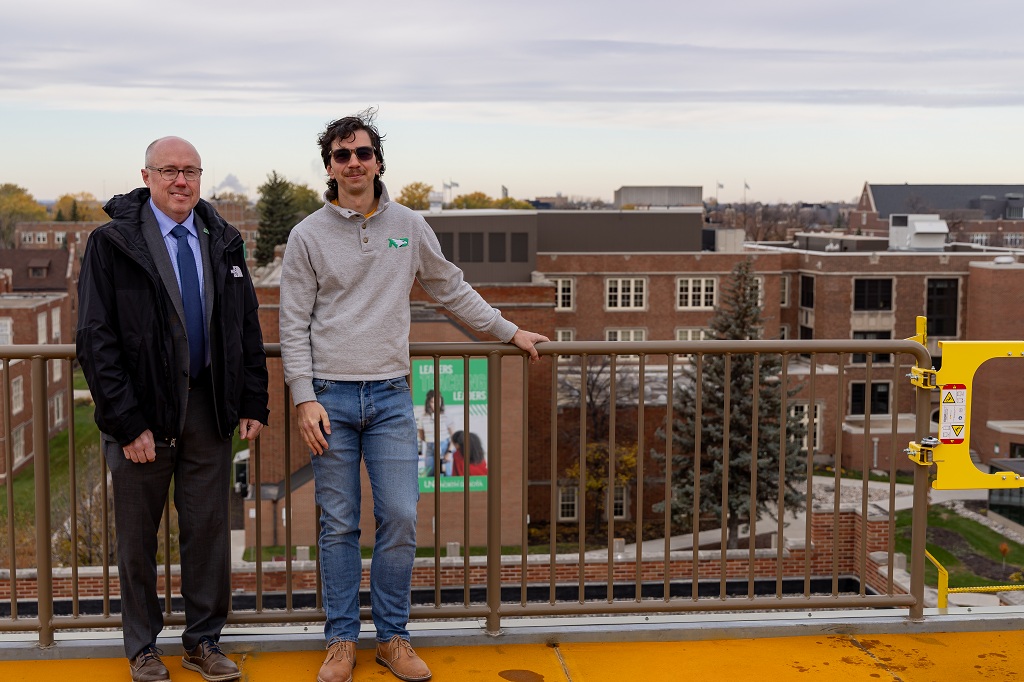
During a recent tour of the Witmer Hall facility, Construction Project Manager Christopher Choate described how an old storage room was transformed into a vibration-isolated, temperature-controlled laser lab that can operate continuously. “Markus provided his vision,” Choate said. “We just tried to accommodate as best we can.”
The result is a facility designed for not only researchers but also students and collaborators:
- Telescope-mountable experiments: Users can attach custom hardware directly to the telescope’s structure.
- Laser table workstations: Heavy optical tables — each weighing over half a ton — let students build delicate systems shielded from vibration.
- Mock satellite links across campus: UND plans to install a retroreflector on Robin Hall or Clifford Hall, enabling ground-to-ground laser link testing over about a mile.
- Full automation: Once operating, the station can track satellites autonomously, letting users communicate from control-room computers in the lab.
“We have a lot of opportunities,” Allgaier said. “Companies or users in the University can bring their own hardware … and mount things directly to the telescope.”
Addressing safety, weather and regulatory challenges
Laser beams and aircraft don’t mix — but UND’s system was designed with safety in mind. In particular, the communication wavelength — 1550 nanometers — is invisible and eye-safe (meaning harmless to air crews) at distance.
Clouds, on the other hand, are immutable. “Clouds interfere,” Allgaier said plainly. To study atmospheric conditions, UND uses sensors that measure cloud ceiling, humidity, wind and optical turbulence by tracking how Polaris or the Sun appear to shimmer. These data help calibrate the adaptive optics system and determine optimal communication windows.
Scientific and strategic impact
Laser communications promise far more than faster downloads.
For example, the system is being built to match the SDA optical standard, giving faculty and students experience with protocols expected to dominate future U.S. defense and commercial satellite fleets. “We can train people who know how to use the hardware,” Allgaier said.
And demand is growing for such experience. Companies in Grand Forks already are hiring satellite operators trained by UND, Allgaier said.
Enabling next-generation GPS and timing
The lab’s ultra-stable lasers, known as frequency combs, can act like atomic clocks. In principle, UND could transmit timing signals to satellites, reducing the need for onboard atomic clocks — the most expensive component of GPS satellites today.
Advancing quantum communication
The same lasers and detectors will support research into quantum key distribution, a technology that promises communication channels theoretically immune to hacking. This dovetails with UND’s broader research strengths in cybersecurity and autonomous systems.
Supporting North Dakota’s high-tech workforce
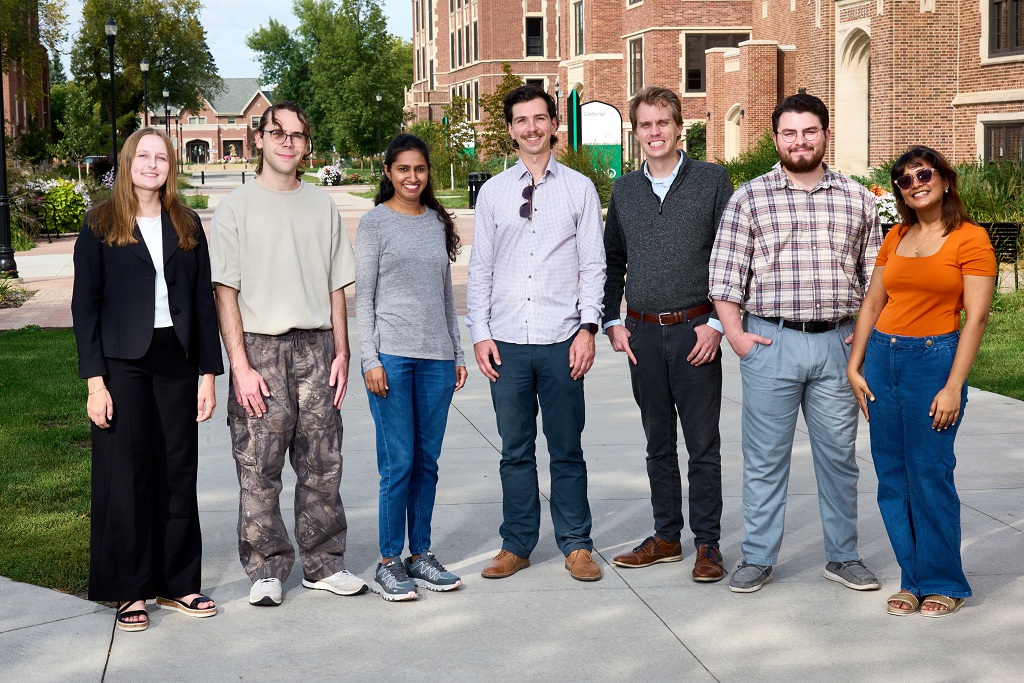
Since 2021, Allgaier’s research has attracted more than $830,000 in NSF funding, much of it tied to optical communications capabilities. As the facility matures, it will help prepare UND graduates for careers in aerospace, defense, telecommunications, optics and photonics.
In early December, cranes lifted the massive telescope components to the roof of Witmer Hall. Soon, adaptive optics hardware, cryogenic detectors, laser systems and miles of fiber will be installed and tested.
By early 2026, UND expects to be conducting operational laser links and welcoming university and industry partners.
When that happens, the basement lab that once stored old computers will have become one of the most advanced optical communications facilities at any university in the world.
As Allgaier joked, reflecting on the power needs, cooling systems and structural modifications required to house the telescopes: “Maybe we should just use the whole building for this work.” But behind the humor is a serious truth: UND is preparing to launch a national exploration of optical communications — and inviting students to help light the way.
####
>> Questions or comments about the UND LEADS Strategic Plan? Your thoughts are welcome! Please contact Ryan Zerr, associate vice president for Strategy & Implementation, or Anna Marie Kinney, coordinator of the University Writing Program, the co-chairs of the UND LEADS Implementation Committee. You also may offer your thoughts by visiting the UND LEADS Strategic Plan home page and clicking on the “Provide your feedback” link.
Thank you for your support of the UND LEADS Strategic Plan!