UND celebrates International Education Week
Students, faculty gather for events highlighting international exchange, importance of fostering peace
Last month, students, faculty and staff at UND celebrated International Education Week – highlighting the benefits of international exchange and scholarship.
The initiative is a joint venture between the U.S. departments of Education and State. According to the program’s website, its purpose is to “promote programs that prepare Americans for a global environment and attract future leaders from abroad to study, learn, and exchange experiences.”
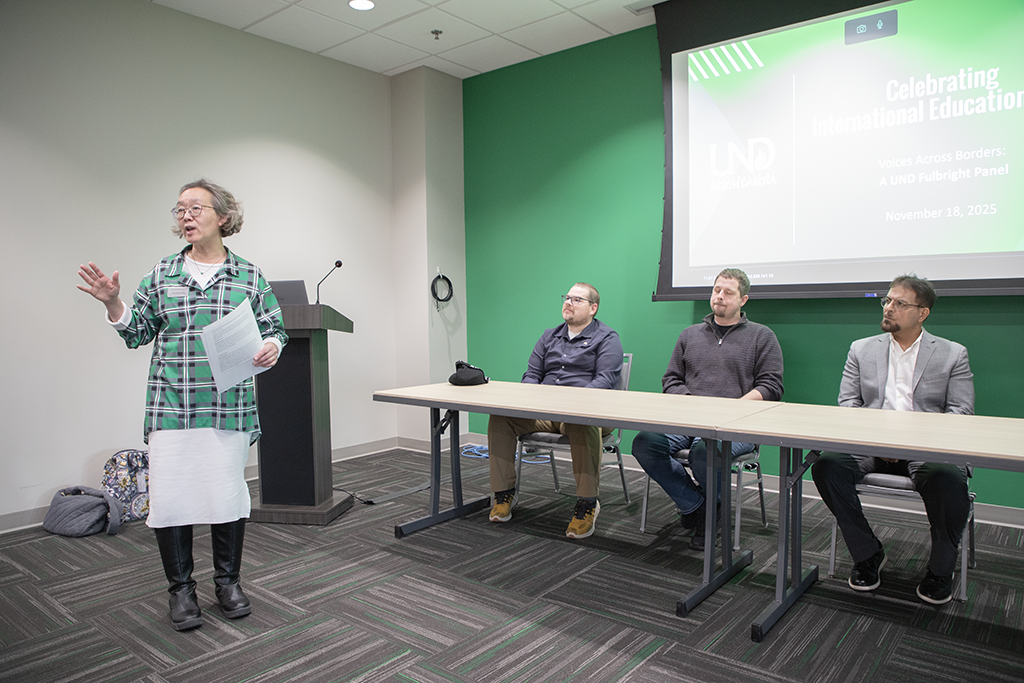
UND kicked off the week by hosting a panel on the Fulbright Program – established in 1946 by former U.S. Sen. J. William Fulbright of Arkansas. The program provides grants and scholarships for successful applicants to study, conduct research or teach in over 160 countries.
Fulbright alumni include Nobel laureates, renowned composers, U.S. Congress members and current and former heads of state. Additionally, Fulbright operates bilateral commissions – facilitating scholarship and cultural exchanges between the U.S. and 49 participating nations.
Yee Han Chu, academic support and fellowship opportunities coordinator at UND, moderated the panel – which featured three faculty members and a visiting scholar – describing their Fulbright experiences. She described the program as an opportunity for personal, professional and academic growth.
“Fulbright is not just an experience of learning about the other, but also learning about yourself,” Chu said.
Aaron Kennedy, associate professor of Atmospheric Sciences, spent nine months conducting research in Iceland with that nation’s Meteorological Office, to better forecast avalanches.
Richard Hoberg, a doctoral student at UND, spent the previous academic year at the Norwegian University of Science and Technology in Trondheim, Norway, conducting research for his dissertation.
Ali Alshami, associate professor of Chemical Engineering, travelled to Doha, Qatar, to teach and conduct research in the field of water purification. Alshami said the experience gave him a chance to reflect on his personal identity.
“I lived in the Middle East when I was child, but going back, I was initially viewed as more of an American,” he said. “It took a bit of work. When I started talking to people and explained that I grew up there, they opened up and connections started to form.”
Qamargul Esova and O’Dane McKoy, visiting Fulbright scholars from Tajikistan and Jamaica, respectively, spoke about their experiences at UND.
McKoy, who is pursuing a PhD in geology at UND, said he has enjoyed learning about North Dakota’s Native American culture – and being exposed to a part of the United States that is little known abroad.
“Where I’m from in Jamaica, you often hear about cities like New York, Los Angeles, Chicago and Miami,” he said. “You never hear about Fargo or Bismarck. Being here has exposed me to that side of American culture that isn’t discussed in media or pop culture.”
Although McKoy described the transition from a tropical Caribbean climate to North Dakota’s harsh winter as “a jolt to the system,” he says he is now well-acclimated.
“I’m sort of looking forward to the snow,” he joked.
The week concluded with a panel at the Memorial Union titled “Peace, purpose and the power of the academy.”
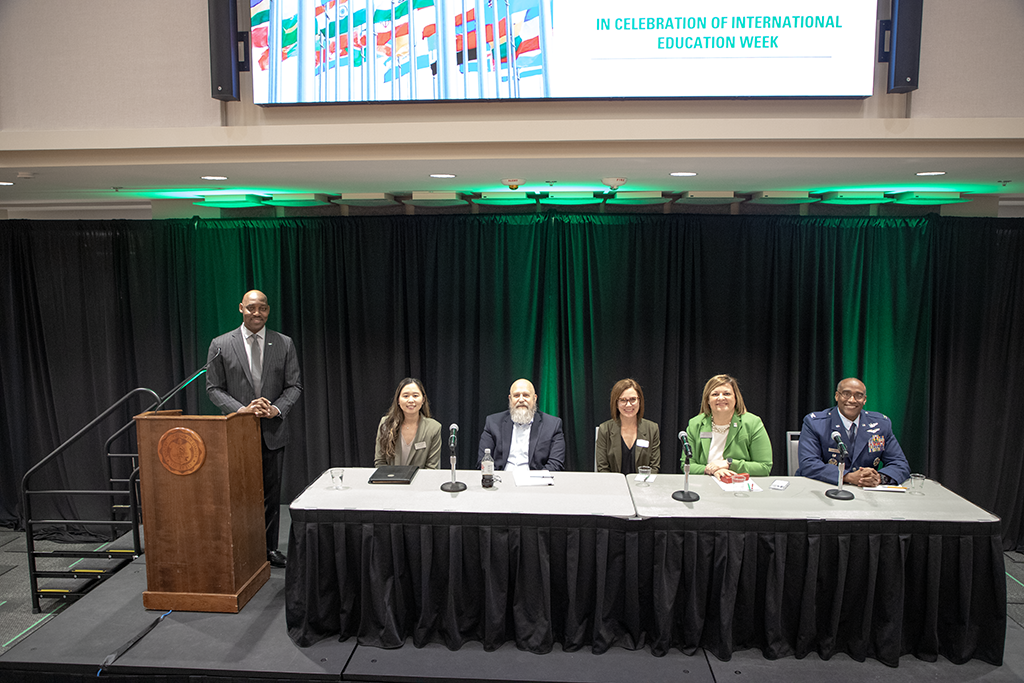
Serving as moderator, Art Malloy, vice president of Student Affairs, discussed the role of higher education in fostering peace.
“In my view, the responsibility of higher education is to help address today’s global crises,” he said. “They offer both challenges and opportunities. Many now recognize that future leaders in science, philosophy, law, business, healthcare, education and counseling, are all found on our college campuses. Shaping a better tomorrow requires us to move from dialogue to empathy to concrete, proactive solutions.”
Col. “Doc” Bishane Whitmore, deputy commander of the 319th Reconnaissance Wing at Grand Forks Air Force Base, stressed the need to supplement national security with peacekeeping. Building goodwill around the world via soft power, he opined, is an effective deterrent to conflict.
“National security tends to be very state-centric — how a nation protects itself against internal and external threats,” he said. “Versus peacekeeping, which is a bit more broad. The way I typically view it, it’s how you transform the conditions that create instability. We do this in a variety of ways as a government — aid, diplomacy, education — there are a lot of ways to empower a society.”
Whitmore also urged attendees to expand their cultural awareness and keep abreast of global affairs.
“One of the best things we can do for peacebuilding is empowering locals in the communities we serve,” he said. “We have plenty of examples of where America has gone in to enact change, but if you don’t have buy-in from that country, it’s never going to stick.”
According to Soojung Kim, interim dean of UND’s School of Graduate Studies, one area in which the campus community can have an immediate impact, is building media literacy. She likened exposing students to examples of disinformation to “inoculation,” as such experiences strengthen their ability to combat disinformation’s spread.
“This is not just an issue pertaining to communication or journalism,” she said. “It applies to students across campus, because social media, misinformation and disinformation is a part of our lives today.”