L’intelligence artificielle
Damien Parrello’s AI skills mean the UND genome-sequencing expert can help another North Dakota research team — namely, geologists
Editor’s note: This story originally appeared in the Holiday 2025 edition of North Dakota Medicine, the quarterly magazine produced by the UND School of Medicine & Health Sciences.
####
It was a vexing problem: how to transfer reams of decades-old data to modern platforms. “By using artificial intelligence,” smiled Damien Parrello. “And I can do that.”
Earlier this year, the North Dakota Geological Survey (NDGS) reached out to the manager of the UND School of Medicine & Health Sciences Genomics Core with a question: how could geologists move geological core sample data embedded in print materials from the 1950s into electronic spreadsheets in 2025? And do so efficiently.
“People had been extracting data by hand,” the French-born Parrello explained of the thousand-plus scanned documents that NDGS staff had been working on one-at-a-time. “Transferring the data like that is very time consuming. And you can imagine the rate of error in doing it that way.”
So Parrello, whose UND-based core functions as a public resource for researchers of various disciplines across the state, explored various AI models to do such data entry for NDGS.
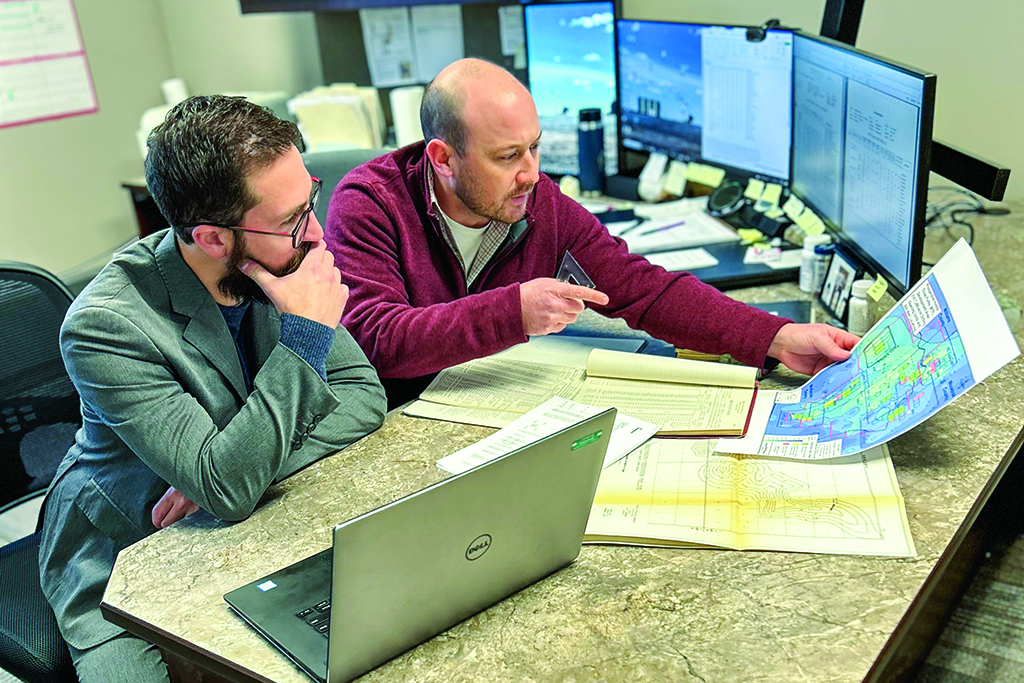
“What I did is develop the tool to automate everything – I was able just to feed the tool with all the scanned documents from the fifties,” Parrello continued. “The tool will go into each page, recognize the table I want to extract the data from, put it in a spreadsheet, and name it with the right information.”
After identifying the appropriate AI model to read scans from old publications that include data on North Dakota counties, such as the Bulletin of Engineering Geology and the Environment, Parrello had his AI-driven tool build a database of historical geological figures.
“The converted core analysis data has been compiled over the course of the past 70-plus years and is still very relevant to present research and resource exploration,” added Tim Nesheim, manager of the Wilson M. Laird Core and Sample Library and head of the North Dakota Geological Survey’s Subsurface Section. “Damien helped us complete a multi-year project within the span of a few months, saving on the order of several hundred to thousands of work hours.”
The converted data, said Nesheim, will be used to identify and examine subsurface rock layers for oil and gas, lithium, porous zones capable of storing carbon dioxide, and geothermal resources.
Asked if such a tool has a healthcare application, Parrello gestured to his computer monitor: “Of course.”
“AI is super versatile,” he said. “Data is data. It could be geology, or it could be health care, yes. And so, for example, I can definitely apply these tools to extract data from healthcare journals or from patient records.”
Referencing the coming explosion in AI-aided “precision” medicine, Parrello noted that the key now is simply to inform the software how to recognize the data in question and convert it into usable information. “Maybe you are more susceptible to one particular type of cancer, based on your own genome and your personal health record,” he said. “By combining these three – genomics, health records, and AI – we can create powerful tools to predict what type of treatment you will need specifically for you. If I get access to a collection of patient records for specific projects, colorectal cancer for example, I could use that to mix or to combine health records with genomics data to create a powerful tool for personalized medicine.”
With a nod and a smile, he gave a subtle shrug. “Fascinating, no?”