UND launches Data Skills Pathway to prepare students for AI-age careers
Hands-on program connects students to paid research, internships and in-demand jobs, in North Dakota and nationwide
Editor’s note: In the UND LEADS Strategic Plan, the Discovery core value calls on the University to “strengthen service units that support creativity, research and innovation in all stages, from program development to promotion and beyond.” This story, which was originally published in UND Today on Jan. 15, reports on a UND program that’s meant to help undergraduates succeed not only at research, but also at most other element of their college careers.
####
The University of North Dakota is expanding workforce-ready training through a new Data Skills Pathway program aimed at helping undergraduates build practical skills for data-driven careers.
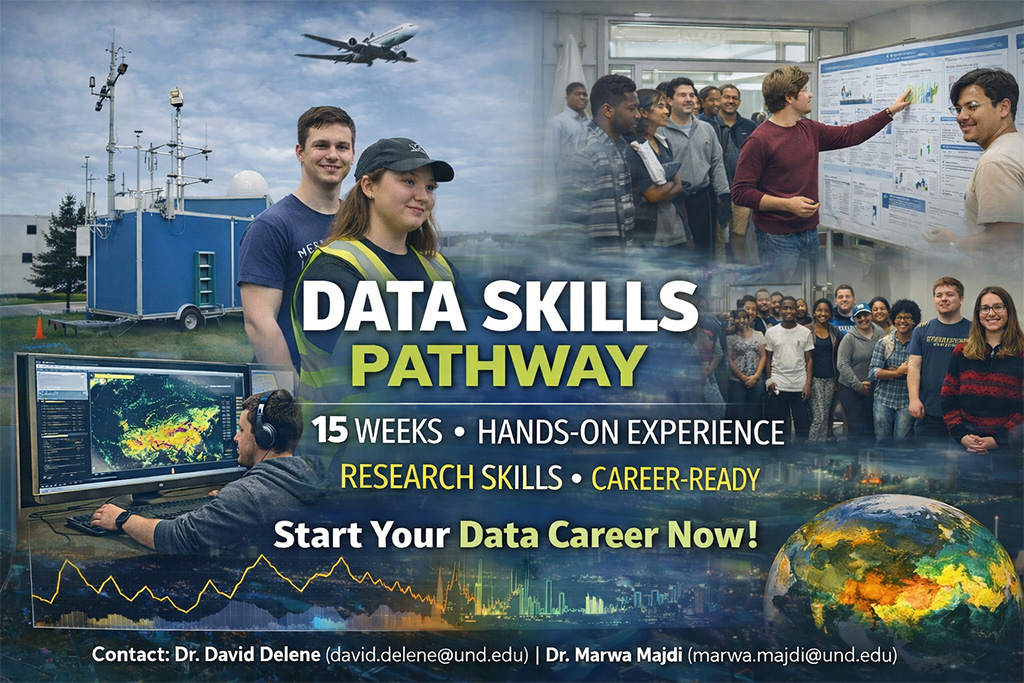
The short-term, structured program teaches students how to turn real-world data into real-world decisions. Based in UND’s Department of Atmospheric Sciences, the pathway is open to students from across the university. It focuses on data analysis, visualization, programming and communication, with the goal of connecting participants to paid research experiences and internships aligned with high-demand careers.
The Data Skills Pathway began Jan. 1 after receiving a nearly $1.6 million grant from the U.S. Department of Education through its Fund for the Improvement of Postsecondary Education–Special Projects (FIPSE–SP) program. The project is designed to test a training model that can be sustained and expanded.
The program is led by David Delene, Atmospheric Sciences research professor, and Marwa Majdi, Atmospheric Sciences research assistant professor. The team also includes Mounir Chrit, Atmospheric Sciences research assistant professor; Daile Zhang, Atmospheric Sciences assistant professor; and Shawn Wagner, Atmospheric Sciences research scientist, who will help evaluate and strengthen the program while mentoring students.
UND’s Experiential Learning Center will help recruit and advise students from across campus, including those who are Pell-eligible and first-generation. The program is designed to fit students’ degree plans while supporting long-term career goals.
“Data is everywhere now, but many students never get the chance to practice the full process that employers expect,” Delene said. “The Data Skills Pathway gives students a clear, supportive and structured environment to build real-world skills using real data to address very important problems.”
A key part of the pathway is learning through setbacks. Students are given challenges where they are likely to struggle, and the team will study how that experience supports learning and skill development.
What the pathway includes
Students often graduate having worked only with small, carefully prepared datasets in step-by-step assignments. In the workplace or in graduate school, they may be expected to manage large datasets and perform analysis that has never been done before.
UND’s pathway is built around a simple idea: students learn best when they understand the full data process, from where information comes from to how it supports decisions. Instead of “perfect” datasets, students work with data that includes gaps, errors and uncertainty — the kind of data they are likely to see on the job.
The pathway includes a step-by-step sequence that features:
- An introduction to data-focused careers
- A programming and tools workshop
- Guided work with real datasets from instruments and models
- A mini project with a short-written report and oral presentation
Students can work with observational datasets from instruments and field projects, lab data or model-based data from simulations and forecast systems. They learn how to clean and organize information, recognize gaps and outliers, and explain the results clearly.
The final project creates a portfolio piece students can include on a résumé or discuss in interviews.
“Students should not have to guess what to do or depend on luck to find the right mentor at the right time,” Majdi said. “We built this as a step-by-step experience with clear expectations, real support and real outcomes that students can use for internships, jobs and graduate school.”
Skills students build
Students gain experience that matches tasks common in data-intensive roles. They learn to:
- Work with large, real datasets
- Create clear plots and summaries
- Document work so it can be repeated
- Communicate results to non-experts
- Learn from failure and keep improving
The program also creates a pathway to paid experience. After completing the program’s orientation, students can apply for paid research positions of about six hours per week. Students who meet expectations may qualify for more hours, continued employment and full-time summer internships. Top participants may also be referred to additional opportunities with private companies, national labs and other universities.
Why it matters
Data-driven decision-making is central to North Dakota industries such as aviation, weather forecasting, energy, transportation and public services. Nationwide, demand continues to grow for workers who can collect, manage and clearly explain data.
The Data Skills Pathway is designed to help UND students enter those careers with stronger skills and real experience.
The project also strengthens UND’s connections with employers through feedback on student projects and by helping connect student to internship opportunities.
Over the four-year project period, UND expects about 80 to 100 undergraduates from multiple disciplines to complete the pathway. The university anticipates most will take part in paid internships or research experiences connected to the program.
Built for long-term use
Program leaders say the pathway is designed to last beyond the grant period. It is being built into UND’s existing academic structure and supported by reusable tools and materials, including standardized lessons, shared data workflows, employer engagement templates and systems to track student outcomes.
The team also plans to document the program so other universities can adopt it, including sample exercises, assessment rubrics and internship learning templates.
“Sustainability is built into how we designed the program,” Delene said. “We are developing a scalable system that has the infrastructure to connect employer needs to students’ classroom experiments using an experiential learning environment where failure is expected and students learn to persevere.”
How to join
Students interested in building job-ready data skills and preparing for paid internships are encouraged to contact David Delene or UND’s Experiential Learning Center.
Students from any major are welcome. Interested students should include their major, year in school and areas of interest when reaching out. The program team will provide information about timelines and next steps for joining the next cohort.
>> Questions or comments about the UND LEADS Strategic Plan? Your thoughts are welcome! Please contact Ryan Zerr, associate vice president for Strategy & Implementation, or Anna Marie Kinney, coordinator of the University Writing Program, the co-chairs of the UND LEADS Implementation Committee. You also may offer your thoughts by visiting the UND LEADS Strategic Plan home page and clicking on the “Provide your feedback” link.
Thank you for your support of the UND LEADS Strategic Plan!‘’