UND’s Art Malloy receives Fulbright award
Vice President of Student Affairs Art Malloy will travel to Taiwan to study peace initiatives in higher education
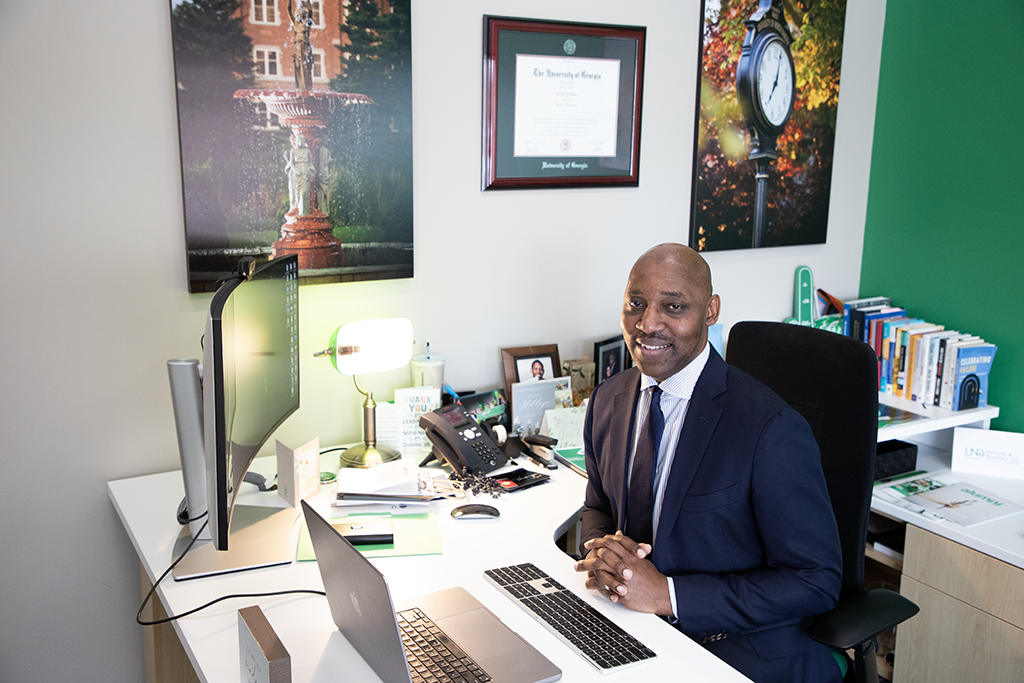
A UND vice president was recently awarded a prestigious Fulbright award – an honor conferred by the U.S. government’s flagship international exchange program.
Established in 1946 by former U.S. Sen. J. William Fulbright of Arkansas, the program provides grants and scholarships for successful applicants to study, conduct research or teach in over 160 countries.
As a recipient of the Fulbright U.S.–Taiwan International Education Administrator’s Award, Vice President of Student Affairs Art Malloy will travel to Taiwan this coming March. He will be joined by 11 other Fulbright fellows from across the United States – all with different research interests.
Malloy will examine the role of peace initiatives in Taiwan’s higher education system – a region of the world where peace can seem fleeting. Tensions between the island and neighboring mainland China have soared, with military posturing increasing in the East and South China Seas.
Malloy’s Fulbright award is the culmination of his participation in several peacebuilding endeavors. His first foray into an international peacebuilding environment came in January of 2024, when he facilitated the attendance of a delegation of UND faculty, staff and students at the Global Peace Summit in Bangkok, Thailand.
The summit in Bangkok, he added, reinforced his belief in the role of the university in fostering peace.
“This has been something that is a natural progression for me,” said Malloy. “I wasn’t even thinking about the Fulbright until we sent the students to Bangkok, and I said, ‘you know, if universities are not promoting peace, who’s doing it?’ I’ve always believed that an administrators on college campuses have the opportunity to change the world one student at a time in the most positive of ways.”
Malloy praised the support of faculty – in particular, Yee Han Chu, academic support and fellowship opportunities coordinator – in helping craft his Fulbright application.
“She helped shape the story I wanted to tell the committee,” he said.
Peacebuilding, Malloy opined, starts at the individual level. An essential trait for effective peacebuilding, he added, is a worldview respectful of all cultures and national identities.
“Learn to respect yourself — be happy with who you are and the way you identify,” Malloy said. “Understand that everybody else should be able to feel the same way and have a level of respect for what others bring to the table. I have always believed that we are better people when we put our collective brainpower together, and there is no doubt in my mind that diversity is the fuel for innovation.”
To gain a deeper understanding of Taiwanese culture, Malloy said he plans to visit several campuses, meet with fellow administrators, sample the local cuisine, attend concerts and visit local museums.
Malloy pointed to several on-campus events that help foster cultural awareness requisite to peacebuilding. These include UND’s annual Feast of Nations, plus monthly coffee hours and community breakfasts at UND’s Hilyard and International centers.
“These are events where we can talk to each other – not talk about each other, not argue with each other,” he said. “My philosophy is the more you learn about other cultures, the less likely you are to disrespect or discount them.”
Additionally, Malloy encourages the campus community to be students of history and geography – as such knowledge is vital to understanding the present state of global affairs – and thus the ability to effect change.
“If you can acknowledge that a country was great in the past, you can envision that they can be great in the future,” he said. “I look for places challenged in the area of peace and try to have conversations with people from that region to ask, ‘how can we get back to a point where we can have the peace that used to exist there, and what are two or three things we can do now to help that region.’”
At the end of the day, Malloy said, building lasting peace boils down to how members of a community perceive – and by extension – treat one another. Malloy said he considers North Dakota, and its welcoming and kind residents, a microcosm for peacebuilding efforts.
“If there is peace in our local neighborhoods, our ability to enjoy life is greatly enhanced,” he said. “This is a safe place because people respect each other. We respect the culture that exists here. Being kind to others makes such a huge difference and in North Dakota, people are kind and nice even without having to be so – and I think that’s what makes this region of the country such a great place.”
Malloy said he hopes the exchange will be reciprocal – and plans on inviting his Taiwanese counterparts to UND in the future to share their experiences with peace initiatives.