Big ideas can fit into 180 seconds, as Three Minute Thesis winners show
Competitors explain forever chemicals, upper-atmosphere microbes and other complex topics for a public audience
Imagine compressing years of research, countless lab hours and stacks of data in the same way the earth makes diamonds: under pressure, in a manner that burns away the excess and leaves only the tightest, purest components as a result.
Then present those components in 180 seconds.
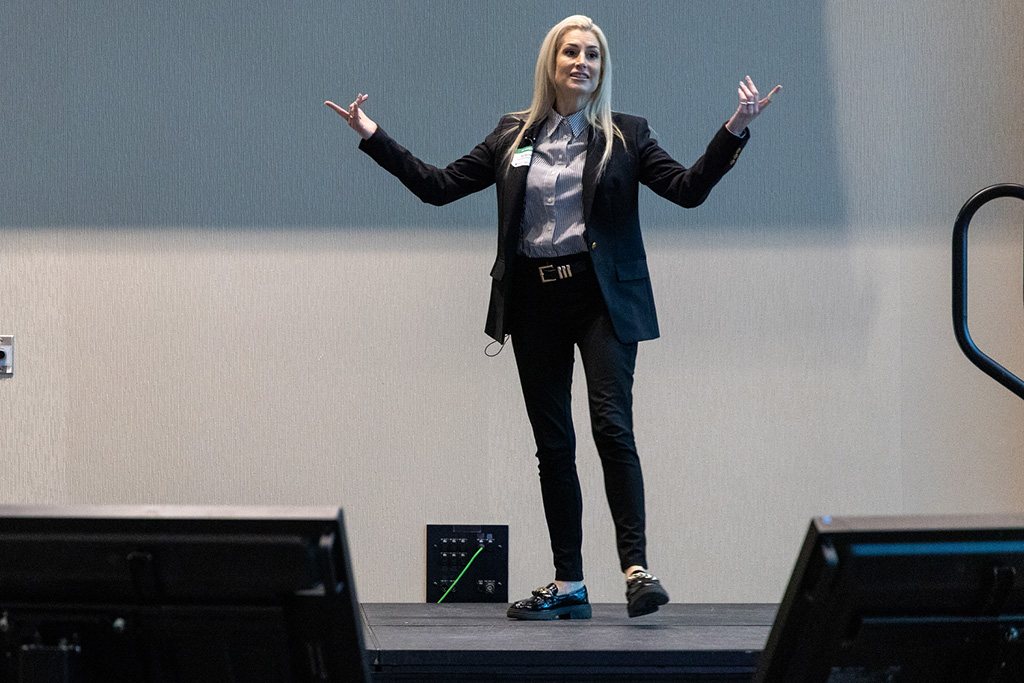
That was what was asked of students participating in the School of Graduate Studies’ annual Three Minute Thesis (3MT) competition, an event which asks students to translate complex research into accessible presentations that anyone can understand — using only their voice, body and a single PowerPoint slide.
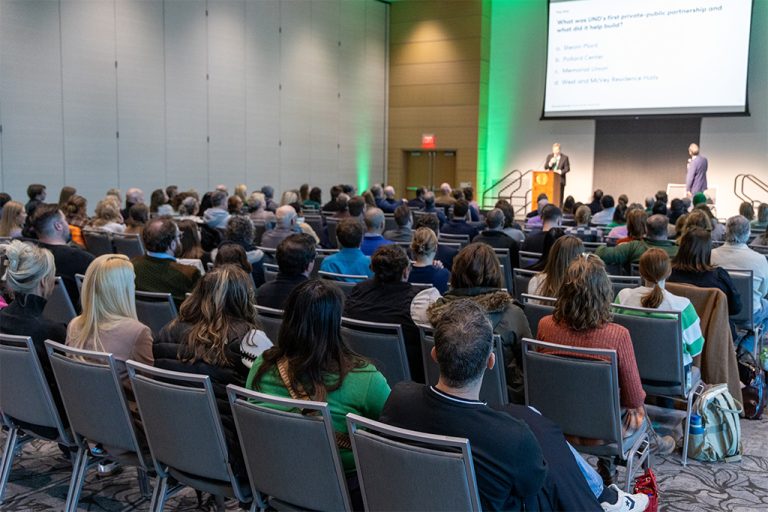
Held at the Memorial Union Ballroom on Jan. 28, this year’s competition showcased fascinating research being conducted across disciplines at the School of Graduate Studies. In addition to being one of the most entertaining research showcases on campus, the event gives competitors a chance to hone their public speaking skills while competing for cash prizes and a spot at the regional competition.
A marriage of research and storytelling
Based on the nature of the competition, presenters tend to gravitate toward storytelling using theatrical gestures and easy-to-understand analogies to keep the audience engaged. This approach proved essential for this year’s winners.
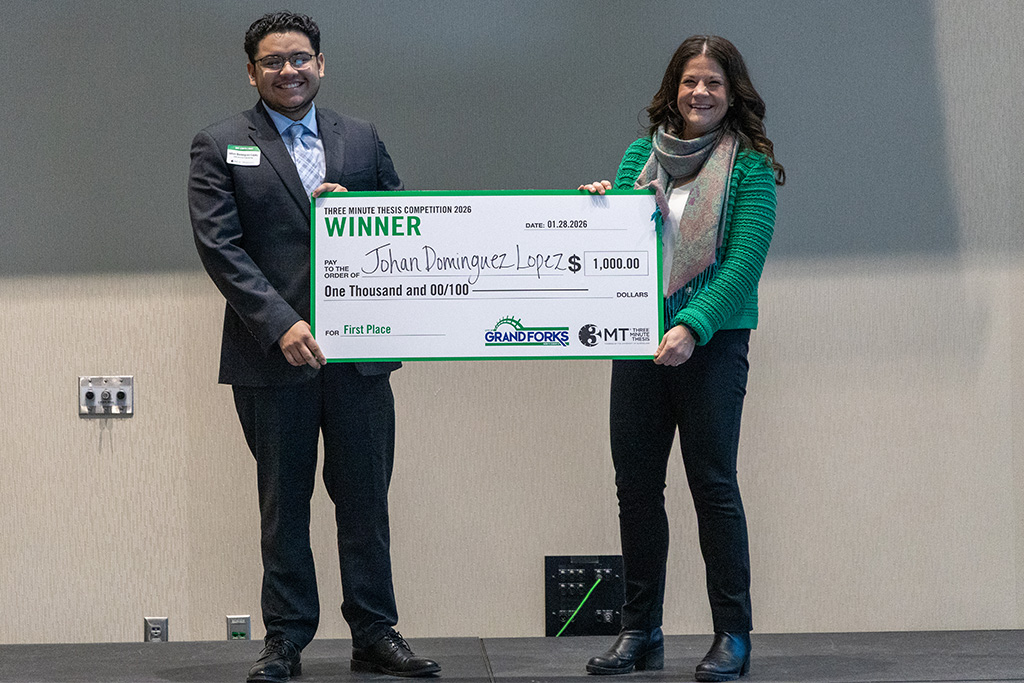
Environmental Engineering graduate student and first-place winner Johan Dominguez Lopez found the competition a natural fit, having spent years honing these skills as a speech and debate competitor in high school.
Dominguez Lopez is doing research on a hot button issue: “forever chemicals.”
PFAS — per- and polyfluoroalkyl substances — have been used for decades to make products water and heat resistant, but their chemical composition also makes them resistant to breakdown in the environment and the human body. And even a small amount of them can cause serious health problems, scientists suggest.
Dominguez Lopez and his team are developing a coated optic fiber system that detects PFAS by “highlighting” their chemical fingerprint under infrared light. The goal is to determine both the type of PFAS present and its concentration.
“With this sensor, we are able to address the ‘forever chemical’ issue,” he told the audience, “so that forever may not be so forever anymore.”
Dominguez Lopez described winning the competition as “such an incredible feeling,” reminiscent of his high school speech days. The process of preparing for 3MT started six months ago for him, and he credited months of training with his coaches and peers for helping distill complex technical concepts into a digestible presentation.
“A lot of our backgrounds have such technical terminology,” he said. “So working with coaches to figure out what’s the sweet spot to really nail home the point was crucial.”
Research for the real world
Another key element of the most successful 3MT presentations is their ability to marry research and real-world impact. In second-place winner Kim Berthet’s presentation, she highlighted the role of atmospheric microorganisms on that all-important real world.
Berthet, an online Earth System Science and Policy student based in Los Angeles, explored Earth’s upper atmosphere, which she described as “like a gaseous ocean.” Her research uncovered microorganisms drifting at extreme altitudes “like microbial surfers.”
Beyond the vivid imagery, Berthet emphasized how these findings could have practical implications. Bacteria can travel long distances, potentially spreading disease, for example. Moreover, atmospheric microbes remain a “final frontier” for microbiology, and they also influence precipitation and crop health.
“That’s right,” she said. “Microbes can make it rain.”
Her team developed a compact, 3D-printed high-altitude bioaerosol sampler — which she described as being about the size of a human head — which has drawn support from NASA and UCLA. Using the sampler, they have found “mysterious microbes” able to withstand extreme cold, low pressure and radiation.
“It might sound like science fiction,” Berthet added. “But in fact, this is a glimpse into life at Earth’s outer limits.”
As an online student, 3MT was the perfect reason for Berthet to visit campus for the first time. She said that the frigid North Dakota weather was a nice change of pace from her sunny and warm homebase, and she appreciated the chance to see her adviser — Associate Professor of Earth System Science and Policy Sean Hammond — and fellow students in person for the first time.
She also noted that the process of preparing and presenting for 3MT’s has had a great effect on her research outside of the competition.
“It’s helped kind of further my research by being able to communicate what I’m doing to people who are not within the life sciences,” she said. “Even for grant writing or for working with other departments, it’s helped.”
From UND to the world
Berthet’s takeaway is exactly the kind of thing that makes 3MT valuable for students, said Soojung Kim, interim dean of the School of Graduate Studies and the lead 3MT trainer. She added that the competition has grown significantly since Atmospheric Science Professor Matt Gilmore brought it to UND in 2018. In the years that followed, the event has drawn participants from across disciplines and helped students simplify their complex research for general audiences.
After attending the national 3MT competition to support Rachael Josephs — last year’s winner, and the second UND student to advance — Kim came away convinced that UND students measure up well against the nation’s best.
“Honestly, all of our top prize winners — not just the first place award — could be on the national stage,” she said.
Kim also added that the diversity on display, from surfing microbes to forever chemicals to third pace winner Chidiebele Oraegbuna’s research on dietary diet and brain health, has been intentionally cultivated. In the future, she hopes that 3MT will represent every program in UND’s School of Graduate Studies.
“It’s been very rewarding to see various disciplines represented over the years,” Kim said. “We have 110 graduate degrees, so I hope that we will continue to grow in terms of size and the diversity of the groundbreaking research represented.”