Chester Fritz Library acquires rare, 444-year-old book
Only 11 copies survive of this book, which was published in Venice in 1582
The Chester Fritz Library’s oldest book just got older — and its title takes a full breath to pronounce.
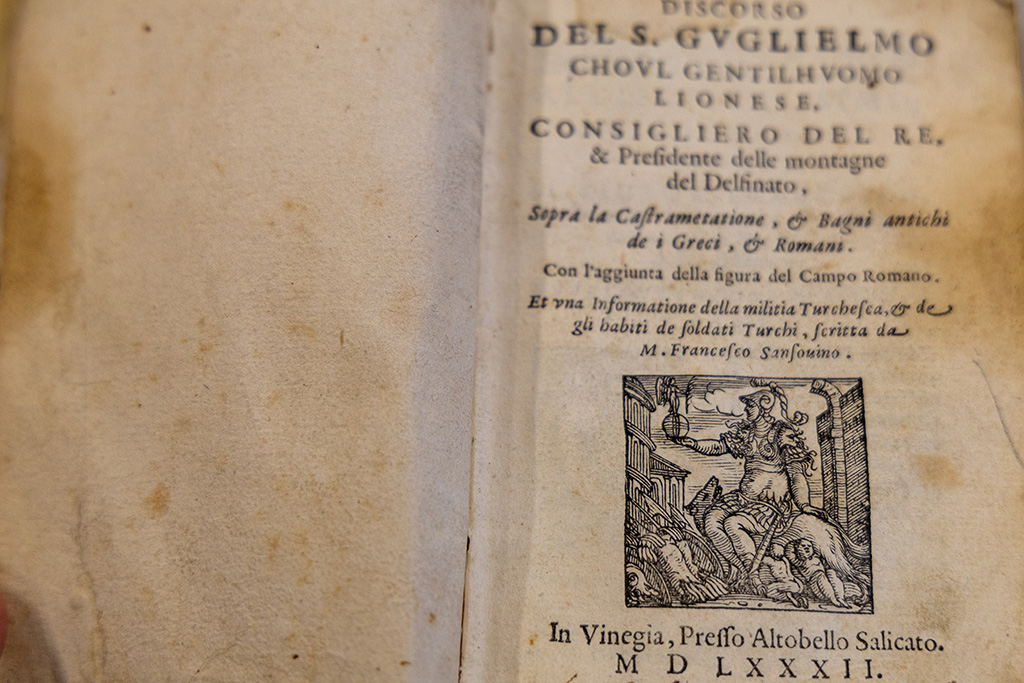
Printed in Venice in 1582, “Discorso del S. Guglielmo Choul gentilhuomo lionese, consigliero del re, & presidente delle montagne del Delfinato, sopra la castrametatione, & bagni antichi de i Greci & Romani” is now the oldest printed text in the Department of Special Collections at Chester Fritz Library. It narrowly edges a Latin book on classical philosophy from 1599 that previously held the title.
There are only 11 copies listed worldwide of the book, library officials say.
Roughly translated, the title reads: “A discourse by Sir Guillaume Choul, a gentleman of Lyon, royal counselor and president of the mountains of the Dauphiné, on the encampments and ancient baths of the Greeks and Romans.”
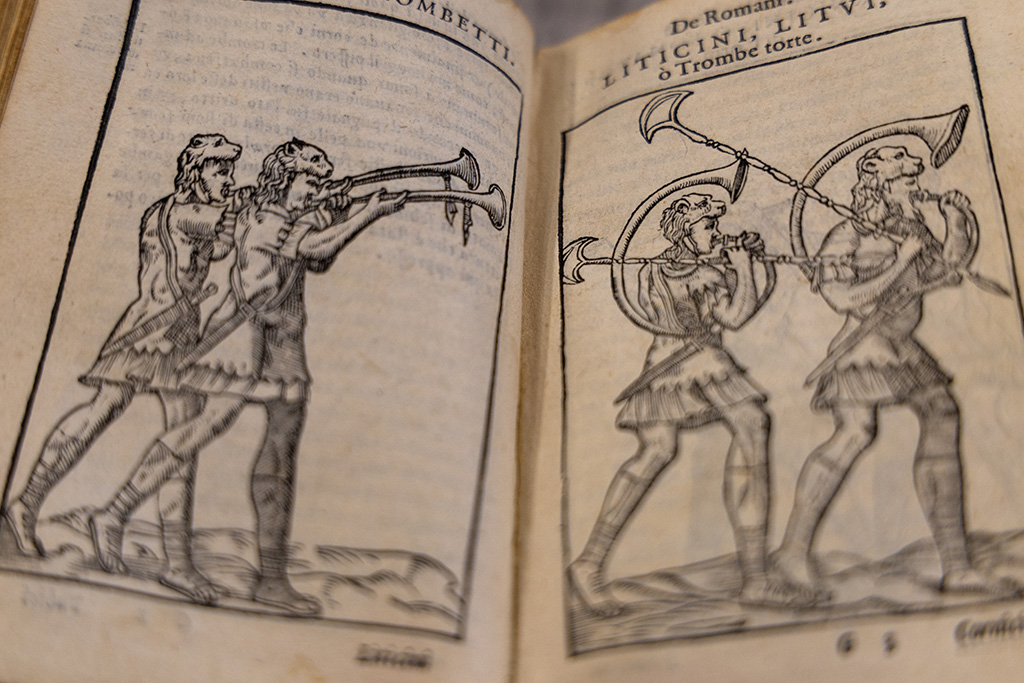
Inside, the Italian text describes ancient Greek and Roman military practices, complete with detailed illustrations of camps, soldiers and bathhouses. WorldCat, a catalog with tens of thousands of participating libraries, lists only 11 copies around the world.
How the rare book made its way to UND
Like many items in Special Collections, the Venetian imprint arrived in Grand Forks through a personal connection. Will Martin, head of digital initiatives, systems and services at the Chester Fritz Library, acquired the book late last year.
The book was originally gifted to David Martin by a friend in the Philadelphia area. Last October, during a visit to Wisconsin, Martin received the volume — and knew just where to take it.
“They were looking for a good place for it,” Martin said. “I suggested donating it to the University, where it can go into the Special Collections Department, be made available to scholars and be kept in a nice, climate-controlled environment.”
Many might be tempted to try their hand on the rare book market for quick cash. For Martin, though, the greater value lay where students and scholars alike can get their hands on it.
“We gather more benefit by putting it into the Chester Fritz Library Special Collections, where it will be made available to scholars for study and students to get up close and personal with a real piece of history,” he said.
The library’s previous “oldest book,” the 1599 Latin philosophy volume, also came with a North Dakota connection. It was donated by the family of former Congressman Usher Burdick, a rare book collector and writer. His son, Quentin Burdick, later served for decades in the U.S. House and Senate.
A rare book that doesn’t show its age
For a book approaching its 450th birthday, this one is in shockingly good condition.
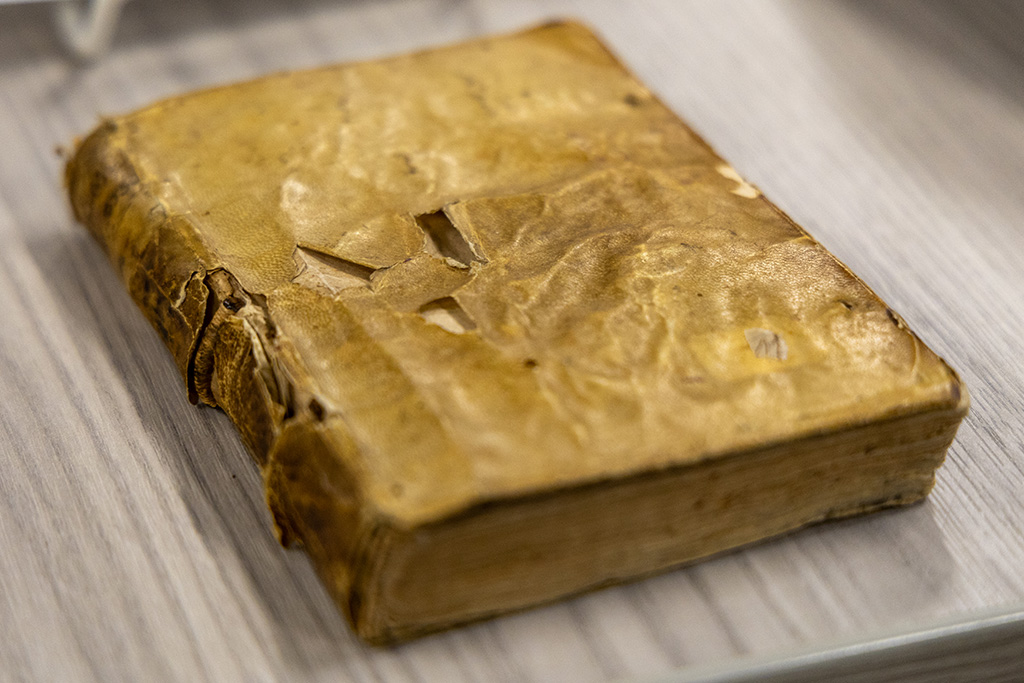
Aside from the holes in its cover and the peeling on its spine, the only evidence that the book is four centuries old is the light browning on the margins of its pages.
Martin donated the book earlier this month and, given his degrees in medieval literature and library studies — as well as a self-taught background in bookbinding — he knows what to look for in an old book.
The cover is a limp vellum binding — parchment used in place of the heavier wooden boards and leather typically used in bookbinding in the period.
“It is, in fact, bound in a piece of vellum, which is the same as parchment,” Martin said. “It’s kind of the medieval equivalent of a paperback.”
The text is entirely in Italian, but casual skimming also reveals detailed illustrations of soldiers marching and training, as well as diagrams of camps — likely made with etched metal or wood stamps, a technique typical of the time.
The most impressive part? Martin believes the book remains in its original binding, a rarity for a book that’s four centuries old.
The generous page margins suggest the book has never been trimmed down for rebinding, a common practice in later centuries, Martin said. Along the spine, raised bands mark the signatures — groups of pages that are folded and sewn together in the binding process.
“The raised bumps on the spine of the book are the result of the supports,” Martin said. “Those are leather cords, which were used to support the individual folded signatures.”
To prepare it for donation, Martin built a custom clamshell case to protect the volume from dust, light and moisture. Today, the book is stored in the Chester Fritz Library Special Collections climate-controlled vault, alongside other rare books and curiosities such as a replica of the Gutenberg Bible, a fingernail-sized collection of Abraham Lincoln speeches and the former “oldest book,” a 1599 philosophy text written in Latin.
Wait, there’s a catch … word
Martin also pointed out a detail that hints at an older, more communal way of using books. A single word — “disciplina” — is printed in the lower right-hand corner of the first page.
“For a lot of the history of printed books, it was really common for people to read books aloud to each other,” Martin said. “So, printers would put a catchword at the bottom of the page — the first word on the next page — so when you’re reading out loud you can keep going while you turn the page.”
Martin describes the detail as a relic of the now-lost practice of reading books together.
“The original audiobook is a person in your family reading to you,” he said. In a way, he added, the book’s new life at UND brings that community focus full circle — not necessarily through reading Italian aloud, but through students gathering around it to study how it was made.
Supervised use allowed
Curt Hanson, head of Special Collections, agrees with this sentiment. The book will be brought out for supervised use. Students wash their hands before handling it and use pencils instead of pens — but no gloves are required.
“We don’t want to have all of these rare books and not have anybody come look at it,” Hanson said.
It’s not every day one gets to touch a book this old, Hanson said, and the connection to history is something that Special Collections staff value.
The book has already been put to good use by students across campus. A graphic design class recently looked at this rare book and several others to study the typography, page layout and the quirks of early modern printing.
“These are students who are more interested in looking at the books as artifacts — how everything is arranged on the page,” Hanson said.
Nichole Martin, archival associate in Special Collections, said that it’s moments such as those that remind her of the importance of the department.
“What I like is when you show them to classes, and then one of the students, after it’s put away, comes back with another student just to show them, too. They don’t realize what we have up here, and they get very excited,” she said. “That’s awesome.”
Added Hanson, “I’m very fond of saying — and this is an unacademic word — that our stuff is just cool.”
To learn more about these books or other Special Collections material, visit the Elwyn B. Robinson Department of Special Collections webpage or stop by the fourth floor of the Chester Fritz Library.