On campus: Remembering Nuremberg’s ‘Citizen Prosecutor’
Former UND Law professor Gregory Gordon recounts life of Ben Ferencz, Nuremberg Trial prosecutor and international justice advocate
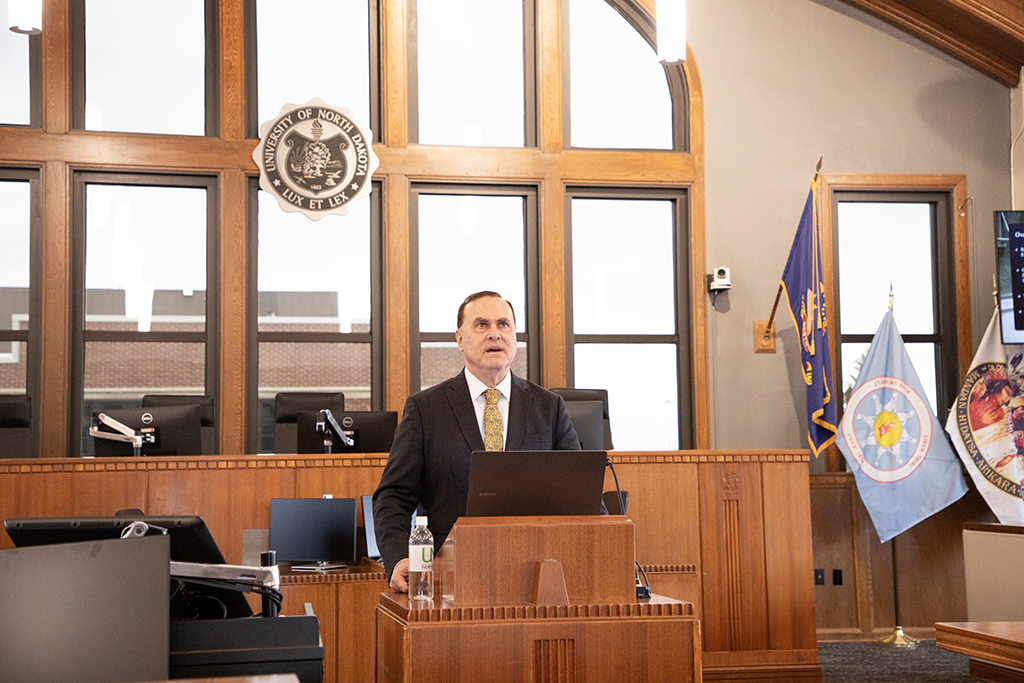
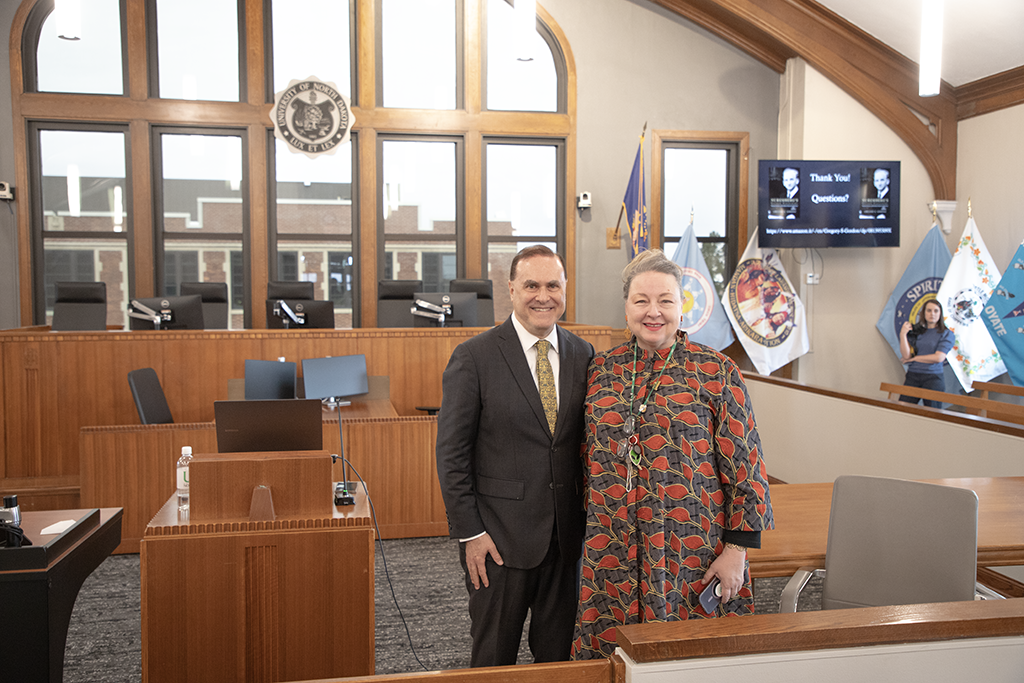
Earlier this week, a former UND law professor returned to campus to deliver a lecture on the life and legal career of one of the 20th century’s most influential jurists — one whose contributions to the field of international justice resonate today.
Over the course of an hour, Gregory Gordon, professor of law at Peking University’s School of Transnational Law, chronicled the life of Ben Ferencz, chief prosecutor for the U.S. Army at the Einsatzgruppen Trial, aka “the biggest murder trial in history.” The trial was one of 12 military tribunals known collectively as the “Nuremberg Trials,” which investigated and prosecuted crimes against humanity committed by leaders of Nazi Germany from 1933-45.
The Einsatzgruppen was a particularly barbaric paramilitary death squad, whose members oversaw the murders of more than a million people during the Nazi invasions of Poland and the Soviet Union from 1939-45. All 22 Einsatzgruppen officers tried by Ferencz were convicted — largely due to Ferencz’s meticulous gathering of evidence and sharp legal mind.
Gordon said a hallmark of Ferencz’s work as a prosecutor was his focus on victim advocacy.
“I think he would consider that his life’s most important work,” Gordon said.
Gordon’s career has seen him serve in several high-profile positions. As a legal officer at the International Criminal Tribunal for Rwanda, he helped prosecute the Tribunal’s “Media Case,” which convicted several media executives for their roles in inciting the 1994 Rwandan Genocide.
Gordon then served as a faculty member at UND’s School of Law from 2006-14, leading the School’s Center for Human Rights and Genocide Studies. Since 2023, he has served as an advisor to Ukrainian prosecutors, relating to Russian war crimes during the country’s invasion of Ukraine.
In his lecture, based on extensive research conducted for his recently published biography titled, “Nuremberg’s Citizen Prosecutor: Benjamin Ferencz and the Birth of International Justice,” Gordon outlined Ferencz’s extraordinary life and career.
Ferencz was born in 1920 to Hungarian Jewish parents in the Romanian-occupied region of Transylvania. The family emigrated to New York City when Ferencz was an infant, fleeing antisemitism.
Despite an impoverished upbringing, Ferencz excelled academically, earning scholarships to both City University of New York and Harvard Law School. After the attack on Pearl Harbor in 1941, Ferencz enlisted in the U.S. Army. He fought in several major battles in the European Theater, including the Normandy Landings and Battle of the Bulge.
Ferencz was later transferred to U.S. Gen. George S. Patton’s Third Army and was tasked with investigating Nazi war crimes – work that would prove seminal in his forthcoming legal career.
Ferencz was honorably discharged from the Army in 1945, but would soon be called back to Germany.
In 1946, U.S. Gen. Telford Taylor, lead counsel at the Nuremberg Trials, tapped Ferencz to head the Berlin office responsible for gathering evidence pertinent to the trials. It was in this role that Ferencz uncovered many documents outlining the Einsatzgruppen’s crimes.
With this evidence in hand, Ferencz approached his boss with a plea to establish a new trial. Although initially hesitant due to a lack of resources from the Pentagon, Taylor agreed — so long as Ferencz continued to fulfil his duties as head of the Berlin office.
After securing justice in the Einsaztgruppen trial, Ferencz led organizations devoted to restitution and reparations for Holocaust victims. He worked as an advisor to Konrad Adenauer, the first post-Nazi Chancellor of West Germany, in the administration’s efforts to negotiate the 1952 Luxembourg Treaty — an agreement that provided Israel with billions of Deutschmarks in reparations.
Ferencz’s advocacy was also vital in establishing the International Criminal Court — a body headquartered in The Hague, Netherlands — tasked with prosecuting the crimes of genocide, crimes against humanity and agression. Ferencz even delivered the closing arguments in the court’s first trial in 2012 — the case convicting Congolese military commander Thomas Lubanga of war crimes.
Gordon’s project to write “the definitive biography of Ferencz” began in earnest when the pair first met at a legal conference in Kampala, Uganda, in 2010. There, Gordon asked Ferencz to write the book’s forward, a request to which he happily obliged.
In the following years, Gordon spent several days interviewing Ferencz for the book at his home in Florida. Although Ferencz did not live to see the completed biography —he died in 2023 at the age of 103 — he was able to read substantial portions of the manuscript, Gordon said.
“As sad as I was that I couldn’t get the book done, I was happy to know he was pleased with what I had already written before he passed,” Gordon said.
One of the book’s most shocking revelations, Gordon said, uncovered Ferencz’s previously unknown role in the tenth Nuremberg trial — which convicted directors of the German munitions giant Krupp of using slave labor in its factories.
During his research, Gordon came across a letter Ferencz wrote to his wife Gertrude, in which Ferencz outlined his role as a podium prosecutor in Krupp — including cross-examining witnesses. As the Krupp trial occurred before Einsatzgruppen, this new evidence concludes that Ferencz worked with Taylor in Nuremberg before being assigned to his position in Berlin.
“I could not believe my eyes,” Gordon said, quoting from the book. “I made cell phone calls in the frozen winter air to fellow Nuremberg experts, including Ferencz’s son Don. They had similarly been ignorant of Ferencz’s Krupp trial exploits and were equally astonished.”
Why had this information not surfaced before, including from Ferencz himself?
Gordon asked Ferencz that very question.
“When I found those documents in the Telford Taylor collection that showed he was interviewing witnesses in the Krupp trial, I took the first plane down to Florida, and this dramatic confrontation with him,” Gordon said. “I asked him, ‘How could we have talked all this time, and you never mentioned your work on the Krupp trial?’ He told me he deliberately omitted it from his life story because he did not think it was important.”
“I think the answer is simple,” Gordon continued. “A perception that involvement in the Krupp proceeding might muddy his Nuremberg legacy. The more streamlined narrative that held over the years was much more powerful.”