Fulbright follow-up: Braving the cold of the North
UND Associate Professor Aaron Kennedy reflects on his eight-month-long, Fulbright/NSF-financed research trip to Iceland
By Averie Eixenberger
After returning to UND from an eight-month research trip in Iceland, Associate Professor Aaron Kennedy is looking forward to the next steps of his project. Whether it be collecting more data or offering chances for more students to travel abroad, he hopes that the future will bring new opportunities for furthering international research.
Initial research
Kennedy, associate professor and chair of Atmospheric Sciences at UND, went to Iceland as a recipient of a Fulbright Iceland-National Science Foundation Arctic Research Grant, a Fulbright U.S. Scholar program for the 2024-2025 academic year. When he initially spent his academic year aboard, his goal was to use his self-developed instrument to study and predict the potential for dangerous avalanches. However, that winter did not provide the ideal conditions for getting the necessary research, making more data collection necessary to achieve the initial goal.
“From a personal goal, I thought it was an extreme success because I got to understand how to improve my instrument and make it more robust,” explained Kennedy. “It taught me some more about the right design to use; but from a science perspective on the avalanche side, we didn’t really get the data to see how useful this information would be.
“And so, the goal of extending our data for an additional winter is to try to have a more typical Icelandic winter, and then hopefully get the data collected so that we can publish some papers about how this would be useful for avalanche forecasting.”
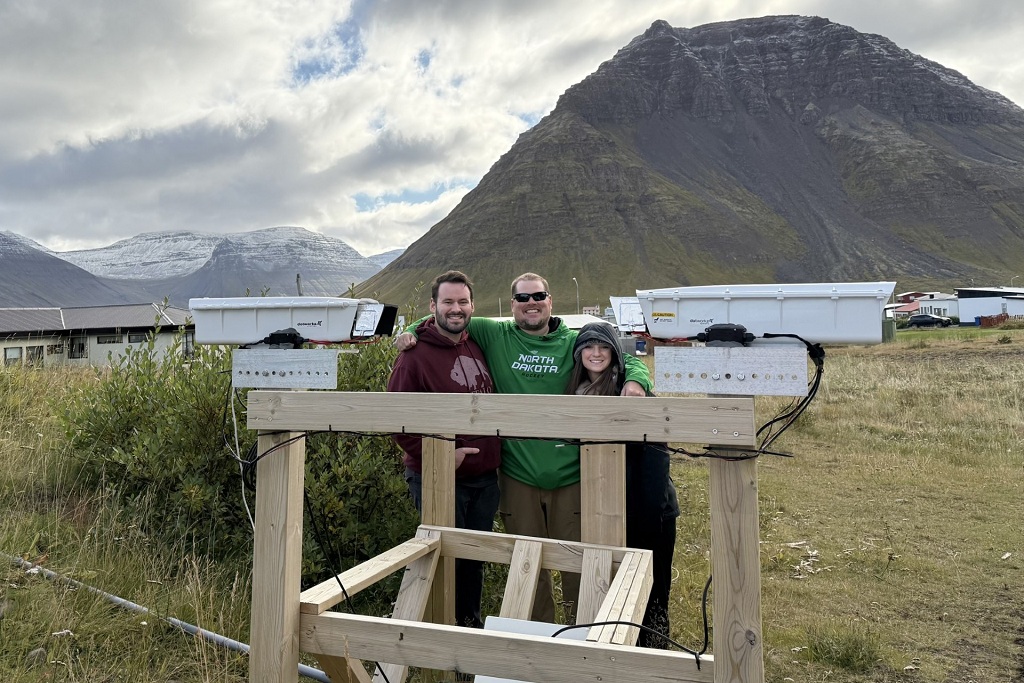
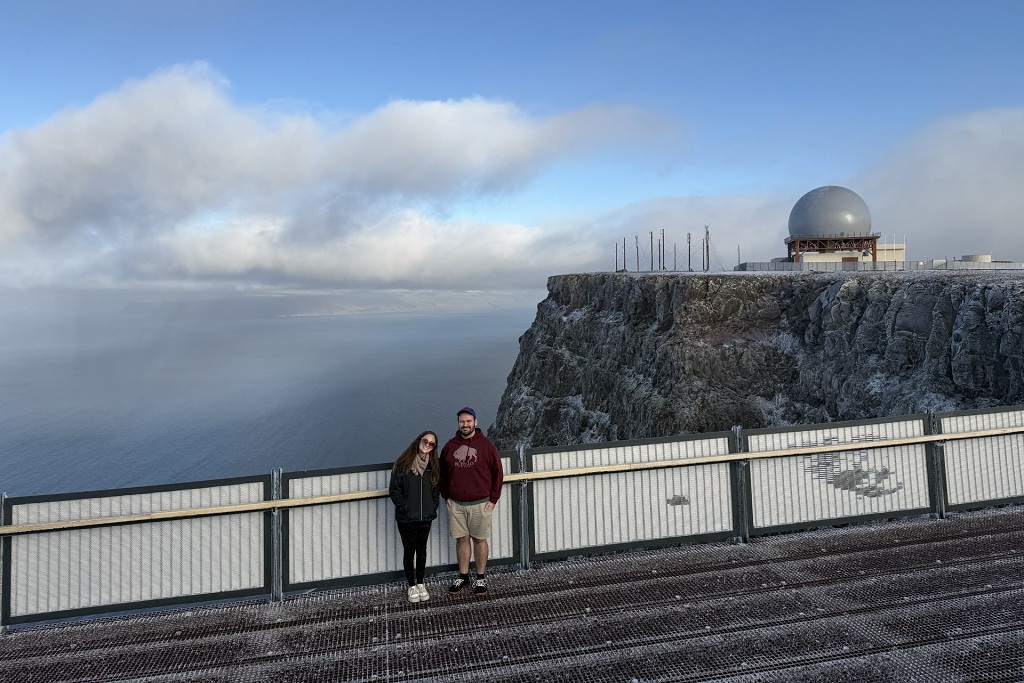
In August, Kennedy returned to Iceland with graduate students Talia Kurtz and Alec Sczepanski to set up the instruments for another year of data collection.
“I like seeing stuff I’ve built be deployed and getting useful data from it,” Kennedy said. “Just seeing something that started from a little seed grant at UND turn into a proposal to the National Science Foundation and then turn into a Fulbright is very special. And so, this little, tiny chunk of money has blown up, and it’s like literally most of my research now.
“And seeing this get to the point where now people are contacting me and saying, ‘Hey, we saw your instruments deployed, the images they’re getting are great, can you do this and that?’ It’s a great feeling to know that you’ve been successful.”
Promoting research around the world
As Kennedy has learned, the impacts of a Fulbright award extend well beyond the period that it funds. For example, he’d love for more students to get the chance to travel and study around the world, he said.
“After I had my experience in Iceland, I feel like a core component of me now is to give our students opportunities to get outside our country and see things from a different perspective,” he said. “Iceland is a perfect place to do it because it’s fairly Westernized, and so it’s pretty approachable. Nearly everyone speaks English, and so for being a foreign country, it’s a lot less scary than perhaps many places for students who have never left the country or maybe even the Midwest before.
“And so, this is an opportunity for them to expand their horizons in a safe way.”
In the spirit of helping more students study abroad, Kennedy this month will be helping a friend who teaches art at the University of Iowa with an interdisciplinary class that combines science and art. The students, as part of the class, will travel to Iceland to collect landscape imagery using weather balloons – a task that Kennedy has experience with.
“During our spring break, I’m going to go down to Iowa and teach for that class about how we do weather ballooning and design payloads,” Kennedy said. “The goal is that I’ll go out early from my own Iceland trip to help them execute this project as a weather consultant. That’s what I want to make happen here at North Dakota: that we can make this intercollegiate and collaborate with Iowa. You never know how these connections will blossom.”
Taking students this past August really inspired him to make such an experience as accessible as possible, Kennedy said.
“I’m a dad, I have daughters at home, but I’m also a ‘student dad,’” Kennedy explained. “I have my grad students who are like my kids, and being able to bring them over to Iceland and see them get really excited about the things I got really excited about, just got me even more passionate about it.
“I decided then that I need to do this more because it’s very rewarding to see your kids get excited about something. So, I’m really pumped about trying to bring these experiences to others.”
Finding connections abroad
Kennedy expressed how the connections he made abroad have continued to flourish beyond the fixed period of the Fulbright. For example, his daughter still maintains friends back in Iceland, and he himself maintains relationships with colleagues across the world.
“I still talk with the Icelandic meteorological office that hosted us,” he said. “They do more forecasting, so they help to maintain instruments and collect data. I also stay in contact with a friend from college who is in the Icelandic ministry as a lead climate scientist, as well as with a local university there to talk about ways they can collaborate.”
Kennedy hopes his research can help people and improve the safety of communities. Likewise, he hopes that the data they are collecting this year will improve the ability to predict avalanches and warn people who may be in danger.
“I got into winter weather after living in North Dakota and discovering that blizzards are difficult to forecast. I felt like we could do a better job,” he explained. “This got me into instrument design; I’m at my happiest when creating things.
“Studying blizzards is only one thing you can do with instruments, which led me to the question of what else we can do,” he continued. “I visited Iceland for fun, and there was a memorial for people who had died in an avalanche. That resonated with me because most of my life, I’ve researched how weather affects people — and here was something that impacted people. I wanted to help.”
A home away from home
Even several months later, Kennedy expressed the fondness he still holds for Iceland. And he told of how even thousands of miles from home, he still found ties to North Dakota.
“Iceland feels like a second home to me,” he said. “A lot of people there are actually familiar with North Dakota, because there is a high population of Icelandic people living here and in Manitoba. As a result, a lot of Icelanders know people in the United States.
“It was weird going to a location where you could meet people on the street who had connections here. It was really rewarding.”
About the author:
 A UND senior, Averie Eixenberger is a communications and writing intern for UND Aerospace.