UND joins universities across North America supporting global weather forecasting effort
UND Atmospheric Sciences students help collect data to improve forecasts of major storm systems
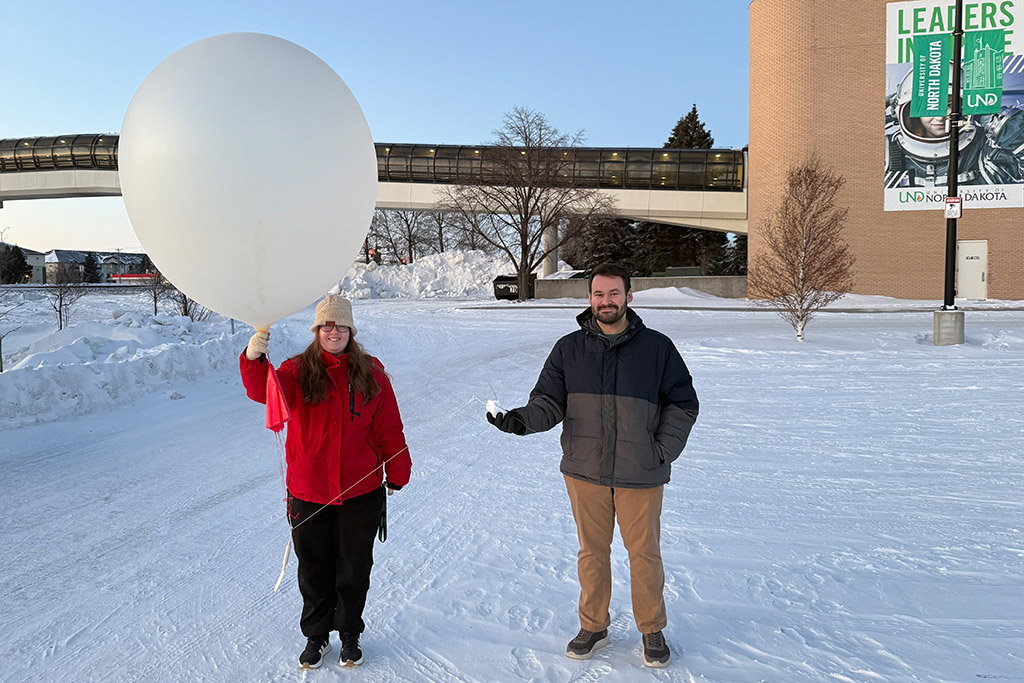
The University of North Dakota is among 16 universities across North America participating in the Coordinated University Sounding Program for Atmospheric River Reconnaissance (CUSP-ARR), a collaborative research effort aimed at improving global weather forecasts.
Led by the Center for Western Weather and Water Extremes (CW3E) at the Scripps Institution of Oceanography at UC San Diego, CUSP-ARR launched its second season in January during the 2025–26 water year. The program will run through late February and engages universities in the U.S. and Canada in collecting observations to study atmospheric rivers and other high-impact weather events.
CUSP-ARR is the land-based component of Atmospheric River Reconnaissance (AR Recon), a Research and Operations Partnership led by CW3E, NOAA and the U.S. Air Force in collaboration with federal agencies and international institutions. The program focuses on launching weather balloons equipped with radiosondes — high-tech sensors that collect atmospheric data — in coordination with AR Recon missions.
Hands-on learning for UND students
CUSP-ARR is powered by teams of faculty, staff and students in university meteorology and atmospheric science programs. At UND, students are involved in launch planning, weather balloon deployment and tracking radiosonde data through the upper atmosphere. Participants also join daily AR Recon briefings to observe how teams across agencies coordinate forecasting and research efforts in real time.
“For students, CUSP-ARR provides hands-on training and a rare inside look at how field research and forecasting come together,” said Marty Ralph, Director of CW3E and PI of AR Recon. “Our goal is to inspire and equip the next generation of meteorologists and atmospheric scientists.”
More than 150 undergraduate and graduate students across the 16 participating universities are expected to take part in the program this year.
Expanding impact on forecasting
While weather balloons have been launched at UND for research and education, this project marks the first time UND-collected data has been incorporated into operational weather forecasts.
“It’s been incredibly rewarding working with our university partners—watching teams of students come together to support a collective science goal, and seeing collected data assimilated into global numerical weather prediction models and used in real time by operational meteorologists,” shares Allison Michaelis, Assistant Professor at North Carolina State University, and lead coordinator for CUSP-ARR.
“I’ve helped launch over 100 weather balloons during my time at UND,” said UND Atmospheric Sciences graduate student Alec Sczepanski. “Over the years, some of our data have been shared with our local National Weather Service office to aid in their forecasts, but this is the first time our data have been ingested into weather prediction models. It’s awesome knowing that the work we’re doing is helping to improve forecasts not just locally, but also on a national and global scale. The opportunity to have students involved in this project – both undergrad and graduate – has been rewarding as many of us are learning about meteorological instrumentation and how the data we collect are applied to science and forecasting. I’ve been grateful to be a part of this project.”
Part of a global effort
As AR Recon evolves into the Global Atmospheric River Reconnaissance Program (GARRP), CUSP-ARR provides critical land-based data that complements airborne campaigns over the Pacific, Gulf and Atlantic ocean basins. The program represents a growing collaboration among universities, government agencies and international partners to strengthen the global observing system.
CUSP-ARR is organized by CW3E in collaboration with North Carolina State University, Indiana University Bloomington and the University of Maryland, Baltimore County.
Participating universities
Participating institutions include Valparaiso University; Texas A&M University; University of Maryland, Baltimore County; University of North Dakota; University at Albany; Virginia Tech; University of Missouri; Oregon State University; North Carolina State University; The University of Oklahoma; The Ohio State University; The University of British Columbia; McGill University; University of California, San Diego (organizing host); Salt River Project/Arizona State University*; and Indiana University Bloomington*.
Radiosonde launch equipment for CUSP-ARR partners is funded by the U.S. Army Corps of Engineers Forecast Informed Reservoir Operations award.
*Volunteer CUSP-ARR partners provide their own consumables for radiosonde launches.