At 57th Annual UND Writers Conference, everyone’s a writer
Event brings authors, artists and agents to UND, connecting them with the community through conversations, classroom visits and shared creative space
Three days each year, UND’s Department of English invites world renowned authors to Grand Forks for the annual UND Writers Conference.
This year, lessons of yesterday, today and tomorrow took center stage at the 2026 UND Writers Conference. But just as often, these lessons unfolded in classrooms, hallways and book signings, where conversations between writers and readers take literature beyond the page.
Now in its 57th year, the conference continues a long-standing tradition of bringing nationally recognized authors to Grand Forks. Just as important, it creates opportunities for those encounters to feel personal and human.
This year’s theme, “Fables& Futures,” explored how storytelling connects the world we live in to the world we imagine. But across the conference, another theme emerged: writing is not just for a select few. It’s for everyone.
For Writers Conference Director and Associate Professor of English Patrick Henry, that sense of connection is both personal and universal.
“Fables and fairytales are such a rich part of people’s backgrounds and upbringings,” Henry said. “One thing that’s happening right now is that writers are retelling and reimagining these stories to respond to the world right now.
“They want their work to make you start asking questions so you can arrive at your own answers and discoveries.”
Closing the distance between writers and readers
Across panels, readings and conversations, the conference was defined as much by curiosity and connection as by craft.
For many attendees, what stood out wasn’t just the programming — it was the access.
“It just feels very informal, very approachable,” said Sophie Wahlstrom, a young writer who traveled from Minneapolis with a friend after seeing an advertisement for the conference. “We’re just sharing space, talking about something we’re all passionate about.”
And that environment is just what Henry wanted to cultivate.
“One of the things that’s really important for me is building that sense of community,” Henry said. “I want the Writers Conference to be a place where everybody feels welcome.”
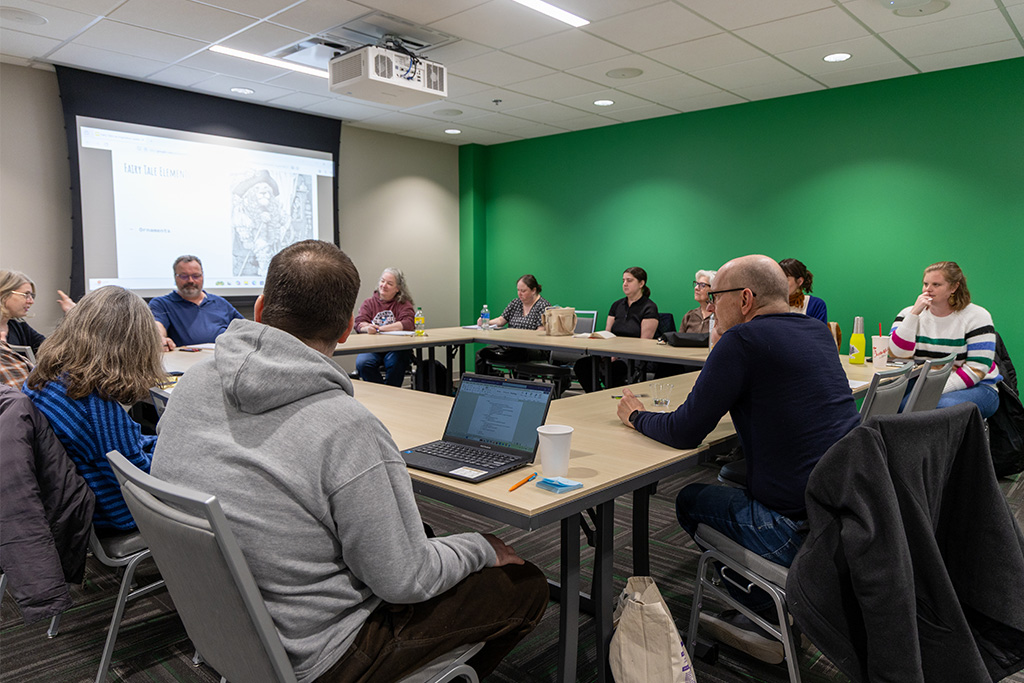
This goes beyond the main stage, reaching classrooms on campus and spaces in the Grand Forks community. Throughout the week, visiting writers participated in UND classes and community programming, meeting directly with students in smaller, more conversational settings.
“It means that some students get the chance to have these authors visit their classes so they can meet and engage with them outside of the conference,” Henry said.
From public library workshops to classroom visits, the increasing focus on community outreach and student involvement has turned the Writers Conference from something to be observed to a shared, more communal experience.
Writers, speaking as people
That same tone carried into the conference’s featured events.
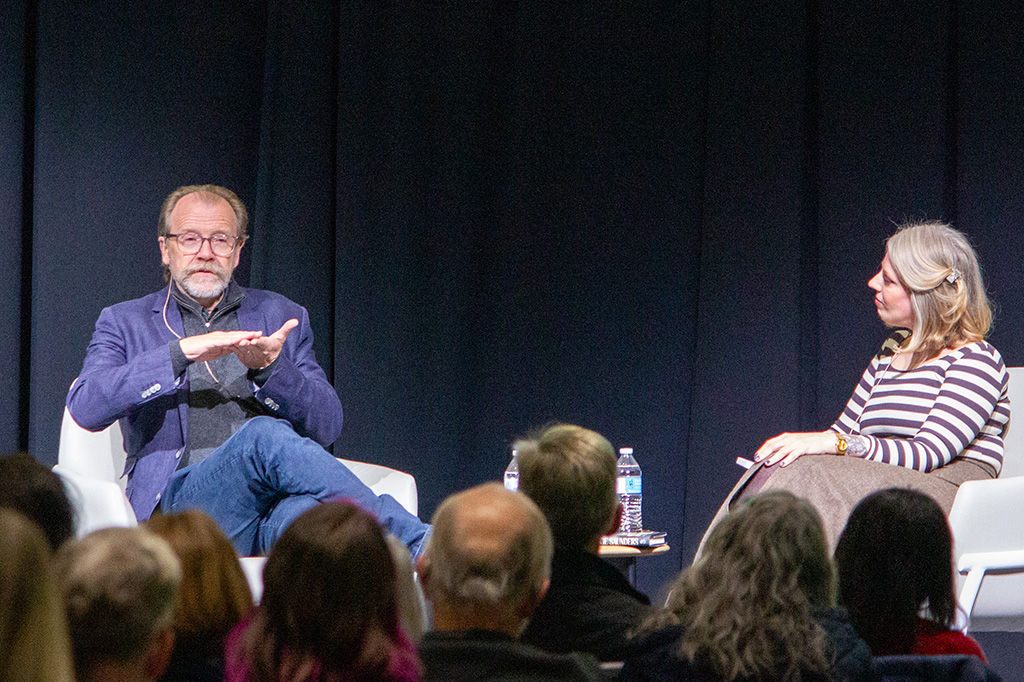
During the John Little Memorial Endowment Special Fiction Event, Booker Prize-winning author of short story collections “Pastoralia” and “Lincoln in the Bardo” and new novel “Vigil” George Saunders and writer of “Happy People Don’t Live Here” Amber Sparks took the stage for a wide-ranging conversation on writing and the human experience.
Sparks opened by crediting Saunders’ work with giving her “permission to be weird,” highlighting the way his writing embraces even his morally questionable characters with compassion.
“I like people generally,” Saunders said. “And I even like stupid people, and I’ve been one myself from time to time.”
Saunders, whose UND connection goes back to 2013 when he was interviewed for UND’s Floodwall magazine, said this instinct is a common one.
In ‘Vigil,’ for example, the unrepentant oil tycoon on his death bed can be treated with care, even if the author and his readers struggle with the situation’s moral ambiguity. As Saunders suggested, even when a perhaps contemptible person is in his or her final hours, “your basic human instinct is to comfort them.”
For many in attendance, moments such as this one reinforced a theme that popped up throughout the conference: that writers are not distant figures, but people working through the same questions as their readers.
The work behind the work
The conversation also extended to discussions of craft. Rather than presenting writing as a finished product, Sparks and Saunders emphasized revision, uncertainty and process.
“What I love is that if I’m going to get you to keep reading my book, I have to respect you so deeply,” Saunders said.
That respect, he explained, comes through revision — refining language and removing what doesn’t belong.
“If I have ‘the cat jumped onto the black table, the ebony surface, the dark expanse,’ somewhere in that sequence, you should feel that I don’t respect you very much,” he said, explaining that repeating information in that way can turn readers off.
Tightening and revising phrases makes the work more accessible and allows the author to “bond” with the reader through mutual respect. Sparks echoed this, adding that the end product is typically wildly different from the first draft.
“The book that you write is gonna look nothing like the book that you end up with,” she said.
For attendees, hearing established writers speak openly about uncertainty made the work feel more attainable — something learned, revised and shared.
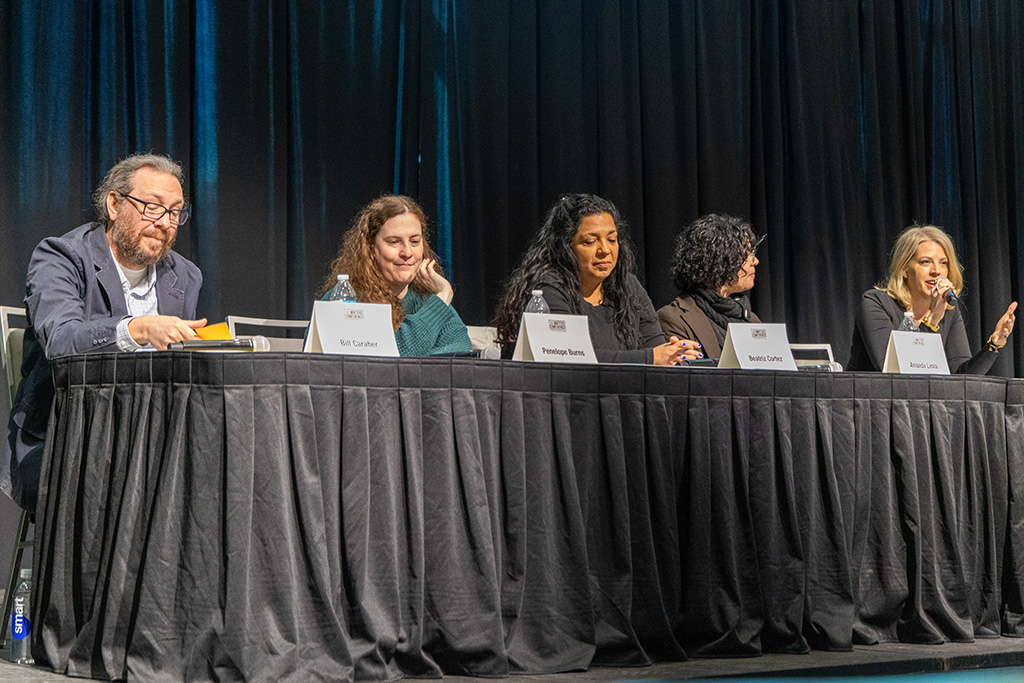
Many paths, one practice
That message carried into the “Fables, Futures, & Creative Professions” panel, where speakers discussed how creative work fits alongside careers. The themes discussed during the panel included battling imposter syndrome and balancing day jobs with artistic craft.
The panel featured Sparks, poet Ananda Lima, artist Beatriz Cortez and literary agent Penelope Burns and was moderated by Associate Professor of History William Caraher.
“I always wrote, but I never thought of myself as a writer,” said poet Lima.
For many, writing exists alongside other work. Sparks, who works full-time in labor communications, described that balance as both challenging and freeing.
“I love having the stability of having a paycheck,” she said. “It frees me to be able to make the art that I want to make.”
Across the panel, speakers emphasized that there is no single path to becoming a writer — and that art and career do not always need to align.
“I really understand career and the work as separate things that sometimes intersect,” Lima said.
Other writers and artists including Megan Kamalei Kakimoto, Anna Maria Hong, Roque Raquel Salas Rivera and Maria Dahvana Headley also contributed readings, panels and workshops throughout the week, each offering their own perspective on storytelling, identity and their creative processes.
Everyone, a writer
For Henry, now in his second year as director, the most meaningful outcomes extend beyond any single event.
“It’s been incredibly humbling,” he said. “I get to see firsthand how much students are empowered and uplifted by these opportunities.”
And, as Henry alluded to, long after the book is shut on the panels, readings and book signings, the page remains open for students who will carry this experience with them long after they graduate.