BeBold UND Women in Leadership Summit spotlights leaders in sports
Event brings to campus Lamoureux twins, other female sports and sports-industry leaders to share career and advocacy lessons
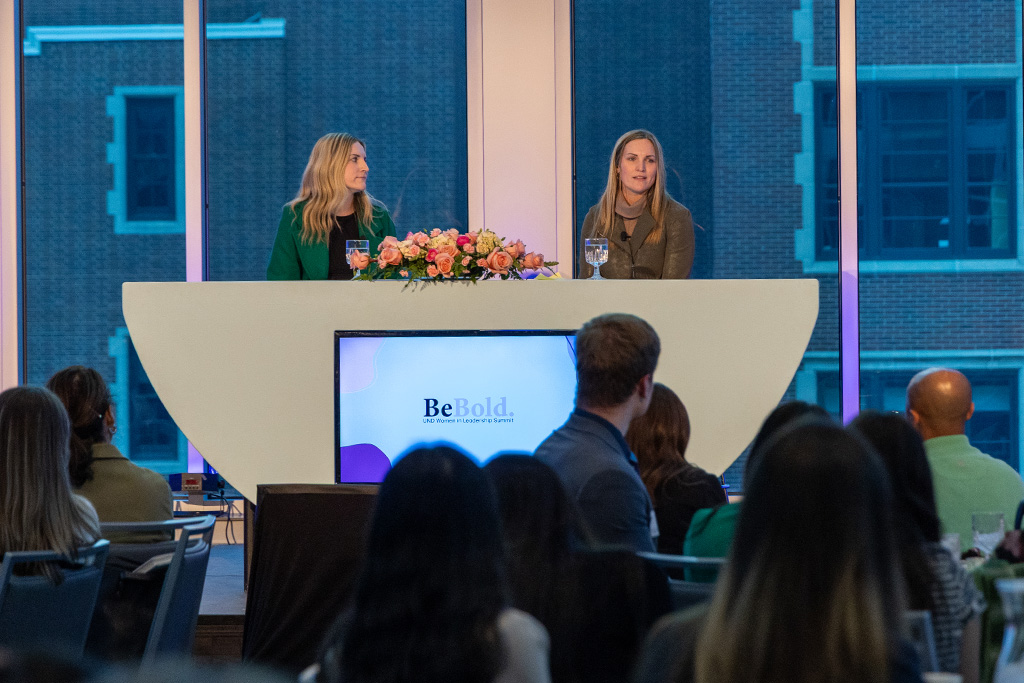
Progress for women in business and sports took center stage at the Memorial Union during the sixth annual BeBold UND Women in Leadership Summit.
Hosted by the Nistler College of Business & Public Administration, the event continues a longstanding effort to connect UND students with leaders and create space for meaningful dialogue around creating more opportunity for women in corporate spaces.
This year’s summit focused on women in sports. A panel of industry professionals opened the day, followed by a keynote address from UND graduates and Olympic gold medalists Jocelyne Lamoureux-Davidson and Monique Lamoureux-Morando.
Together, six successful women gave students insight into building careers while helping shape a more equitable future.
Finding a path in business
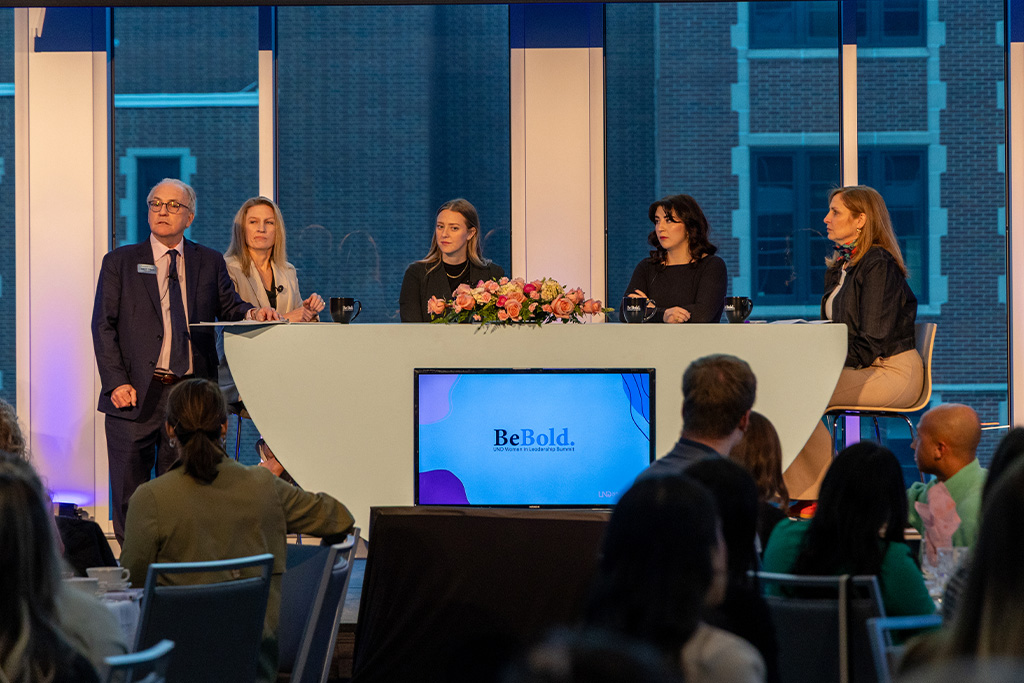
The day began with a panel moderated by UND alumna Mary Fisher and featuring Holly Corbin, senior human resource specialist for the Minnesota Twins; Annie Chipman Stockl, vice president of marketing for the Winnipeg Jets; and Mia Treuer, sports attorney and counsel with On Location, who discussed career pathways and leadership in the sports industry.
Panelists shared how they entered the sports industry — often through indirect paths that required persistence, flexibility and a willingness to take risks.
Some described leaving stable roles to pursue internships. Others pointed to class projects, networking or simply reaching out to professionals in the field.
“Networking is probably the No. 1 thing that you need to become very good at in order to help reset your career,” Fisher said.
For students interested in sports, panelists emphasized that passion alone isn’t enough.
“It’s more about being able to work as a part of a team by finding the successes of your teammates and your coworkers and building them up,” Chipman Stockl said.
Additionally, they pointed to the importance of transferable skills — communication, collaboration and the ability to adapt in fast-paced environments.
“I would say I want someone who’s curious, collaborative and adaptable,” Treuer said.
They also encouraged students to use the resources available to them on campus (including faculty connections and peer networks) and to continue building relationships over time.
Advocating for yourself
The conversation then shifted to self-advocacy — particularly for women entering the workforce.
Panelists spoke candidly about negotiating salaries, navigating workplace dynamics and building confidence early in a career.
“If you don’t ask, you don’t get,” Fisher said.
They encouraged students to advocate not only for compensation, but for opportunities, flexibility and professional growth.
“‘No’ doesn’t have to actually mean ‘no.’ It doesn’t mean anything, unless you want it to,” Treuer said. Panelists agreed that rejection is just a part of the process — and can lead to new directions or unexpected opportunities.
Panelists also emphasized the importance of building relationships and supporting others along the way, noting that mentorship and collaboration play a key role in long-term success.
“Don’t pull up the ladder; put the ladder down,” Fisher said. “When we let other women up the ladder, we all win.”
A platform for change
Those ideas carried into the keynote, during which UND alumnae and former UND women’s hockey players Jocelyne Lamoureux-Davidson and Monique Lamoureux-Morando focused on the U.S. women’s national hockey team’s negotiations with USA Hockey. The negotiations led to a boycott of the 2017 World Championships.
At the time, players were training at an elite level while balancing jobs and financial needs. After graduating, the sisters were coaching in addition to practicing and noticed other players struggling to work full time and play at the highest level.
“And we quickly realized that, ‘Hey, this is not right. We need to change this,’” Lamoureux-Morando said.
Negotiations stretched over several years, with little progress. As the 2017 tournament approached, the team identified a moment where collective action could create change.
“Our team collectively announced on Twitter that we weren’t going to play in the World Championship unless significant progress was made,” Lamoureux-Davidson said.
This decision came with great risk. At the time of negotiation, USA Hockey explored replacement options that would leave USA Women’s Hockey players out of the competition.
“But we were willing to step away from all of it, if we if we were not able to come to an agreement,” Lamoureux-Morando said. “Because we don’t want to represent something that doesn’t align with what we’re trying to pursue as athletes,”.
Looking ahead
The team ultimately reached an agreement that improved compensation and resources and helped the game grow at multiple levels.
And for the Lamoureux sisters, the long-term impact was always the priority.
“We full well knew that if we came to an agreement, we would see some benefits of this contract, but mostly it was going to impact the next generation,” Lamoureux-Davidson said.
They pointed to continued momentum in women’s hockey — including increased visibility and the development of professional opportunities — as part of the legacy they helped create.
“We really believe that that contract in 2017 helped kick start the movement towards the professional league,” Lamoureux-Davidson said.
This came back to one of the sisters’ guiding principles: “Did we make things better than we found it?”
Continuing the work
This spirit — one of paving the way forward and improving opportunities for future generations — is at the heart of the BeBold Women in Business Summit.
Across both the panel and keynote, the message was consistent. Whether in the boardroom or on the hockey rink, advocating for oneself and other women is essential to creating a more equitable future.
Or, as Lamoureux-Morando put it: “Just do the right thing. And — when things aren’t right —we need to stand up and say something.”