Chester Fritz Library marks progress on digital accessibility
Staff for state’s largest library maintain efforts to meet digital accessibility standards under ADA Title II
Editor’s note: In the UND LEADS Strategic Plan, the “Equity” core value includes a call to “work to meet the changing needs of our students and employees with a commitment to access and inclusion.”
The following story describes the Chester Fritz Library’s robust and inspiring efforts to meet new digital accessibility standards, which have been established under the Americans with Disabilities Act’s Title II.
####
The number of projects on Will Martin’s spreadsheet is staggering.
As head of digital initiatives for the Chester Fritz Library, Martin and his team have been tracking all that needs to be done to meet the updated Title II requirements of the Americans with Disabilities Act — mandating most public institutions, such as UND, to meet enhanced standards for digital accessibility.
Those familiar with the library’s network of databases and repositories can appreciate the magnitude of reaching full compliance, even as the original deadline was recently extended from April 24, 2026, to 2027.
As digitization of scholarly works, past and present, is more the norm, the impact is measured in hundreds of thousands of pages; and that impact doesn’t account for all the partnerships and third-party relationships needed to accommodate the state’s flagship university and research enterprise.
In a knowing understatement, with a hint of a smile, Martin said of North Dakota’s biggest library: “We have a lot of stuff.”
Yet boxes have been checked on that spreadsheet over the past two years, project by project. Much time and energy has been dedicated to addressing digital accessibility at the Chester Fritz Library, Martin remarked.
Rebecca Bichel, dean of Libraries and Information Resources, said her team’s commitment to access is core to the library’s mission.
“We are committed to ensuring that each student, faculty and community member is fully able to access our research collections,” she said. “Digital accessibility is key to honoring that commitment.”
This story will cover:
- How digital accessibility impacts UND’s Scholarly Commons, the University’s digital repository.
- The process of digitization and the Chester Fritz Library’s hiring of a digitization coordinator.
- The effect of new regulations on external services and partnerships contracted by the library.
- Changes to the library’s computer lab spaces to accommodate peoples’ needs.
With the prospect of “full compliance” remaining an evolving, moving target, Martin’s goal is to make digital accessibility considered every step of the way, and to make what already exists as accessible as it can be.
Scholarly Commons
Though it’s often mentioned that Chester Fritz Library is the state’s largest, in terms of borrowable items, its multiple floors of volumes pale in comparison to the digital stacks the library maintains.
UND Scholarly Commons is the institutional repository for the University containing everything from past accreditation documents to political cartoons from the mid-20th century in Special Collections, Martin said. The library is actively digitizing UND’s dissertations, theses and a wide range of other special collections.
How is this affected by the new digital accessibility regulations?
A key component of the new version of Title II now taking effect next year is the archival exception. The ADA fact sheet has more specific language, but this exception applies to content that was created before the deadline, is kept in an area meant for archived content and hasn’t been altered since it was archived.
Following the deadline, content destined for the Scholarly Commons must meet the new standards. That means PDF copies of dissertations need to be properly tagged and structured; images and diagrams need to have proper descriptions in the metadata, and so on.
As things stand, this change will dramatically slow the pace of UND’s decade-long process of digitization.
Martin shared that, since 2016, UND has digitized about half of all dissertations and theses that have been produced at the University since its founding, and efforts have been made to accelerate the processing of this backlog prior to the deadline, including outsourcing to a company specializing in mass digitization.
By having UND’s past material meet all criteria for what is “archived” under the ADA, the Chester Fritz Library’s concerns about digital accessibility can look forward, rather than simultaneously to the past.
Martin assured that if, for instance, a professor chose an archived thesis as a reading assignment, his team would go back and alter it to make sure it was fully accessible, as that material would then be considered in active use.
Centralizing digitization
To make a prior document accessible is the cause of much friction in the work of digital accessibility — so far requiring intensive individual attention.
Imagine a PDF created for a scanned historical document. Such a file, in the process of digitization, has likely gone through optical character recognition software to convert the document’s words to searchable, copyable text.
This process of OCR does not address accessibility, Martin said.
“It can’t identify the structure of the document,” he added. “There won’t be anything tagged as a heading, or alternative text describing illustrations, all of which need to be added to produce an accessible PDF.”
It’s this element of structure that is key to assistive technologies being useful.
At present, remediating a single file by hand — using PDF editing software such as Adobe Acrobat — can take anywhere from 40 minutes to several hours, given the range of material processed by Chester Fritz Library staff.
Ideally, advancements are made in AI that can lead to better recognition systems, Martin said. In other words, the process of OCR could also recognize structure and other data, resulting in a more finalized, accessible product to be reviewed by people.
Short of magic-button solutions, Chester Fritz Library recently hired for a digitization coordinator position. Translating UND’s intellectual property to a digital format has historically been a decentralized process at the library, according to Martin.
“We are hoping, with this new position, to centralize and streamline these functions,” Martin said.
In turn, accessibility practices can become integrated in the digitization process.
Martin’s goal is for the coordinator to quickly get up to speed on the relevant requirements under the Web Content Accessibility Guidelines 2.1 Level A/AA, the standards going into effect for ADA Title II, and maintain UND’s work of archiving its products of research and discovery.
The greater aspiration, as set forth by Title II, is for all digital works to be created with the “structure” of digital accessibility in mind, which would ease the tasks taken on by UND’s archivists.
Third-party relationships
Under the Title II changes, the University also needs to address the external, third-party services and resources it makes available to staff, faculty and students for its activities.
At Chester Fritz Library, this comprises a massive portion of its available research databases and journal access, among other resources accessed through the library to attain information.
“There are millions of articles in these databases,” Martin remarked.
How does UND ensure compliance across this web of annually paid access for UND’s research enterprise?
When evaluating a potential new vendor, or renewing a contract with an existing partner, accessibility review has become part of the process. UND can request a vendor to provide a “voluntary product accessibility template,” commonly referred to as a VPAT. A different version of this is the “accessibility compliance report.”
Such documents list relevant accessibility criteria, as set forth by WCAG, and provide space to indicate whether and to what degree products conform with applicable criteria, Martin said.
So far, bigger vendors have been aware of what’s expected of institutions across the country and are making moves to address accessibility issues on their platforms, Martin said. Again, common issues have to do with content hosted on those platforms in the form of PDFs.
“We are dependent on these vendors to correct any issues, as we don’t have access to their systems, nor can we make alterations to their documents,” Martin said. “Between us asking and other institutions in the same position asking, the pressure will mount steadily.”
In the meantime, the documentation of accessibility reviews shows UND to be doing its best to provide accessible resources and services.
Computer lab changes
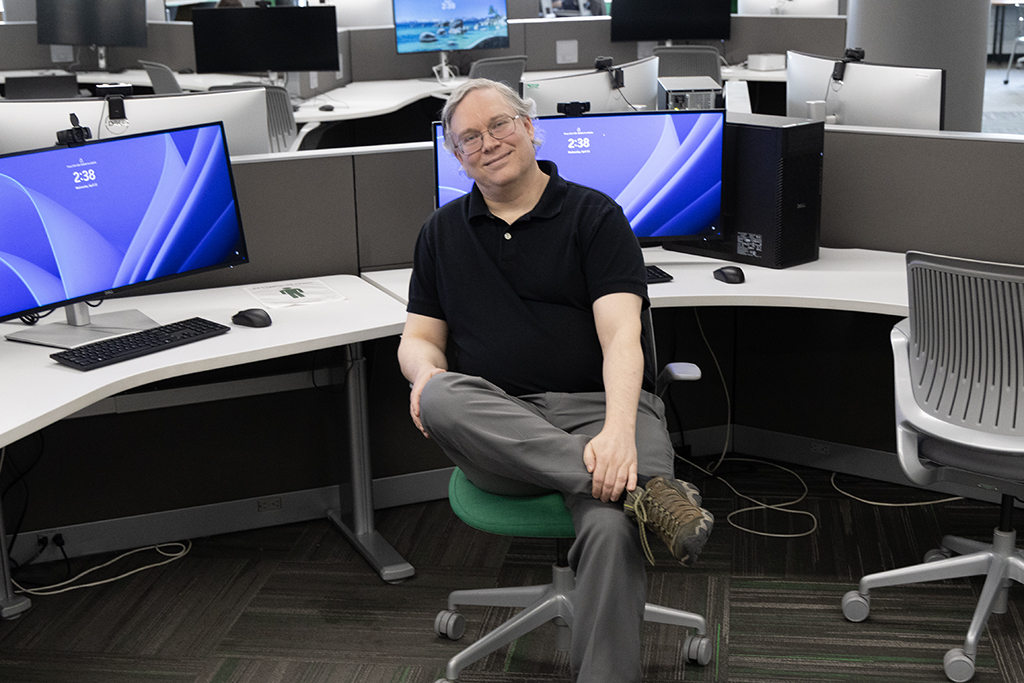
And while many changes are being made “behind the scenes” with respect to the Chester Fritz Library’s daily business, visitors using the computer labs have likely noticed much bigger screens at each station.
Moving from 22-inch monitors to 34-inch curved displays was a previously anticipated upgrade, Martin remarked, but it can aid those needing more digital workspace and increased area for zooming in on text and images.
Of the 30 seats in the main, second-floor computer lab, 10 of them provide space for people to plug in and use their own laptops on the bigger screens — a potential accommodation for those using their own suites of adaptive software and hardware.
The upgrade more central to digital accessibility has been the installation of the program Non-Visual Desktop Access, commonly referred to as NVDA, on each Windows machine in the library. The software is free and widely used, supporting many popular computer applications (i.e. internet browsers, email clients, Microsoft Word, etc.).
The screen reader software isn’t something that Martin expects to be used all that often, but “I wanted it to be available when somebody needs it,” he said.
Accessibility from the start
Reflecting on this cumulative progress at Chester Fritz Library, Martin’s mind goes to his days as a graduate student at University of Texas at Ausin, working under one of the co-chairs of the WCAG 2.0 working group, John Slatin.
Martin was one of Slatin’s graduate assistants in the English department; Slatin was the head of the university’s accessibility institute at the time and taught at UT Austin for 29 years.
Today, an annual digital accessibility training conference, AccessU, is named in his honor.
“He had lost his sight to retinitis pigmentosa … he died less than a year after I started working with him,” Martin said. “The experience was deeply affecting and left me with a deep and abiding commitment to accessibility. He was such a sweet man.
“When I’m engaged in this work, I’m doing it for John.”
As has often been repeated since UND announced its goals to meet Title II, the goal in this work is to make digital accessibility part of the process, rather than an afterthought.
Dean Rebecca Bichel emphasized another point: accessibility benefits everyone. She credited collaborations across campus with librarians, the Teaching Transformation & Development Academy and other departments in prioritizing progress toward compliance.
“Captions help non-native speakers and people studying in noisy environments; clear heading structure helps everyone navigate long documents; good color contrast helps people in bright light,” she said. “Prioritizing digital accessibility for persons with disabilities improves usability for the entire campus community.”
By doing so, not only does the University meet federal mandates, but it also lives up to its aspirations of promoting an inviting campus, a welcoming community and an exceptional educational experience for all.
****
>> Questions or comments about the UND LEADS Strategic Plan? Your thoughts are welcome! Please contact Ryan Zerr, associate vice president for Strategy & Implementation, or Anna Marie Kinney, coordinator of the University Writing Program, the co-chairs of the UND LEADS Implementation Committee. You also may offer your thoughts by visiting the UND LEADS Strategic Plan home page and clicking on the “Provide your feedback” link.
Thank you for your support of the UND LEADS Strategic Plan!