Biography by UND English professor gets glowing New Yorker review
Courtney Kersten, assistant professor of English, chronicles life of Linda Goodman, bestselling astrologer
****
A UND professor recently received high praise in a prominent national publication for her biography of one of astrology’s trailblazing figures.
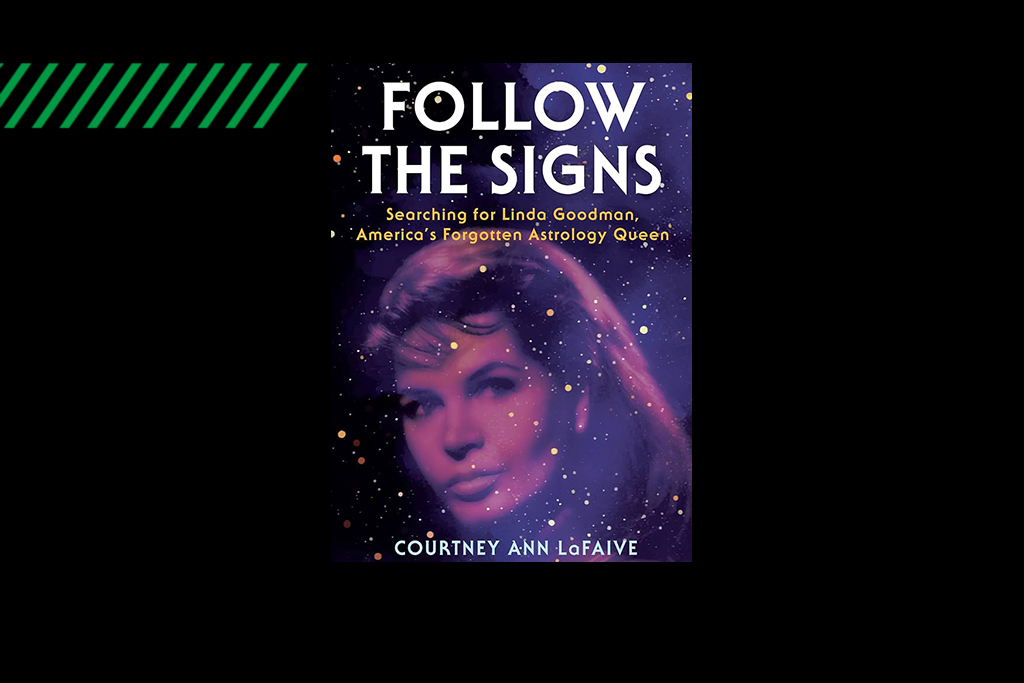
Courtney Kersten, assistant professor of English, who publishes under the pen name Courtney Ann LaFaive, has written a book titled “Follow the Signs: Searching for Linda Goodman, America’s Forgotten Astrology Queen.” The book chronicles the life of Goodman, a fascinating figure who is widely credited with popularizing astrology in the U.S. in the 1960s and 70s.
In early June, Kersten’s book was praised in a feature-length review in the New Yorker, a publication that for over a century has provided long-form journalism and commentary on the arts and literature. “Goodman didn’t live forever, but she got the next best thing: a passionate biographer,” the review declares. “ ‘Follow the Signs: Searching for Linda Goodman, America’s Forgotten Astrology Queen’ (University of Iowa Press), by Courtney Ann LaFaive, an assistant professor of English at the University of North Dakota, is a pensive, often sublime book that isn’t a dutiful work of scholarship so much as an adventure tale, blending fiction, criticism, and memoir.”
Kersten’s interest in Goodman began as when Kersten was a young teenager, browsing the stacks of her public library in rural Wisconsin. There, she discovered Goodman’s first book, “Sun Signs.” Published in 1968, the book became a New York Times bestseller – the first of its genre to appear on the Times’ list.
“Astrology before the 1960s was a really academic subject,” Kersten said. “The language of astrology was archaic and wasn’t meant for the average person to consume. I think what Linda Goodman did was fill this void by taking what was interesting about more occult, esoteric astrology and combining it with the everyday voice of newspaper horoscopes, and giving people a book.”
Goodman followed up “Sun Signs,” with her 1978 book, “Linda Goodman’s Love Signs: A New Approach to the Human Heart.” The book, which examines compatibility between the 12 astrological zodiac signs, was also a commercial success – earning Goodman a then record $2.3 million advance.
Kersten said she encountered challenges in researching for her book – in particular, Goodman’s reclusive lifestyle and aversion to media attention.
“Researching Goodman was really difficult,” she said. “A lot of times when you have a research project, the first thing you do is go to an archive and see what’s available. Linda Goodman was a very cryptic and secretive figure – for instance, she never even publicized her date of birth. So, the book became more of a hybrid project – not a strictly scholarly project – where I was combining fiction that I gleaned from Linda’s life, alongside my own journey to find her and cultural criticism.”
Kersten also wrote the book to repair what she calls Goodman’s tarnished reputation.
After her daughter Sally died in 1973 of an apparent suicide, Goodman refused to accept police and coroners’ reports, spending years searching for evidence that her daughter was still alive. Kersten opined that Goodman’s inability to accept her daughter’s mortality led to her being branded a conspiracy theorist – and thus diminished her contributions to astrology in the public eye.
“Rather than being seen as this figure who was really brave and influential in the 1960s and 70s, today I think she’s seen as sort of a laughingstock – or this woman who grieved and is sort of crazy,” Kersten said. “I wanted to write a book to redeem her.”
Despite her extensive knowledge of Goodman’s life and career, Kersten nonetheless ran into some surprises while researching the book.
“I learned a lot of things about her that complicated this image I already had,” Kersten said. “Part of what was surprising to me, was that while her first two books were quite readable for mainstream audiences, she was really somebody who lived more on the outskirts of society. She believed in a lot of conspiracy theories and alternative viewpoints around health. Part of my journey as a biographer was coming to a much greater understanding her complexity.”
“Part of the book too, is reconciling with these parasocial relationships we have,” Kersten added. “Whether it’s a literary figure or celebrity we loved growing up, how do we come to an understanding of their nuances, flaws and what makes them important?”
****
>> Questions or comments about the UND LEADS Strategic Plan? Your thoughts are welcome! Please contact Ryan Zerr, associate vice president for Strategy & Implementation, or Brandon Wallace, senior financial accountant, the co-chairs of the UND LEADS Implementation Committee. You also may offer your thoughts by visiting the UND LEADS Strategic Plan home page and clicking on the “Provide your feedback” link.
Thank you for your support of the UND LEADS Strategic Plan!