From UND to the U.N., via The Conversation
One article can change ‘entire trajectory of your work,’ says UND’s Lee Ann Williams on writing for The Conversation
A UND scholar’s articles in The Conversation have opened doors to a multitude of scholastic accolades and professional development opportunities.
Lee Ann Williams, clinical assistant professor and program director of UND’s Rehabilitation and Human Services program, recently wrote her ninth article in The Conversation. The nonprofit publication invites academics to write for lay readers, in a process that involves the scholars describing or calling upon their work.
The resulting media exposure surrounding her scholarship has established Williams as an international authority in the fields of accessibility, disaster preparedness and relief, and mental health awareness.
“I’m the classic example that one article can change the entire trajectory of your work,” she said.
A central tenet of The Conversation’s mission is the free exchange of scholarly information; and with that in mind, news outlets are encouraged to republish Conversation articles for free, via the organization’s Creative Commons license. That means the articles show up on the websites of CNN, the Washington Post, Smithsonian magazine and other outlets around the world, a marked contrast to very limited circulation of articles in most peer-reviewed academic journals.
As a result, Williams’ nine articles have reached a collective audience of over 285,000 readers, The Conversation’s analytics show. One of her articles — published in February — highlights the challenges of recruiting students to pursue careers in teaching, and has generated more than 175,000 reads. That’s more than any other of the 75 Conversation articles published by UND faculty members.
“The academic journals don’t get 175,000 people reading your articles,” Williams said. “It allows you to reach an audience you have never reached.”
After Williams published her first Conversation article in January 2024 – on the importance of mental health support for teachers – she began being interviewed by media outlets such as Prairie Public Broadcasting and the Academic Minute podcast. The latter is a forum for scholars from across the world to share their research.
“When I wrote that first article, I thought I was writing something that was common sense – that teachers needed mental health support,” she said. “It resonated with so many people and just grew.”
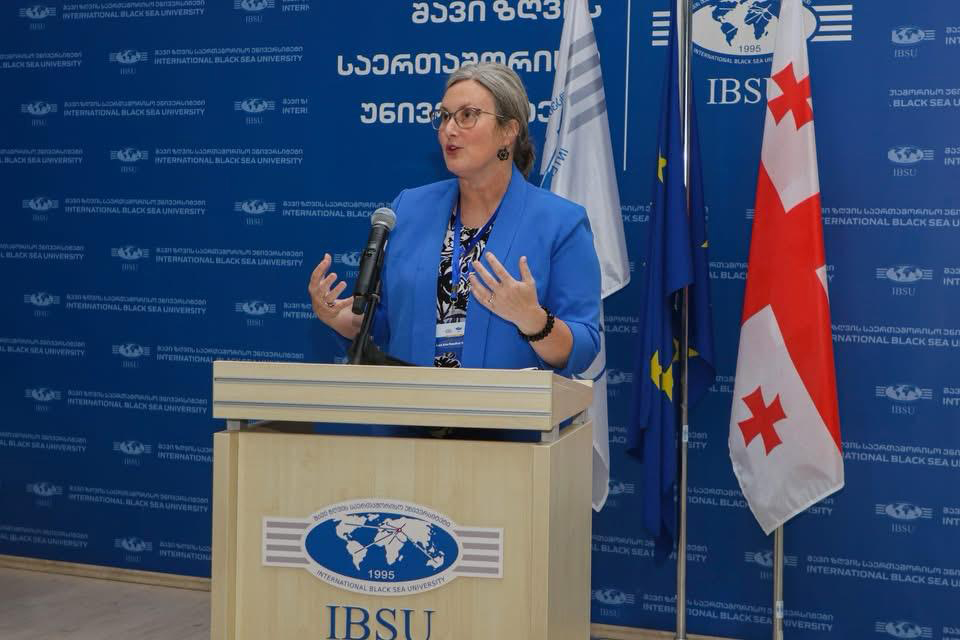
The professional development opportunities and media engagements flowed from there. Williams has shared her expertise at several international conferences, among them the International Conference of Education, Research and Innovation in Sevilla, Spain. She also delivered the keynote address at the 15th International Research Conference on Education, Language and Literature in Tbilisi, Georgia, in May 2025.
Williams’ work has also led to previously unimaginable opportunities with the world’s preeminent intergovernmental organization: the United Nations.
This past June, she participated in the U.N.’s Intensive Summer Study Program. Hosted at the body’s headquarters in New York, the five-day-long seminar introduces participants to the U.N.’s myriad committees, treaties and functions.
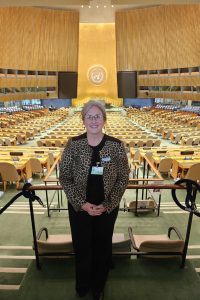
While in New York, Williams interacted with many dignitaries – including Stéphane Dujarric, spokesman for the U.N. Secretary-General. She also had the opportunity to observe the U.N. Convention on the Rights of Persons with Disabilities in session – a landmark treaty that seeks to improve inclusivity and accessibility for those with disabilities.
In the contributed photo at left, Williams poses at the United Nations headquarters in New York.
Williams said the program was an invaluable learning experience – one that challenged her preconceptions toward the U.N.
“One of the statements on the wall of the U.N. is that it wasn’t built to send us to heaven – it was actually built to keep us from going to hell,” she said. “That really resonated with me. The U.N. is a place where all of us can come together with one voice, even if it’s not congruent or is different, whether that difference is cultural or economic. I had never thought of that way – I had just thought ‘how relevant is the U.N. without the United States’ money.’”
“I see the world differently because of the opportunities I’ve had, and the conversations and seats that have been opened to me,” Williams added. “I’ve had seats at tables I would never have thought I would be at.”
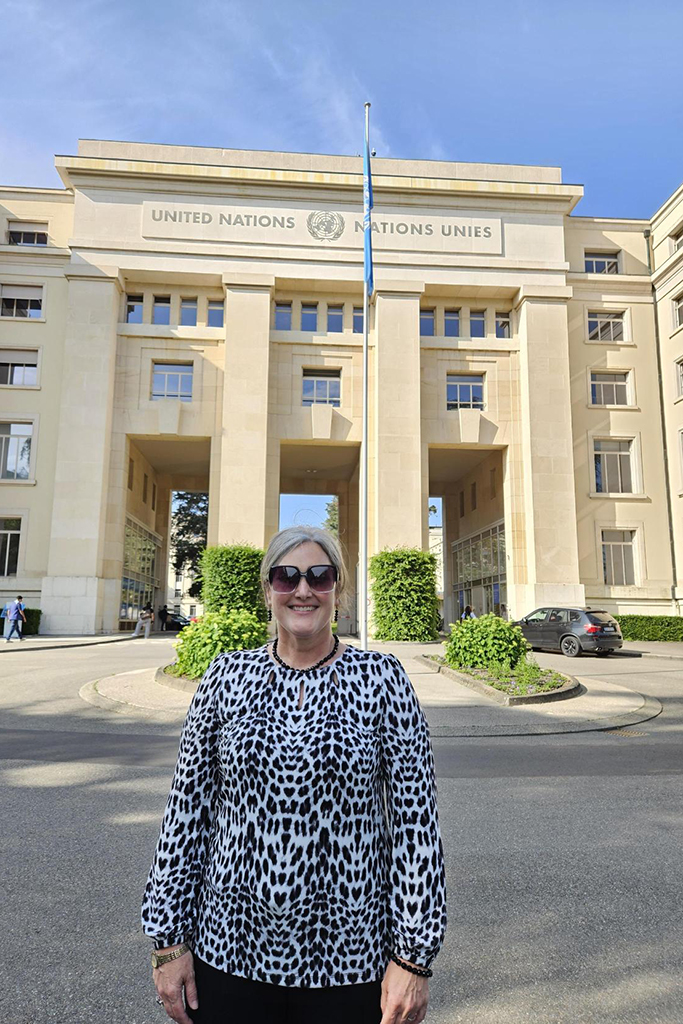
Next week, Williams will add another high-profile international experience to her resume. She recently accepted an invitation to attend the first session of the U.N.’s Intergovernmental Working Group on the Human Rights of Older Persons, held at the Palais des Nations in Geneva.
The venue, which Williams visited in June 2025 while attending the U.N.’s eighth session of the Global Platform for Disaster Risk Reduction, was previously headquarters to the now-defunct League of Nations. Today it houses the U.N. Office at Geneva, one of the body’s four offices – alongside Nairobi, Kenya, Vienna and The Hague, Netherlands.
“Watching history being made like next week with the Older Adults Human Rights Declaration, not only allows me to give back personally, but also lets our students be at the forefront of some of the most important issues in rehabilitation and human services,” Williams said.
Williams added that the opportunities afforded to her as a result of her Conversation authorship boosts her teaching and scholarship.
“These opportunities allow me to stay on the cusp of current issues, and have a seat at the table to watch as real changes are being made globally,” she said. “It allows me to share this information in real time with students who will take it forward into the future.”
Williams also praised the support of her colleagues in her endeavors, stating that, “without my colleagues, peers and leadership at UND constantly pushing me to seek new heights, I would have never been able to achieve so much.”
“It’s been such an honor to write these with such great people behind me, who have really encouraged me to keep going,” she added. “Having colleagues who are interested in what you are doing makes a big difference. And I get to do that all while wearing the UND logo and UND green.”