Cleared for what’s next: Summit celebrates 20 years of UAS
At the 20th UAS Summit & Expo, UND and its partners reflect on the investments that built the UAS industry
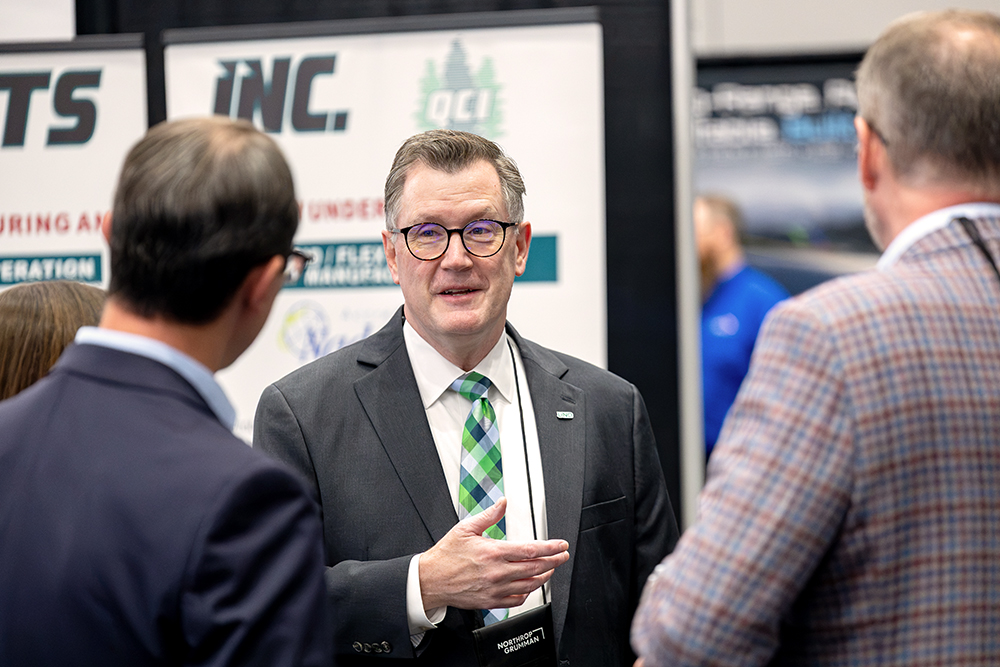
For two decades, Grand Forks has served as a proving ground for unmanned aviation. At the 20th UAS Summit & Expo, speakers reflected on the investments that built the industry and the challenges that lie ahead.
Held Oct. 13-14 at the Alerus Center, the summit brought together researchers, industry representatives, military leaders and government officials to discuss challenges that have changed considerably since the beginning.
Twenty years ago, unmanned aviation was still an emerging field. Through investments in research and education North Dakota’s leaders began building the partnerships and capabilities that would help establish Grand Forks as a nationally recognized center for the industry.
The first 20 years
When the first UAS Action Summit convened in 2006, the groundwork for an unmanned aviation industry was taking shape.
Changes to Grand Forks Air Force Base’s mission had prompted regional leaders to consider new opportunities for the area’s aviation expertise. UND, building on its established aviation programs, expanded its involvement in UAS research and education.
In 2006, UND received a North Dakota Center of Excellence designation for its UAS work. Three years later, the University introduced the nation’s first undergraduate degree program in UAS operations, preparing students for an emerging industry.
In 2013, the Federal Aviation Administration selected North Dakota as one of six national UAS test sites. The Northern Plains UAS Test Site became operational the following year, providing an environment to test emerging technologies and advance the integration of unmanned aircraft into the national airspace.
In 2015, Grand Sky opened at Grand Forks Air Force Base as the nation’s first commercial UAS business and aviation park, bringing new opportunities for research and commercial development. As the industry grew, so did the need to operate unmanned aircraft safely beyond the direct sight of their pilots.
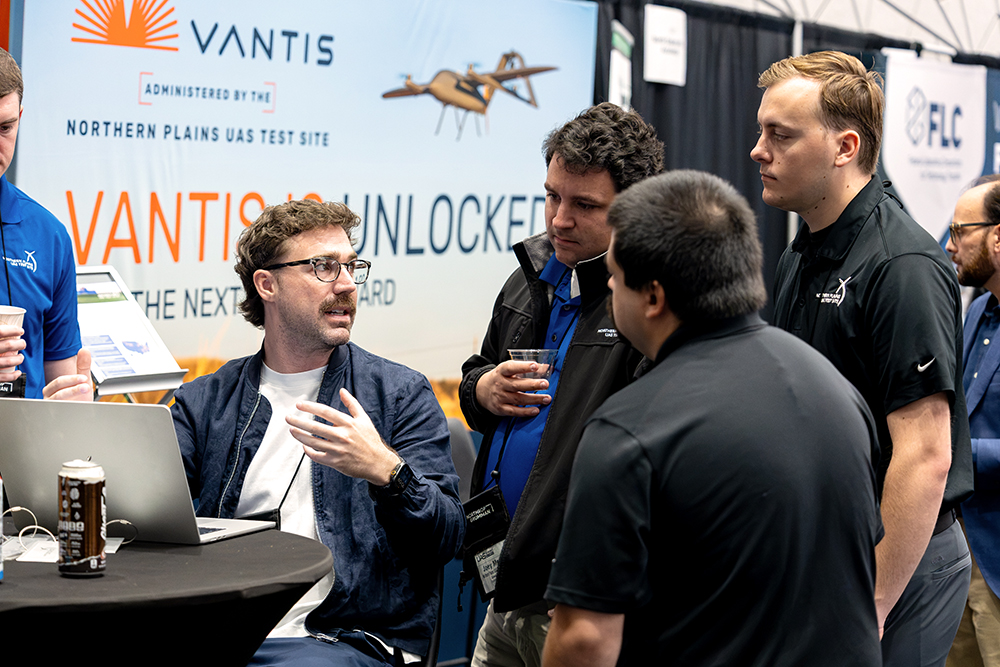
In 2019, North Dakota committed an initial $28 million toward developing a statewide network for beyond-visual-line-of-sight operations. Introduced in 2020, Vantis built on years of research and collaboration involving UND, the Northern Plains UAS Test Site and industry partners to support unmanned aircraft operations across greater distances.
For UND students, those investments have opened new career paths. Opportunities once concentrated among military-connected companies have expanded into a broader civilian commercial market. Two decades later, the region’s investments have produced a network of researchers, educators, businesses and government agencies working to advance unmanned aviation.
The summit’s “20 Years, 20 Voices” feature highlighted perspectives from people who helped shape the region’s UAS industry.
Building a UAS hub
That network has become one of North Dakota’s greatest advantages. John Nelson, chief operating officer of BBI International, which organizes the summit, reflected on the importance of connecting people who may be working on different parts of the same challenge.
“Find the person who’s working on the other half of the problem you’re trying to solve,” Nelson said. “Ideas discussed at this event have become programs. Programs have become infrastructure. Research has become operational capability.”
U.S. Rep. Julie Fedorchak echoed that sentiment in a video message played during the summit’s general session.
“North Dakota has never been a state that sits around waiting to see what comes next. We keep moving forward. We keep finding new opportunities, and most importantly, we keep working together.”
Those partnerships were evident in two announcements made by U.S. Sen. John Hoeven during the summit.
The first, Project ATLAS, brings together UND, NASA, the Department of War and the North Dakota National Guard to explore how unmanned aircraft and ground vehicles can operate together. The initiative will examine applications in military training, base support and combat operations, with UND and NASA conducting experiments supported by the North Dakota National Guard.
The second announcement established UND as the first and only university in the nation to serve as a clearinghouse for the Joint Interagency Task Force 401’s counter-drone technology efforts. Under the agreement, UND, with support from the Northern Plains UAS Test Site, will help identify promising technologies for further evaluation and development. The task force will outline the capabilities needed to address emerging threats.
“I think the secret, the strength, the greatness of our ecosystem here is that we have more partnerships than anyone,” Hoeven said. “We can do it here because for 20 years we built this ecosystem.”
For UND President Andrew Armacost, those agreements reflect the importance of connecting university research with industry and national security partners.
“These types of partnerships are key to the University of North Dakota continuing to be a successful catalyst for ideas that benefit our work in national security,” Armacost said.
The next 20 years
If the first two decades were spent building the foundation for unmanned aviation, the next may be defined by how that foundation is put to use. Throughout the summit, discussions turned toward artificial intelligence, autonomous operations, national security and the challenge of integrating increasingly complex technologies into everyday activities.
For UND, that future extends to research in aerospace, autonomous systems and space operations. As those fields become increasingly connected, so too will the expertise required of students and researchers.
Armacost also highlighted UND’s efforts to move research beyond campus and into practical applications, pointing to the University’s recent economic innovation and prosperity designation.
“You can’t just receive a designation and let your foot off the accelerator,” Armacost said.
What the industry will look like in another 20 years remains uncertain. But as the summit looked toward the future, Col. Alfred Rosales, commander of the 319th Reconnaissance Wing at Grand Forks Air Force Base, pointed to a fundamental change in the industry’s priorities.
“We are not talking about unmanned aerial systems and what they are anymore. We are about delivering capability at scale,” he said.