Can AI teach you how to garden?
Question leads to test of ChatGPT-developed harvest plan at GRO.UND Learning Garden
As a new gardener, Lacey Anderson admitted she killed a lot of plants in her first year.

As a researcher and longtime teacher, Anderson had years of experience studying sociology, sustainability and learning — particularly related to climate change.
Drawn to studying the natural world, culminating in her Ph.D. in Educational Foundations & Research from UND, her early experience in the garden led her to consider the importance of generational knowledge.
How do you learn gardening when there isn’t an experienced green thumb standing next to you, teaching you?
Could AI fill that role for the next generation of gardeners?
Anderson, who now serves as director of the East Grand Forks Campbell Library, was the latest speaker in UND’s AI Forum Series.
Anderson’s session focused on the question of AI’s role as a technology bridging educational gaps.
Planting the prompt
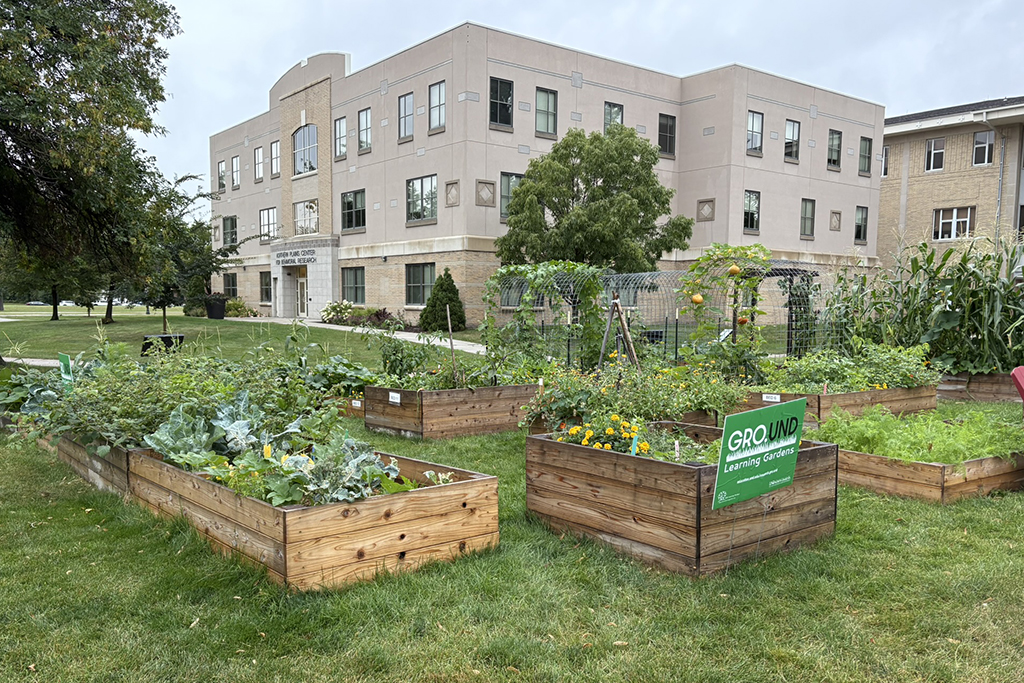
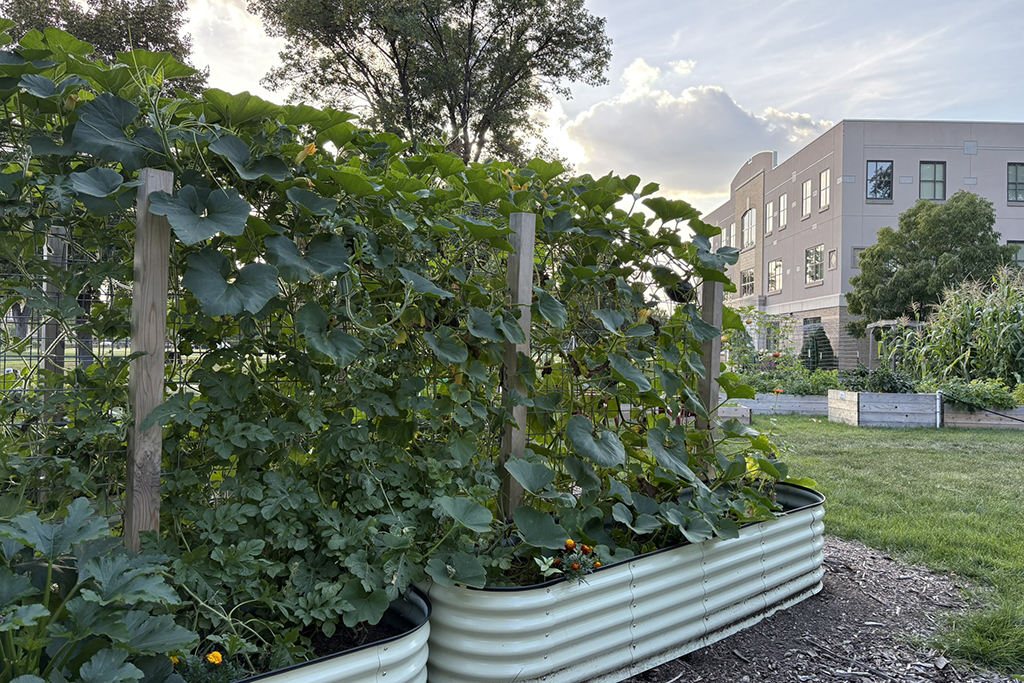
The University’s GRO.UND Learning Garden provided an exceptional testbed for Anderson’s research project.
Led by professors Cheryl and Joshua Hunter in the College of Education & Human Development, the garden annually serves as a “living classroom” for people of all ages to engage with nature through seasonal cycles, ecological stewardship and community collaboration.
As UND Today reported at the time of its establishment, “the garden provides a gathering space to connect and learn about others as well as the whole process of growing our own food from seed to compost.”
In another recent UND Today report, the Learning Garden was awarded the 2026 Dr. Robert H. Boyd Healthy UND Champion Award for its contributions to the health and well-being of the campus community.
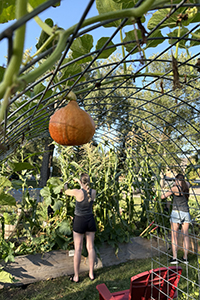
Now located along Stanford Street, across the street from Education Northwest, the garden is maintained through thousands of staff and volunteer hours, Anderson said. Volunteers’ gardening expertise and levels of experience varied greatly.
“So, the idea was: can we teach novice gardeners how to be an effective gardener by relying only on what artificial intelligence would tell them?” Anderson said.
Of the garden’s 90 planted varieties of flowers and produce, Anderson picked 50 that would deliver harvestable roots, fruits and vegetables throughout the summer and fall.
She then turned to ChatGPT to write a prompt, which turned out to be its own exhaustive process of research and development.
Developing the desired prompt took around five months of periodically working with ChatGPT to iterate and refine what exactly she wanted the language model to return.
“I gave it very specific climate data for Grand Forks and historical crop data, along with the kinds of crops we would use,” Anderson said.
The final prompt was a whopping 900-plus words long, but Anderson presented a truncated version during her talk:
“I would like help finding the dates of when my crops should be harvested in my garden that is located in Grand Forks, N.D. Please use specific crop harvest data for each of the crops based on when they were planted to indicate when each crop should be harvested. Advice on how to know that a crop is ready for harvest, as well as tips on harvesting and storing the crops would be helpful, as well.”
Through the ensuing growing season, Anderson kept detailed records, even with so many volunteers and groups coming and going.
“I am personally proud of that,” Anderson remarked of the tracking process. Between hurried notes on her phone and pen-and-paper scribbled observations, it was tedious work to deliver results for quantitative analysis.
AI’s harvest missed the mark
The result?
“There was a significant difference between when AI said things would be ready and when we actually were able to harvest them,” Anderson said.
The predictions ranged from 69 days too early to 33 days late when compared to the real-world garden. On average, crops were harvested around 17 days later than what AI predicted.
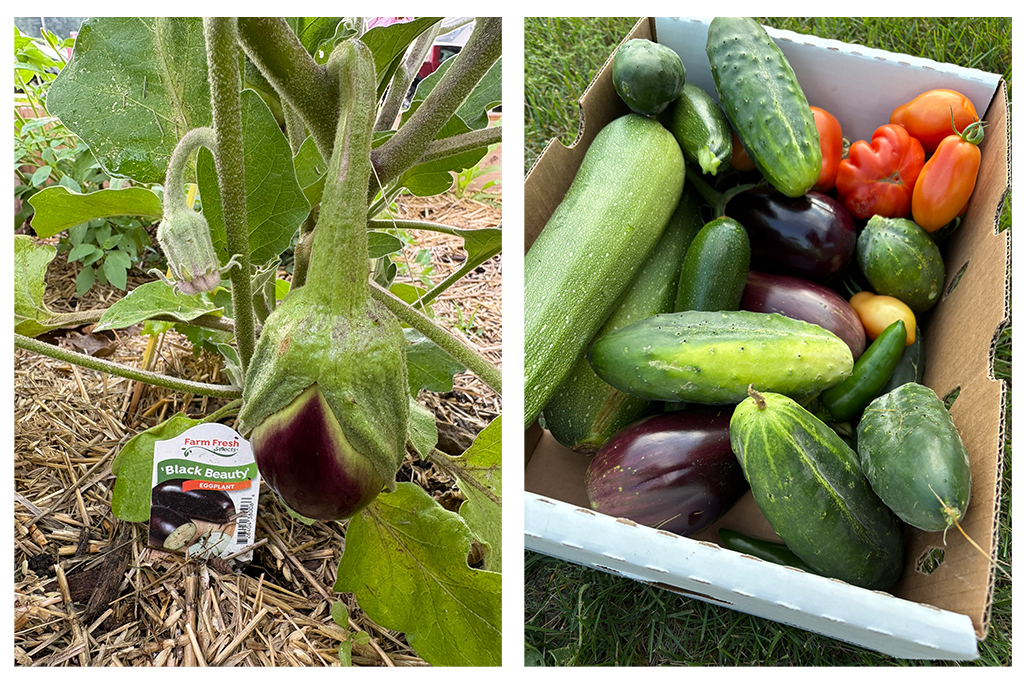
Anderson showed a side-by-side example of an eggplant. The picture on the left was taken on the date provided by ChatGPT, and it was barely budding. The example on the right showed it after harvest, two weeks later, with its trademark purple sheen.
By just relying on AI, the gardener wouldn’t have had anything worth eating.
This example elucidated a broader idea about how people are using AI as it’s reaching ubiquity in daily life.
“When you think of how AI is used in a classroom, students will go, ‘Here’s a beautiful paper that I wrote,’” Anderson said. “And on the surface level, you can fake a lot of stuff. It says the right words; it can format beautifully.
“But when you translate that to a garden, you can’t fake whether an eggplant is ready to eat.”
The eggplant harvest was something that Anderson felt much easier to teach, regarding the reliability of AI, than anything written in comments for graded assignments.
‘You don’t know what you don’t know’
Where the AI plan fell short, perhaps inevitably, was in the myriad details and factors affecting plant growth.
Anderson gave the example of heavy smoke cover during the growing season — a filter to certain light reaching plants that affects growth rates.
“AI doesn’t predict that unless you ask it to pay attention to it,” Anderson said. “If I would have done this type of thing every week, and told it the variables to pay attention to, I probably would have received much more nuanced and accurate information.”
But therein lies the trouble with relying solely on AI as a novice in almost any field: you don’t know what you don’t know.
“You rely on this technology to fill those gaps,” Anderson said. “And if you don’t have that background information, you’re not going to know whether it’s accurate or not.”
This also applied to some of the growing advice provided by AI. While the prompt delivered useful tips on plants to grow alongside others, it didn’t deliver proper advice on the distance to keep, say, a bug-trapping plant away from desirable berries.
But as expert gardeners and growers of things will tell you, Anderson said, even when you have all the knowledge and do everything right, there are a lot of things that can go wrong.
Get out there and grow
Given the environmental impact of using AI, Anderson said she is leaving gardening research behind. Now a librarian, she pointed out that there are a lot of excellent volumes on gardening in your local library.
She also said the results of the research project drew her to advocate for intergenerational learning — talking to the neighbor or family member who gardens or volunteering at a community green space.
Anderson also had a development to share, along those lines: the Minnesota Department of Education granted the East Grand Forks Campbell Library an award of $50,000 to host a learning garden of its own to promote experiential learning.
The goal is to replicate what Anderson learned working with the GRO.UND initiative to host classes for the community, thereby passing her experiences and knowledge to the next generations of aspiring gardeners.
Held throughout the year, each session of the AI Forum Series features guest speakers, live demos, group discussions and explorations of AI tools spotlighting emerging technologies, applications in higher education and considerations of ethics.
The next session will take place on Tuesday, Dec. 8, featuring Anna Kinney, Sri Lalitha Nuthulapati and Richard Van Eck representing UND’s Co.AI Initiative.