Securing American energy dominance
North Dakota native John Reiten outlines his work on National Energy Dominance Council in latest Eye of the Hawk address
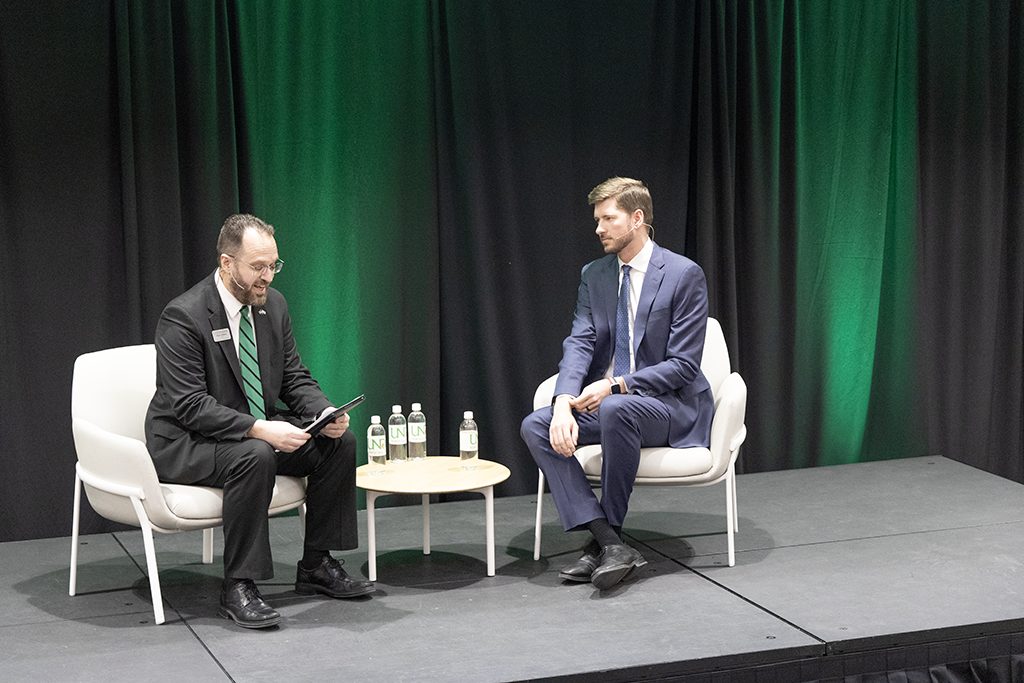
Last week, students, staff and faculty gathered to hear a prominent federal policymaker reflect on the state and University’s role in shaping the nation’s energy future.
On Thursday, Nov. 12, John Reiten, special assistant to the President and deputy executive director of the National Energy Dominance Council, visited campus to deliver the latest address in UND’s “Eye of the Hawk” lecture series. The series invites experts in the fields of law, engineering, business and the arts to share their perspectives with the campus community.
Appearing at the Memorial Union’s Social Stairs for a question-and-answer session with Ryan Adams, dean of UND’s College of Engineering & Mines, Reiten outlined his work on the NEDC – created via executive order in February 2025. The body is composed of individuals working together to enhance the nation’s energy policy and is chaired by Secretary of the Interior and former North Dakota Governor Doug Burgum.
A native of Minot, Reiten said his previous roles as a policy advisor to Burgum and state director for U.S. Rep. Julie Fedorchak gave him invaluable experience to take to Washington.
“There was no opportunity that better prepared me to work where I do now than working in the governor’s office,” he said. “North Dakota has such a wide breadth of energy policy – coal, critical minerals, oil and natural gas, biofuels, wind and solar. We have it all.”
At its most basic level, Reiten said, energy dominance means providing cheap energy to consumers at home and having the capacity to export to allies abroad.
“When we think about what many countries have done, they’ve had the mindset – and we’ve had this mindset in the past – of energy subtraction,” he said. “Over the last 20 years we have not really increased the need for energy, maybe one to two percent per year. We’re in a new age. With artificial intelligence and re-industrialization, we’re seeing a massive increase in energy needed.”
And North Dakota has played an outsized role in securing America’s energy dominance.
The shale revolution of the late 2000s, and improvements in horizontal drilling and hydraulic fracturing, have led to a surplus of oil and natural gas. This trend is particularly evident in the state’s Bakken Formation, where monthly oil production spiked from around 2.5 million barrels per month in 2005 to over 47 million in October 2019, according to data from the U.S. Energy Information Administration.
This glut in production, Reiten added, has allowed the U.S. to aid its allies during recent supply shocks caused by wars in Iran and Ukraine – key transit hubs for the global transport of oil and natural gas, respectively.
“When Russia invaded Ukraine, and Europe had to diversify from Russian gas, the United States stepped up,” he said. “We were able to provide 60 percent of the natural gas Europe needed during that first winter (2022) of the war with Ukraine. Our industry has raised its hand and said, ‘we’re willing to supply the globe with that energy.’”
Another area of the NEDC’s work is securing a reliable domestic supply chain and refining capacity for rare earth elements. Although the state’s lignite coal deposits are seen as a potential resource for extracting these elements, China still controls over 90% of the world’s supply – which are essential components for consumer electronics, automobiles and defense systems.
Unlike increasing oil and gas production, which Reiten said boils down to approving more drilling permits and streamlining environmental reviews, the U.S. needs to develop the infrastructure required to extract, process and distribute rare earth elements.
“When we showed up on day one, one of the guys on our team put up a periodic table in our office and said, ‘we have to fix one of these elements every week between now and the end of the President’s term,’” Reiten said. “That’s how critical this is for our country. Not only do we have to start mining in this country again, which we’ve gotten out of the business of doing. We also have no midstream, no ability to refine the products. That’s all been happening in China as well.”
In the interim, the U.S. is pursuing international agreements with allies in an effort to diversify the global supply chain of rare earths. UND researchers have also played a key role in addressing this challenge.
In September 2025, the University signed a memorandum of understanding with Bulgarian Energy Holding – the country’s state-owned energy holding firm. The agreement explores the feasibility of extracting and processing rare earths from lignite coal present in Bulgaria’s Maritsa Basin.
In his concluding remarks, Reiten praised UND’s role in securing the nation’s energy future – particularly its commitment to research and development, and partnerships with key industry players.
“UND is set up for so much great success,” he said. “The ability to make tough international policy decisions started because of people taking risks and innovating. It’s going to take more incredibly smart and bright people working on the challenges of today and tomorrow.”