UND holds Grand Challenges relaunch
Event highlights UND’s innovation in autonomy, healthcare, national security, among other disciplines
Last month, UND reaffirmed its commitment to its Grand Challenges – highlighting the University’s work in the fields of autonomous systems, healthcare, energy and national security, among other disciplines.
On Tuesday, Oct. 27, before an audience of faculty, staff, students and alumni at the Gorecki Alumni Center, UND held a relaunch of its six Grand Challenges. The initiative brings researchers together from across campus to seek interdisciplinary solutions in the following areas: advanced autonomous systems, AI and computational science, energy advancement and innovation, human health and wellbeing, national security and space innovation, and thriving rural communities.
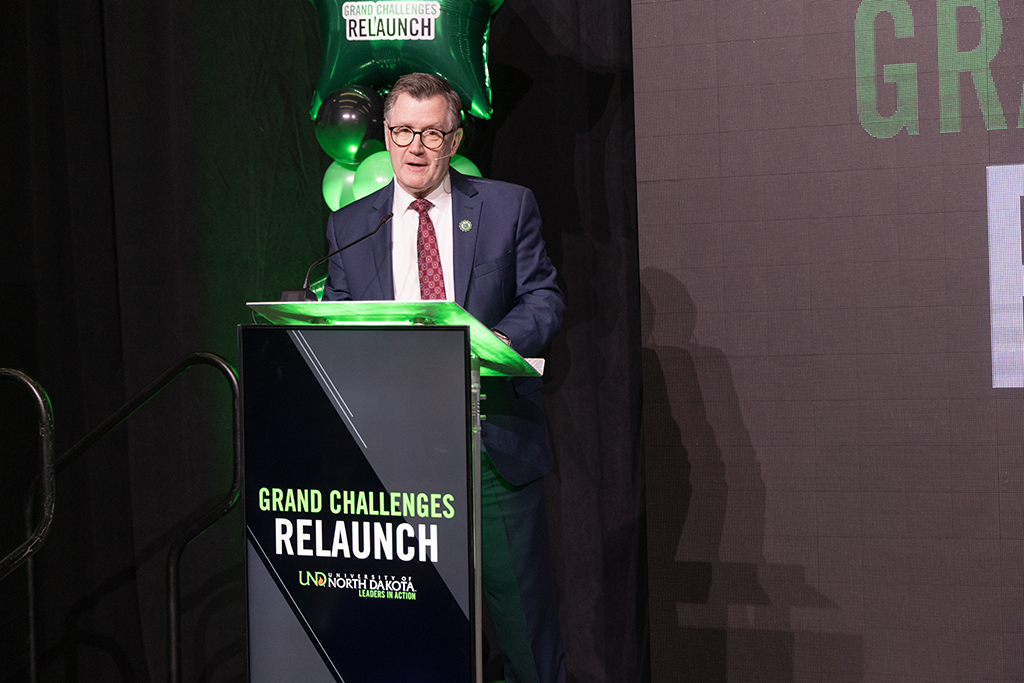
Scott Snyder, vice president of Research & Economic Development, opened the event. Now in his third year in the role, he praised the campus community’s efforts in fostering a sense of discovery and serving the state of North Dakota.
“I’m incredibly proud of the work that gets done on this campus,” he said. “We solve big problems, and we solve them together. We create art and literature, send satellites to space and help save lives.”
UND President Andy Armacost thanked Snyder and Bryant Smalley, associate vice president for Research & Discovery Development, for their leadership in developing the Grand Challenges. He called the initiative a campus-wide effort, likening it to the work that went into crafting the University’s strategic plan.
“I think it’s important for all of us to recognize an overarching thought about the University,” Armacost said. “When we put the UND LEADS strategic vision and plan together, it took the entire campus – we had well over 700 people involved. What I’m grateful for that Bryant and Scott have done is they reached out to constituents from across the campus. They engaged well over 200 people in their examination of the Grand Challenges, and the ways that we can refine them.”
Smalley added that the work of the Grand Challenges is ongoing and invited all faculty members to participate in a planned symposium to discuss the initiative moving forward.
“One of the most exciting things about the Grand Challenges, is they are not just a list of things UND does well,” he said. “They are an invitation to discuss what more we can accomplish together.”
Mike Mannausau, vice president of development at the UND Alumni Association and Foundation, said that the Grand Challenges are inextricable from the Foundation’s Forever UND campaign – a $625 million fundraising campaign that supports capital projects, research and endowed faculty positions.
“The Grand Challenges help inspire philanthropic investments by connecting donors to meaningful work,” he said. “What excites the most about the relaunch isn’t simply six new fundraising opportunities; it’s six conversations about the future.
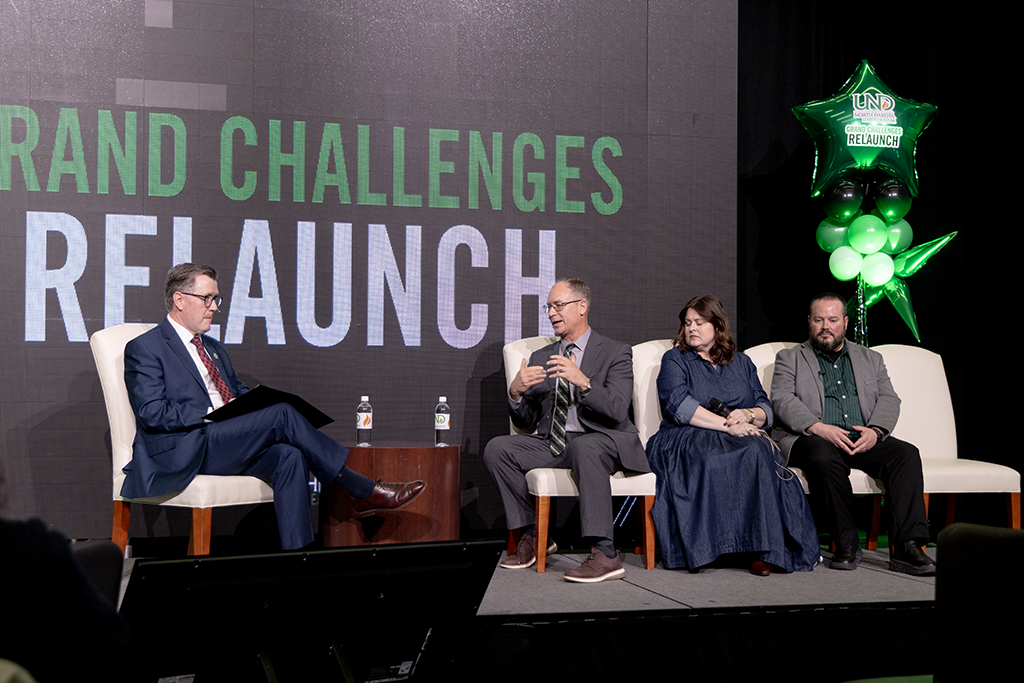
Following opening remarks, Armacost welcomed faculty members whose research activity supports the Grand Challenges, onstage for a fireside chat. Justin Montigne, assistant professor of Music, and Emily Cherry Oliver, Chester Fritz distinguished professor and chair of UND’s Theatre Arts department, discussed their work on the intersection of AI and the arts.
Oliver, who serves as co-director of UND’s AI and Human Innovation initiative, said the curiosity and desire to implement AI ethically has grown.
“Like all things, it has evolved,” she said. “Initially, people were either very excited or very afraid. As AI has become more embedded in what we’re doing and thinking about, people are becoming more curious. I think that is the intersection of where we can start with connecting what AI can do through research, while also making sure the arts and humanities are embedded as well.”
Montigne, who specializes in vocal instruction, spoke about his work on the “ND Vocal” initiative. The program uses a smartphone app powered by AI to provide students, particularly in rural areas of North Dakota, with feedback on their vocal instruction.
“The ultimate goal is that this will work in partnership with, and have input from teachers,” he said. “In some rural areas, there’s maybe one teacher who’s doing choir and band for K-12, driving the bus, directing the musical and coaching soccer. The goal is to give support and individualized attention to students.”
Mark Askelson, associate vice president for research – national security, spoke on UND’s role in autonomous systems and national security. He stated that both Grand Challenges are multi-disciplinary endeavors – supported by each of the University’s academic colleges along with industry partners.
“There are so many touch points relevant to autonomy and national security, that there are incredible opportunities to get involved,” he said.