UND hosts General Atomics VP in ongoing National Security speakers’ series
‘I’m absolutely blown away by the level of work that’s going on here‚’ said Patrick ‘Mike’ Shortsleeve of campus’ national security initiative.
Last week, an executive from one of the nation’s most prominent defense contractors visited campus for a look into the groundbreaking research and scholarship that supports his organization’s mission.
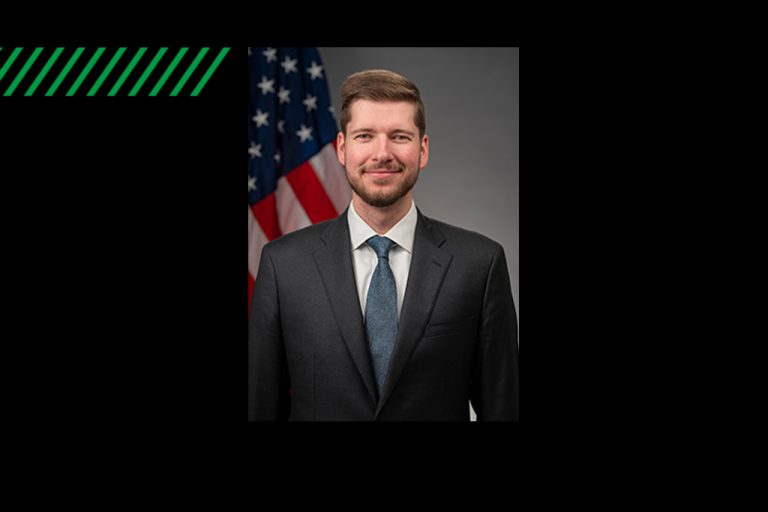
On Thursday, Nov. 5, Patrick “Mike” Shortsleeve, vice president of strategy business development at General Atomics Aeronautical Systems, became the latest guest in the University’s series titled “UND LEADS: Broad Perspectives on National Security.”
Now in its third year, the series is devoted to wide-ranging discussions with leaders on issues of national security. It features two speakers each academic year – one taking place on campus in the fall, and the other in Washington each spring.
Last year, UND hosted Ben Davies, corporate vice president of Northrop Grumman, and president of the company’s Defense Systems Sector.
With a 35-year career bridging military service and defense industry leadership, Shortsleeve shared a wealth of experience and knowledge with his audience of UND students, faculty and staff. He began his career as an intelligence officer in the United States Air Force, serving for 28 years in assignments across the globe.
After retiring from the Air Force as a Colonel in 2019, Shortsleeve began his career at General Atomics. In his current role, he oversees a vast portion of the company’s unmanned aircraft systems portfolio, including the MQ-9 Reaper aircraft and Collaborative Command Aircraft.
The latter system is a joint initiative between General Atomics and the U.S. Air Force, which will employ uncrewed aircraft in tandem with existing fighter jets.
Shortsleeve remarked that friends and colleagues have often told him his career has been “Forrest Gump-like,” alluding to the 1994 film and its protagonist’s proclivity to be in the right place at the right time.
“I’ve had the opportunity to be involved in some very large National Security movements just by chance,” he said. “I was put on the spot to use the skillsets I had developed.”
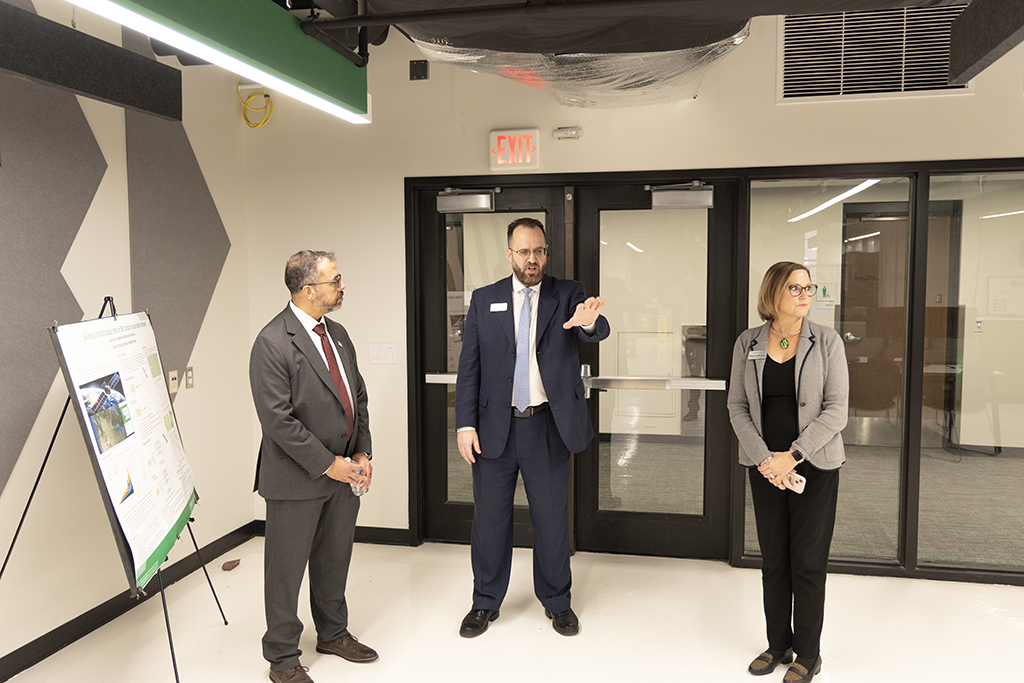
During his visit to campus, Shortsleeve toured UND’s Mark & Claudia Thompson National Security Corridor. The facility – housed within UND’s College of Engineering & Mines at Harrington Hall – contains lab and classroom space that bolster the University’s capabilities in digital engineering, satellite testing and design and quantum computing, among other fields.
Educating the next generation of professionals
Later in the afternoon, Shortsleeve visited with UND students for a question-and-answer session, where he discussed his background and offered students career advice.
Shortsleeve encouraged students to take advantage of all opportunities – academic and professional – presented to them and develop a strong reputation and work ethic.
“What you’re doing right now – the interactions, learning, collaboration and friendships – is absolutely vital for the rest of your life,” he said. “Your reputation, integrity and how you approach life also begins now.”
Shortsleeve said that despite the stereotypical association of national security with the military, it falls under a much larger umbrella of professions, ranging from diplomacy to engineering.
“You don’t have to wear a uniform to be in national security,” he said. “If you go off and create things from an engineering perspective, algorithms as a software engineer – whatever it may be – that’s contributing.”
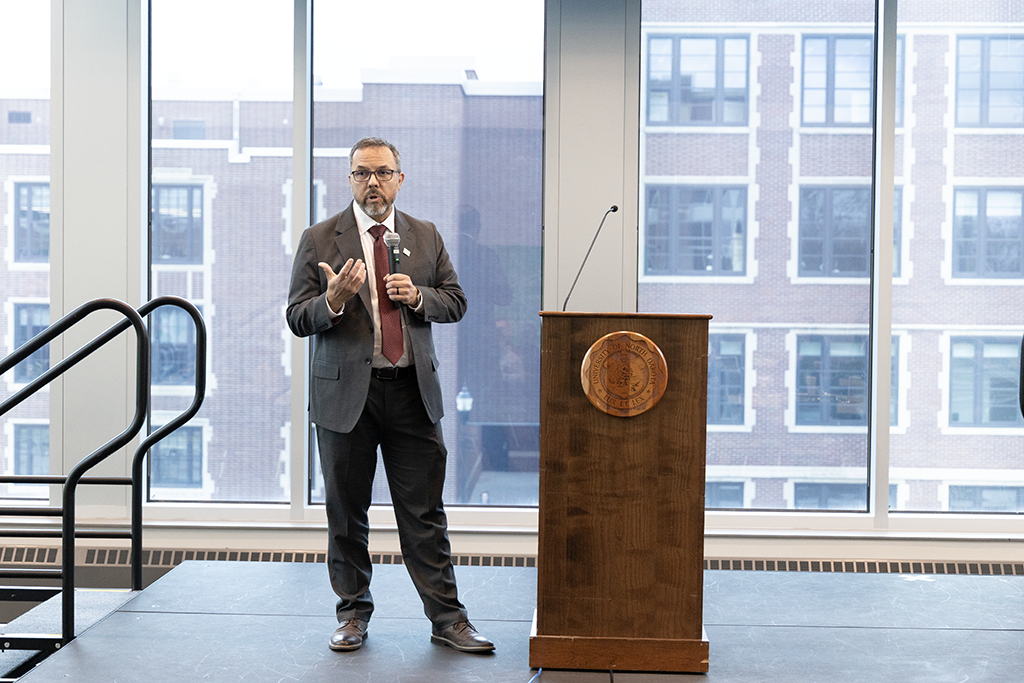
Shortsleeve added that when hiring for roles at General Atomics, he looks for critical thinkers, those who are inquisitive and have a well-rounded knowledge base.
“Building depth in certain subject areas is great, but you want to have a broader understanding of how a lot of things work,” Shortsleeve added. “When I’m hiring people for positions, I’m looking for how they think and approach things. Communication skills are vital as well – you want to have someone who can engage with you.”
The future of warfare
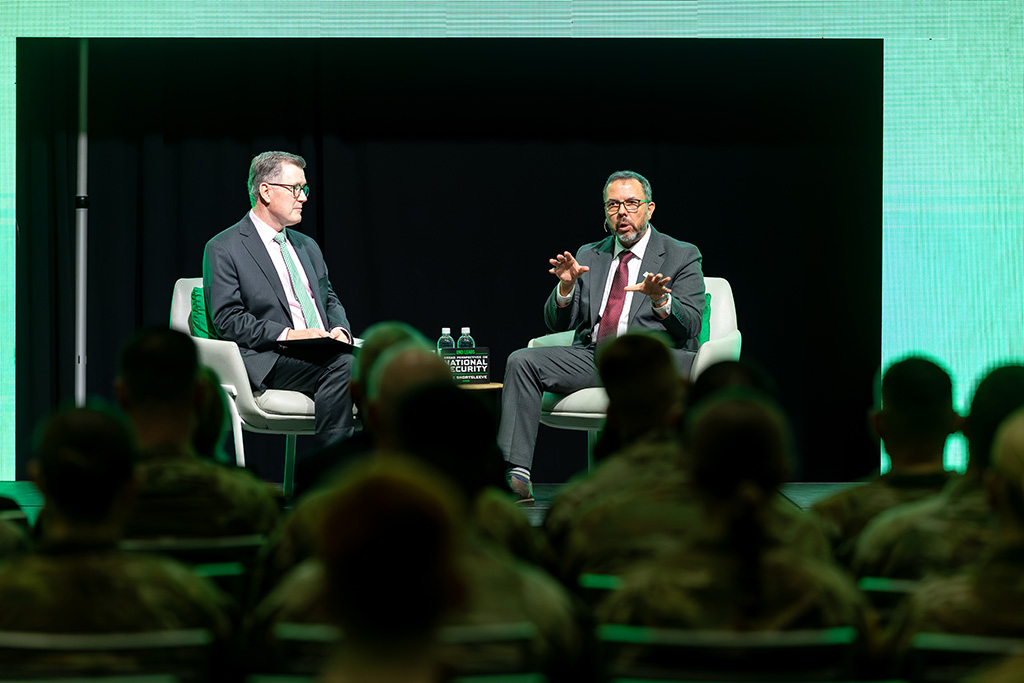
Shortsleeve concluded his visit by joining UND President Andy Armacost onstage for a fireside chat. He began by expressing amazement at the University’s commitment to its National Security Initiative.
“I’m absolutely blown away by the level of work that’s going on here – way more than I ever expected was occurring here,” he said. “I was saying to others, my wheels were turning on where collaboration could be, or how I could help connect others in industry or the military to come experience what you have going on here. I’d be very hard pressed to find another university that’s doing the level of work that you’re doing.
The pair discussed topics including the future of unmanned aircraft in warfare, to the origins of Shortsleeve’s surname.
“People are probably wondering, ‘what the heck kind of name is Shortsleeve,’” Shortsleeve said. “It’s translated from the French name ‘Courtemanche.’ The name can be found in documents dating back to the 900s, with Rene Courtemanche – who was a knight that helped defend a small town in France.”
Shortsleeve opined that the future of warfare will be marked by an increase in attritable unmanned aircraft systems. These systems, he said, serve to reduce costs and risk to human life.
He called General Atomics’ MQ-9 aircraft “the canary in the coalmine,” pertaining to the use of UAS in warfare – marking a shift in drone technology from reconnaissance and intelligence gathering, to tracking and engaging targets.
“The battle space in the future is going to be no different, except there will be more of them out there,” he said. “That does not mean that manned aircraft are going away by any means, however. I would make the prediction that certainly within the next 20-30 years, the preponderance of aircraft we’re going to see on the tarmac at a military airfield is going to be some kind of unmanned capability.”
Shortsleeve also told UND Today, that the role of the U.S.’ allies is vital in securing both the homeland and western liberal order. At its specialized hangar housed at Grand Sky Business and Aviation Park, General Atomics trains defense personnel from Italy, Spain, the Netherlands and the United Kingdom – among other allied nations – on the Reaper and MQ9-B Sky Guardian aircraft.
“If you want to be successful in any kind of crisis or war, you need friends with you – coalition partners,” he said. “By having like-type systems, similar training and understanding and having individuals trained here in a U.S. environment, that allows interoperability to be much more seamless. Nations don’t normally go and fight by themselves. Unfortunately, if you choose to go by yourself, you’re probably going to lose.”