In orbit, and securing the homeland
Grand Forks poised to be on frontlines of Space Development Agency initiatives, North Dakota Sen. Kevin Cramer says during visit to UND
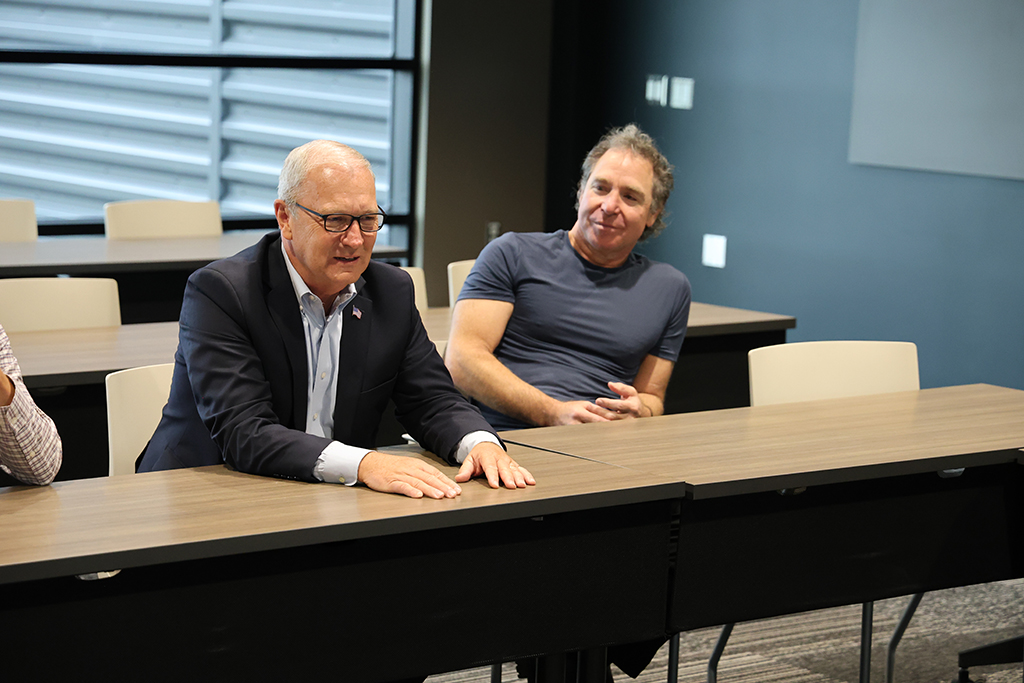
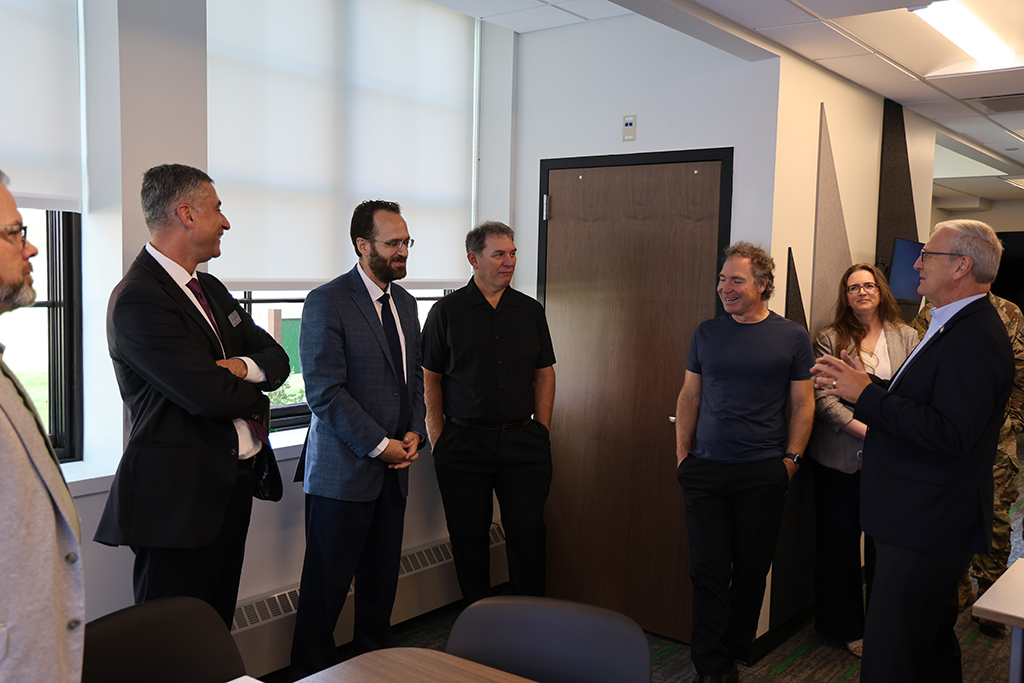
In August, a major innovator in the field of space satellites — along with North Dakota’s junior U.S. senator — visited UND to discuss the future of the domain and see for themselves the work being done on campus to bolster national security.
U.S. Sen. Kevin Cramer and Greg Wyler, founder and CEO of the satellite communications startup E-Space, were joined by deans, department heads, faculty members and area innovators for a look into the role the university plays in advancing satellite research.
Cramer and Wyler’s visit comes after the U.S. Space Development Agency announced an educational partnership agreement with UND. Under the agreement, SDA personnel will be authorized to teach courses and develop a workforce pipeline through internships and a student training center at the agency’s Operations Center North, which will be housed at Grand Forks Air Force Base.
SDA will also assist tenants of UND’s Center for Innovation in developing, testing and operating low earth orbit satellites, which have a variety of applications critical to telecommunications and national security.
Cramer expressed amazement at the momentum and level of collaboration between the Space Development Agency, UND and Grand Forks’ uncrewed aerial systems (UAS) ecosystem.
“It’s not just the government side, it’s the commercial side as well,” he said. “It’s the part that generates wealth and creates opportunities and jobs. It employs all the people you educate and train at UND and is an important part of this ecosystem.”
Such work comes with great responsibility for safeguarding our national security from adversaries, Cramer added, but opined that those working on such initiatives are well qualified to do so.
“If a hypersonic missile gets launched from Russia or China, the first people who will know about it are right here in Grand Forks,” he said. “I’m grateful that the people who live here — in addition to their intellect and academic training — are patriotic and have an ethic about the burden we carry.”
As a member of the Senate Armed Services Committee, Cramer pushed legislation that established the U.S. Space Force, which became the eighth uniformed service branch in 2019. He said that although his Senate colleagues initially expressed skepticism toward its necessity, there is now a strong consensus surrounding the importance of the Space Force and its mission.
“Five or six years ago, space wasn’t considered by most people to be a contested domain,” he said. “I arm wrestled with a lot of skeptics to get a 15-14 vote out of committee; there is not one of those ‘No’ votes that’s a ‘No’ vote today. Today we look at space, and that’s all we think about — hypersonics, the satellite systems providing cover and communications for the warfighter.”
Wyler, whose company has headquarters in both Arlington, Texas and Toulouse, France, and employs about 200 people, said UND and Grand Forks are producing the talent needed to further grow in the industry.
“What I realized a long time ago when I first started building companies, is just how important people and access to human resources are,” he said. “You guys are all creating that critical infrastructure for America.”
Wyler and Cramer concluded their visit by touring UND’s National Security Corridor. The corridor — housed in a recently renovated Harrington Hall — will feature laboratories and a clean room for satellite research and design.