Unmasking brain injury
Some 150 plaster masks created by individuals with brain injury will be displayed in mid-February at the School of Medicine & Health Sciences
By Jena Pierce
Once someone has experienced a brain injury, it can be hard for the survivor to communicate or explain how they feel. But one project is helping survivors to express their thoughts and emotions.
The Unmasking Brain Injury project was started in 2017 by the North Dakota Brain Injury Network as part of a national campaign that began at Hinds Feet Farms, a North Carolina brain-injury camp. Participants have the chance to design a mask while telling their story and educate people what it is like to live with a brain injury.
The national collection currently houses more than 1,500 masks virtually.
Carly Endres, senior project coordinator with NDBIN, has seen firsthand the impact making the masks has had on people. “Over the past seven years, more than 150 masks have been designed by individuals in North Dakota who have survived a brain injury — and their voices are powerful. This really is an opportunity to allow them to use their voice and experience in a different way.
“And it can be therapeutic, especially if they have had a hard time finding a way to express how they are feeling.”
Displaying masks
The entire collection of plaster masks will be on display at the UND School of Medicine & Health Sciences from Feb. 11-14 in the West Atrium. Masks may be viewed from 8 a.m. to 4 p.m. those four days. This is a unique opportunity for anyone to learn more about brain injury, and schools, students, families and other community groups are encouraged to visit the display.
“Since our collection of masks has grown, and with the fragile nature of the masks, it is rare we are able to display the complete collection,” Endres explained. “So this really is a unique opportunity for us and for others who want to learn more about brain injury.”
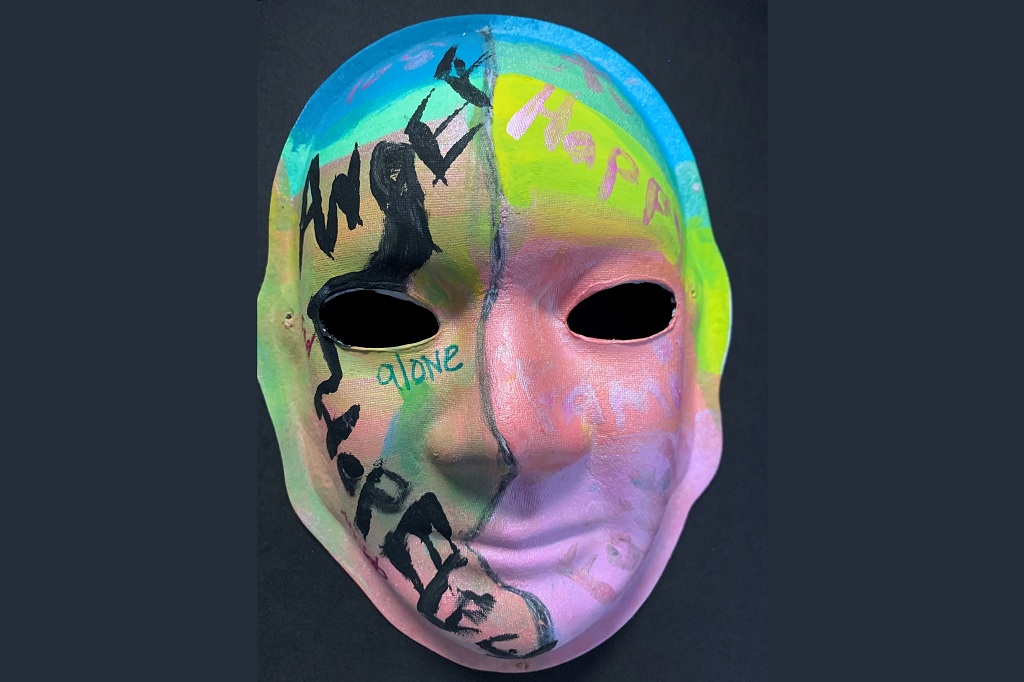
Each mask shares the first name of the survivor, the city where they live, a summary of how they received their injury and an explanation of the mask design. Masks are also featured every Monday on the NDBIN Facebook page. One recent mask shared displayed this information:
Name: Willi I.
Halladay, Twin Buttes
Brain Injury: Had it in my classroom when a student, Orlando S.. saved my life. He told the secretary, she came and got me to the hospital.
Explanation of Mask:
My mask illustrates 2 sides of me.
One side is anger, hopeless, alone and lost. I can’t teach no more.
The other side is faith, happy, and family. They love and support me.
I’m learning how to cope with emotions.
Unmasking events
Unmasking events, where survivors can create the masks, are held a couple times throughout the year in different parts of the state. All materials are provided free of charge. The next upcoming Unmasking event will be held in Bismarck on Feb. 10 from 3 to 5 p.m. Central at the Bismarck Veterans Memorial Library.
To RSVP for this event, reach out to Andrea Sailer, resource facilitator for NDBIN, by email or call 701.777.3297.
Endres sees this project as providing a personal lifeline from survivors to others. “By combining therapy, art and advocacy, this project presents an entirely unique perspective on life with brain injury for survivors, family, caregivers, and professionals,” she said. “It is a way to really share their unique experience and emotions they might otherwise have been keeping inside themselves.”
In February, all of the 150 masks in the collection will be on display, showing a visual representation of a small percentage of people living in North Dakota who have experienced a brain injury, whether it is through a traumatic brain injury, an acquired brain injury or a stroke. This exhibition allows others to see that persons living with a disability due to their brain injury are like anyone else, deserving of dignity, respect, compassion and the opportunity to prove their value as citizens in their communities.
Groups, schools or community organizations who would like to host an Unmaking event should reach out to NDBIN at 855.866.1884 for more information.
About the North Dakota Brain Injury Network
NDBIN has been providing information and support to individuals with brain injury and their family members in North Dakota since 2010. Resource facilitators assist with navigating the service system and provide technical assistance in finding the right resources for everyone. Services offered include outreach and education to increase public awareness of brain injury, as well as peer support by connecting people with others who have experienced a brain injury.
About the author:
Jena Pierce is communications manager for the Center for Rural Health at UND.