‘America’s UAS proving ground’ hosts annual summit
UND continues to help grow region’s UAS ecosystem through partnerships and education, UAS Summit & Expo speakers say
On Oct. 14-15, hundreds of experts in the field of unmanned aircraft systems gathered at the Alerus Center in Grand Forks to discuss the field’s latest technological advancements and potential for continued innovation.
Now in its 19th year, the UAS Summit and Expo continues to grow in stature – bringing together academics, defense leaders and key industry players each October in Grand Forks.
The summit is operated by BBI International, a Grand Forks-based conference producer and publisher of UAS-oriented trade journals. With 750 registered attendees representing 35 states and six countries, the latest summit was the largest in the event’s history.
Proclaiming the 2025 summit’s theme as “accessing America’s UAS proving grounds,” John Nelson, chief operating officer at BBI, called the region’s UAS ecosystem “the nation’s hub for unmanned innovation.”
“This community’s momentum doesn’t stop,” he said. “Together, we’re advancing unmanned systems, supporting national security and shaping the next era of UAS through research, technology and real-world applications.”
Nelson added that Grand Forks is also poised to lead the nation in counter-UAS research.
During a visit to Grand Sky Business and Aviation Park earlier this month, U.S. Sen. John Hoeven announced that Grand Forks Air Force Base will serve as the Point Defense Battle Lab for the Air Force’s Air Combat Command. The lab will work with industry partners to devise strategies to combat hostile drone traffic.
Hoeven also announced a partnership with AeroVironment – a defense contractor specializing in radar and satellite communications pertaining to counter-UAS. The company will deploy its 360-degree radar system at Grand Sky, called AV HALO, to detect and track UAS traffic.
UND’s role
With its first-in-the-nation bachelor’s degree in UAS operations and robust partnerships with the defense community and innovators, UND plays a vital role in sustaining the ecosystem’s growth and supporting these counter-UAS initiatives.
At the conference, UND President Andy Armacost called UND “a proving ground for counter-UAS,” in addition to its already cutting-edge work in traditional UAS.
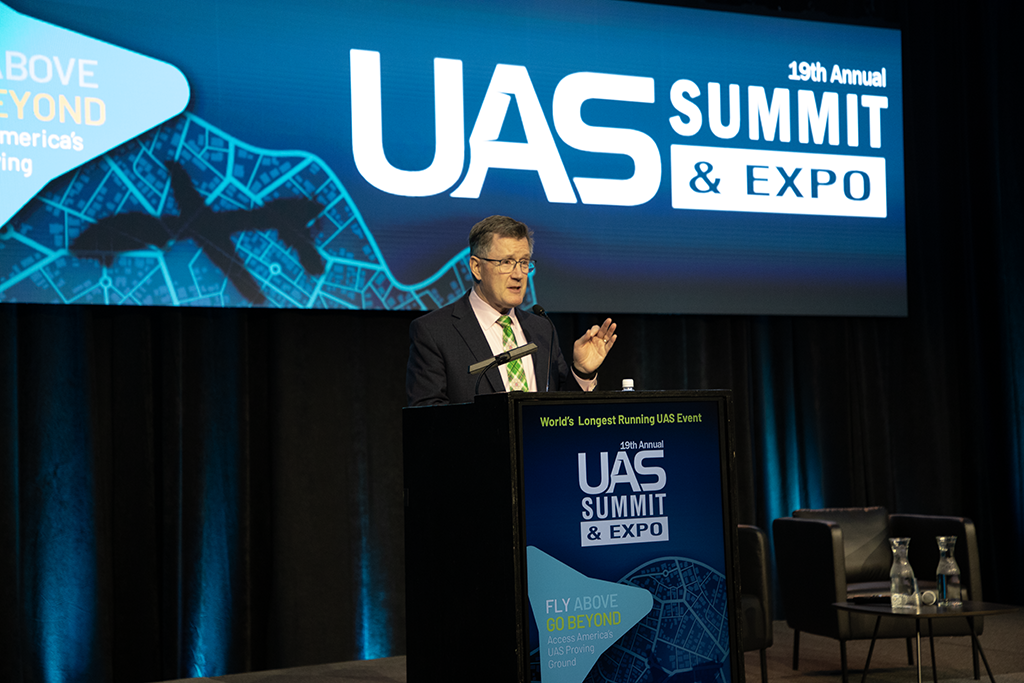
One such example cited by Armacost is a recent memorandum of understanding between UND and the North Dakota Air and Army National Guards. The MOU established a series of counter-UAS experiments conducted at Camp Grafton, N.D., and Gorman Field – the latter known as UND’s UAS airport – simulating “red team” scenarios of adversarial drones encroaching on Army Air Defense Artillery command posts.
In the classroom, Armacost added, UND has built a 31-seat facility for its UAS students to simulate counter-UAS technology.
Additionally, UND strives to be a leader in addressing the myriad legal and ethical questions surrounding the implementation and development of artificial intelligence – a sector with strong ties to UAS, Armacost said .
“I think the University of North Dakota, as a flagship institution that involves not just our technology development, but also our amazing work in the liberal arts and humanities, allows us to look at AI in the context of humanity,” he said. “How do we adopt these technologies, keeping humanity at the forefront?”
Legislative support
North Dakota Lt. Gov. Michelle Strinden spoke of the importance of Grand Forks’ UAS ecosystem to national security, and consequently, the steadfast support it receives from state lawmakers.
“This kind of progress doesn’t happen by accident,” Strinden said. “It takes a concerted effort from all sectors. Our UAS ecosystem is a three-legged stool, consisting of private industry, government and academia.”
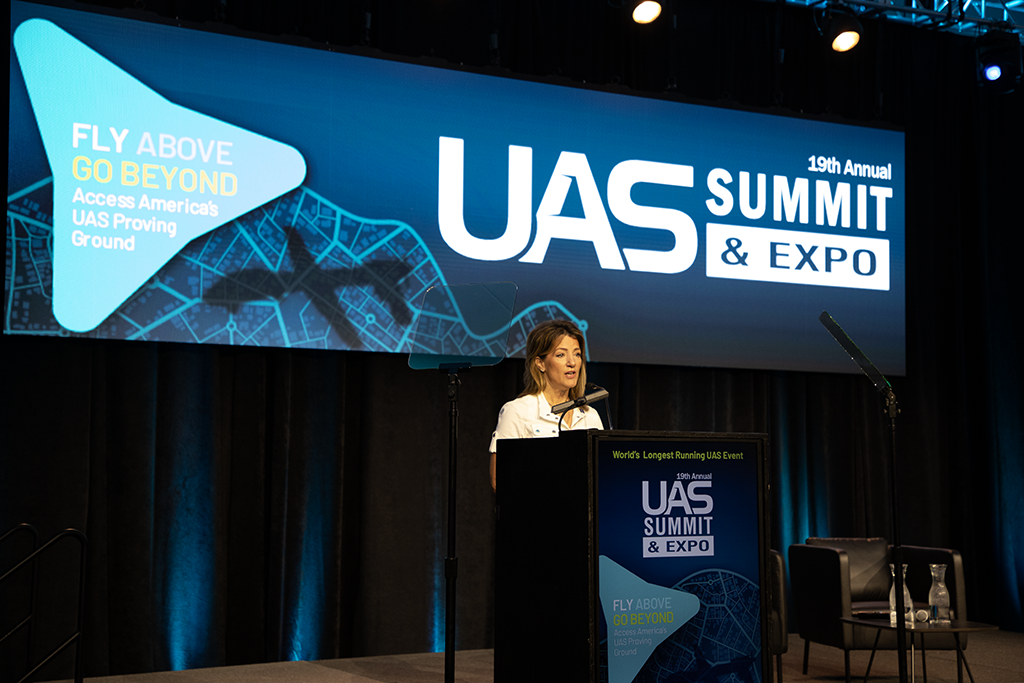
She cited House Bill 1038, which authorizes the integration of FAA radar data with Vantis — the statewide network tasked with enabling Beyond Visual Line-of-Sight (BVLOS) flights for drone operators. This agreement, Strinden said, will enhance security and expand Vantis’ range of coverage from 3,000 to 56,000 miles — nearly 80% of North Dakota’s land area.
Additionally, Senate Bill 2018 appropriates $9 million to state agencies to replace drones that are non-compliant with federal security standards. Strinden said this legislation is particularly salient, given that 90 percent of drones used by state agencies were made in China.
“From a national security standpoint, we need to be 100 percent certain that the drones we are using meet the highest standards for privacy, data control and safety,” she said. “We can’t afford to put those things into the hands of our biggest strategic adversary.”
UAS at the federal level
Despite being unable to attend the summit in person due to the ongoing federal government shutdown, North Dakota’s U.S. Sens. Hoeven and Kevin Cramer appeared virtually.
Hoeven appeared with Troy Meink, secretary of the Air Force, to talk about developments in UAS technology, both in Grand Forks and across the globe. Meink outlined the omnipresence of drones in modern warfare – particularly in the Russia-Ukraine war.
The use of attritable, small range drones, Meink said, has become the dominant weapons system in the conflict. The casualties inflicted by such warfare, he added, are a stark reminder of the importance of air superiority in combat.
“Essentially, it has degraded into a sort of World War I-style trench warfare where drones have replaced artillery,” Meink said. “From an Air Force perspective, we don’t ever want to get into that type of scenario.”
“There’s nothing we do in warfare that doesn’t require air dominance,” Hoeven concurred.
Meink added that the U.S. armed forces can learn a lot from the Pacific theater — which poses the logistical challenge of moving equipment and personnel thousands of miles between engagements.
“Even in a fast jet, it’s four or five hours between locations,” he said. “How we move equipment around could be a determinant of whether we win in that environment, should we have to fight there. However, if you can solve the problem in the Indo-Pacific, you can solve the problem in any theater in the world.”
Hoeven also pointed to the SkyRange mission housed at Grand Sky — a hypersonic missile testing program using retrofitted Northrop Grumman RQ-4 Global Hawk aircraft. According to Hoeven, America’s previous method of tracking hypersonics — via Navy ships stationed in the Pacific — was impractical and potentially observable by adversaries.
Why North Dakota?
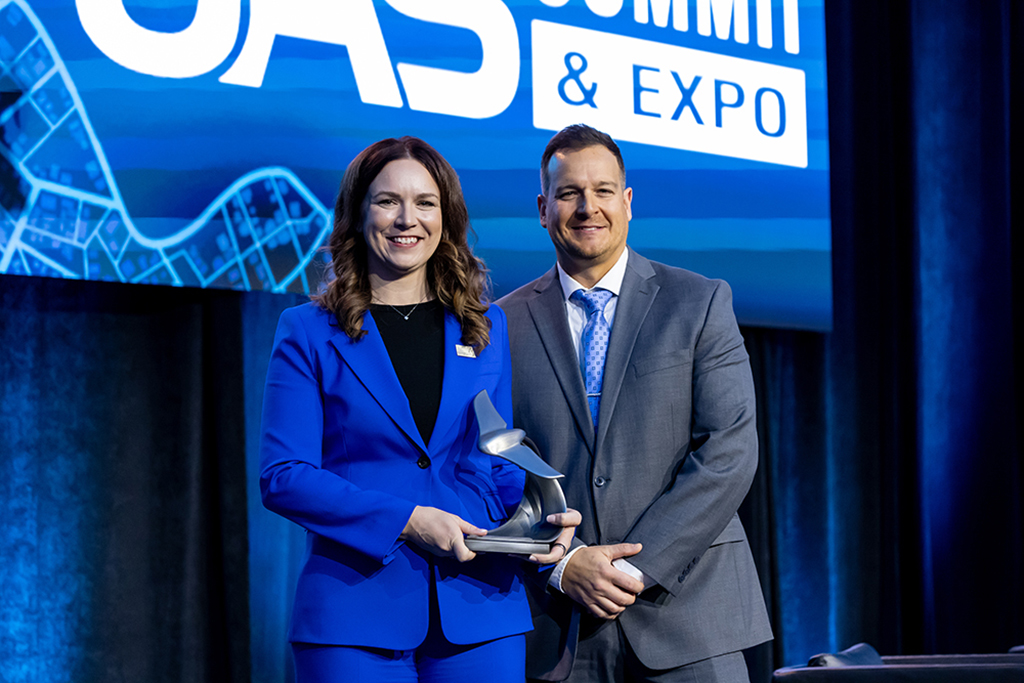
Erin Roesler, deputy executive director of the Northern Plains UAS Test Site — one of seven authorized by the FAA nationally — received the summit’s annual Sky Pioneer Award, an award whose inaugural recipients were Hoeven and Cramer. It recognizes leaders and innovators in the industry.
Leader and innovator are apt descriptors for Roesler.
In her position, Roesler plays a key role in overseeing the operation of Vantis. She also advises policymakers at the national level, as head of the FAA’s UAS BVLOS Aviation Rulemaking Committee.
In her acceptance speech, Roesler praised the level of collaboration between the ecosystem’s players – asserting that it plays a role in building Grand Forks’ reputation as a UAS hub.
“I often get asked, ‘why North Dakota?,’” she said. “And my answer is slightly unconventional. I say it’s because we don’t have enough people. We don’t have time for competition or silos. Collaboration isn’t a strategy; it’s survival.”