Collaborative often, decisive when needed and student-centered at all times
Former UND president Kendall Baker is remembered for his steadfast leadership, vision and deep devotion to UND
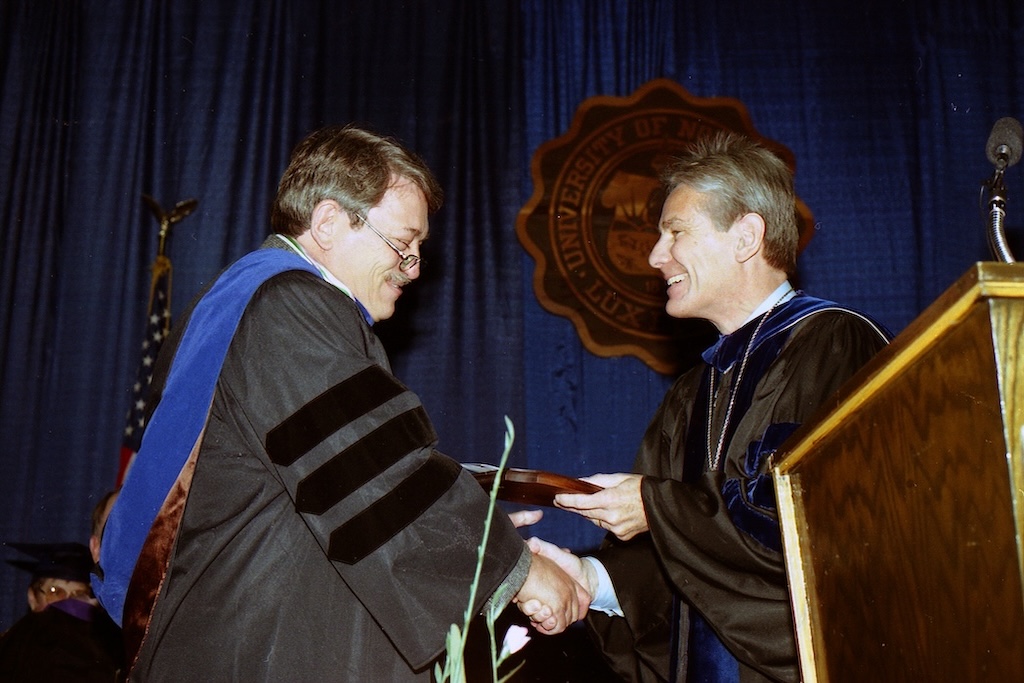
The University of North Dakota community is remembering Kendall Baker, a president whose steady leadership and deep commitment shaped UND through both transformational progress and profound challenge.
Baker, who led the University from 1992 to 1999, died Thursday, Nov. 27, in Windsor, Colo., where he had lived in retirement with his wife, Toby.
“I was deeply saddened to hear about the passing of former UND President Kendall Baker,” said President Andrew Armacost. “President Baker remains an extremely important figure in UND history. His service to UND over seven years was extraordinary, including his leadership during the devastating flood of 1997 and the subsequent restoration of our campus and the local community.
“It is because of his hard work that we are able to continue to grow the University and serve our students and the state of North Dakota. I sincerely extend my condolences to Toby Baker and all the Baker family.”
Speaking to UND Today, Toby Baker said she remembered her husband’s leadership style as being collaborative, as he sought out differing opinions on situations of all kinds. In fact, in the evenings when they discussed challenges to overcome, she would intentionally take an opposite point of view so they could together flesh out the best path forward, she said.
“I think he appreciated more than anyone I knew seeking opinions that did not agree with his own,” Toby Baker said. “I think it made his leadership better, because he was willing to listen to other points of view.”
Toby Baker said that UND represents the entire state beyond Grand Forks, and recalled how on many occasions, they visited small, rural North Dakota communities. President Baker was fluent in German and would frequently speak the language with German-speaking North Dakotans in those towns, she said.
On one occasion, they were invited to a small town that had but one café. When they came upon a four-way stop in the town, there was a sign reading, “Come meet President Baker at the café!” She asked their group to stop and took a photo of that sign, which President Baker kept on his desk from then on.
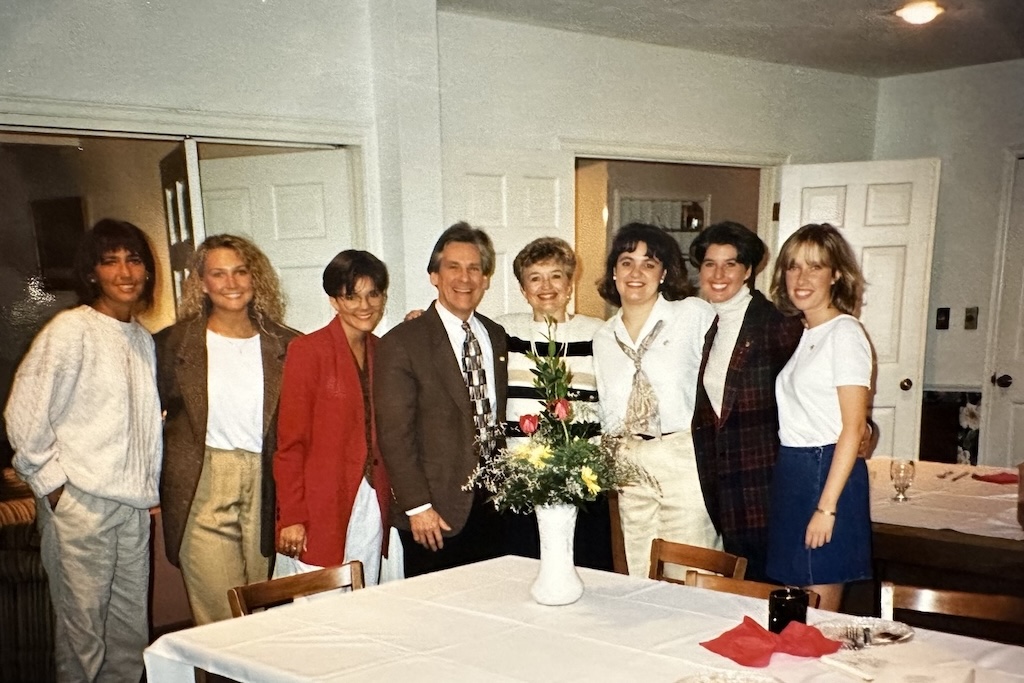
Cassie Gerhardt, senior associate Vice President for Student Affairs, who was a student at UND during President Baker’s tenure, remembered him as a student-centered university president. A former president of the Alpha Chi Omega sorority on campus, Gerhardt recalled being invited for dinner to the President’s house, and President Baker accepting a dinner invitation in kind. He even sent her a wedding gift, three years after she graduated from UND, she said.
“I’ve always had fond memories of the fact that he still took time to send a card and a gift three years after I graduated,” Gerhardt said.
Baker’s introduction to UND leadership was as demanding as it was defining. On his very first day in office, recalled Peter Johnson, now director of Government Relations & Public Affairs for the UND Alumni Association & Foundation, Baker received a fax from North Dakota Gov. Ed Schafer — a UND alum who, more than two decades later, would serve as UND’s interim president.
The message was not ceremonial; instead, it directed all state agency heads to cut their budgets by 10 percent. For Baker, this meant guiding UND through its first major budget-reduction process in decades, a complex and often tempestuous undertaking that nonetheless showed his ability to make principled decisions under pressure.
Beyond navigating financial issues, Baker expanded UND’s physical footprint in ways that continue to shape campus life today. He opened up the Bronson Property — the land north of Sixth Street — for development, setting the stage for one of the most significant expansions in the University’s modern history. The area now houses Ralph Engelstad Arena, the Betty Engelstad Sioux Center, the School of Medicine & Health Sciences, the Wellness Center, multiple housing units, an apartment complex, a gas station, and retail space—vital components of today’s campus and student life.
The Flood of 1997
Yet no moment tested Baker’s leadership more than the Flood of 1997. As the Red River rose, UND — along with Grand Forks, East Grand Forks, and other regional communities — faced a disaster of historic proportions. Ken and Toby Baker joined students, staff and residents in sandbagging and protecting campus buildings.
After floodwater damaged 73 buildings and inflicted millions of dollars in losses, Baker guided UND through the long process of recovery, stabilization and renewal.
Toby Baker recalled that despite his usual collaborative attitude concerning University leadership, President Baker had to take a firmer hand.
“There was so much to be done every single day, and it was interesting to see how his leadership style changed, really, to be a little more directive,” she said.
Under Baker’s direction, the University became an essential partner in the region’s rebuilding efforts. He opened campus facilities to city, county and state agencies needing temporary operating space and welcomed displaced residents seeking shelter. His leadership helped UND rebound from significant infrastructure loss and a decline in enrollment—an achievement still recognized as one of the institution’s most resilient eras.
Reflecting on that time in a 2016 Grand Forks Herald interview, Baker recalled keeping a coffee mug inscribed with the flood-era slogan: “Make it happen.” “We talk about our years at UND all the time, and we could talk about the flood for days,” he said in the interview. “There is no question in the world about the strength of our relationship to North Dakota, to Grand Forks and UND.”
His connection to the University endured long after his presidency. “If you watch me on the couch when the hockey team or football team plays,” he added, “it’s pretty clear we’re strong supporters of the University and its academic programs.”
After leaving UND in 1999, Baker served until 2011 as the tenth president of Ohio Northern University, retiring as president emeritus. He and Toby then relocated to Windsor, Colo., though UND remained deeply meaningful to him. In a 2020 UND video featuring reflections from past presidents, he spoke warmly about what makes North Dakota—and UND—distinct: “It’s a big state,” he said. “But it’s a state with a very, very special kind of people. Enthusiasm and commitment … they’re contagious. And it is because of the enthusiasm and commitment that the students at UND had, that I think an awful lot of other people were equally devoted to this fine institution.”
As the UND community reflects on Baker’s life and legacy, he is remembered as a leader who guided the University to the edge of the 21st century, through crisis, renewal, expansion, and change. His leadership, humility, and enduring devotion to UND continue to echo across campus and beyond.